
A kind of cuo/zro2 water gas shift catalyst and preparation method thereof
A technology for transforming catalysts and water gas, applied in physical/chemical process catalysts, chemical instruments and methods, metal/metal oxides/metal hydroxide catalysts, etc., can solve the problem of uneven distribution of CuO particles on the surface of catalysts and the inability of CuO Catalysis, difficult to maintain thermal stability and other problems, to achieve excellent catalytic performance, improve thermal stability and water resistance, and broad industrial application prospects
Patent Information
- Authority / Receiving Office
- CN · China
- Patent Type
- Patents(China)
- Current Assignee / Owner
- Publication Date
- 2015-12-02
- Estimated Expiration
- Not applicable · inactive patent
Smart Images
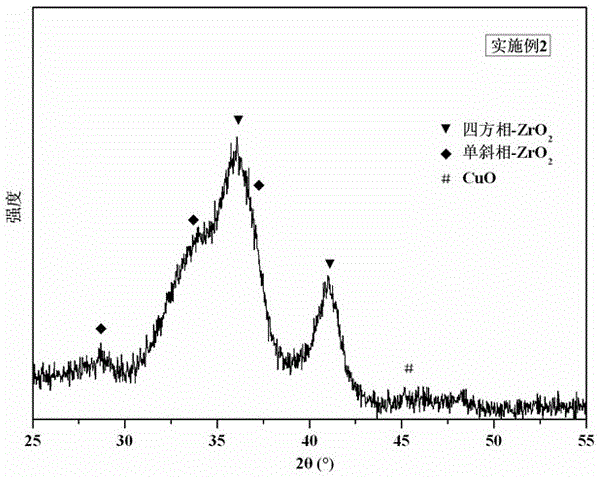
Figure 1 
Figure 2
Abstract
Description
technical field
[0001] The invention belongs to the field of water gas shift technology and catalyst technology, in particular to a CuO / ZrO 2 Water gas shift catalyst and preparation method thereof. Background technique
[0002] Water-Gas-Shift Reaction (Water-Gas-ShiftReaction, CO+H 2 O→CO+H 2 ) is an extremely important reaction process in the chemical industry, and is widely used in the ammonia synthesis industry and hydrogen production industry using coal, oil and natural gas as raw materials. In recent years, with the development of vehicle-mounted proton exchange membrane fuel cell (PEMFC) technology, the water-gas shift reaction, as an important link in the PEMFC online hydrogen production system, has once again attracted widespread attention. At present, shift catalysts commonly used in industry mainly include iron-chromium-based high-temperature shift catalysts, copper-zinc-based low-temperature shift catalysts, and cobalt-molybdenum-based wide-temperature sulfur...
Examples
Embodiment 1
[0017] 0.877gCuCl 2 2H 2 O, 15.081g ZrOCl 2 ·8H 2 O and 3.120g urea were dispersed in 65mL deionized water to prepare a mixed solution [ie n(Cu):n(Zr)=1:9, n(Cu+Zr):n(urea)=1:1]. The above mixed solution was transferred into a hydrothermal reaction kettle with a volume of 100 mL, the hydrothermal temperature was controlled at 210° C., and the hydrothermal time was 3 hours. The hydrothermal product was washed to remove impurity ions, dried at 120°C for 8 hours, and then calcined at 500°C for 4 hours to obtain CuO / ZrO 2 Water gas shift catalyst.
Embodiment 2
[0019] 3.769gCu(NO 3 ) 2 ·3H 2 O, 11.730gZrOCl 2 ·8H 2 O and 3.744g urea were dispersed in 65mL deionized water to prepare a mixed solution [ie n(Cu):n(Zr)=3:7, n(Cu+Zr):n(urea)=1:1.5]. The above mixed solution was transferred into a hydrothermal reaction kettle with a volume of 100 mL, and the hydrothermal temperature was controlled at 180° C., and the hydrothermal time was 6 hours. The hydrothermal product was washed to remove impurity ions, dried at 120°C for 8 hours, and then calcined at 400°C for 4 hours to obtain CuO / ZrO 2 Water gas shift catalyst. figure 1 It is CuO / ZrO in Example 2 2 X-ray diffraction pattern of a water gas shift catalyst. Depend on figure 1 It can be known that CuO / ZrO in Example 2 2 ZrO in Water Gas Shift Catalyst 2 At the same time, it has two crystal phases of tetragonal phase and monoclinic phase. And no diffraction peak of crystalline CuO was found, indicating that CuO exists in a highly dispersed state or has been mixed with ZrO 2 Th...
Embodiment 3
[0021] 5.191gCu(Ac) 2 2H 2 O, 11.162gZr(NO 3 ) 4 ·5H 2 O and 4.68g urea were dispersed in 65mL deionized water to prepare a mixed solution [ie n(Cu):n(Zr)=5:5, n(Cu+Zr):n(urea)=1:2]. The above mixed solution was transferred into a hydrothermal reaction kettle with a volume of 100 mL, and the hydrothermal temperature was controlled at 150° C., and the hydrothermal time was 24 hours. The hydrothermal product was washed to remove impurity ions, dried at 120°C for 8 hours, and then calcined at 300°C for 4 hours to obtain CuO / ZrO 2 Water gas shift catalyst.