
Method for synthesizing 1,3,4,6-tetraacetyl-L-gulose
A technology of tetraacetyl and gulose, applied in chemical instruments and methods, sugar derivatives, sugar derivatives, etc., can solve the problems of high requirements for experimental operators, difficult to scale up production, long synthetic routes, etc., and achieve the synthetic route. Short, easy-to-operate, easy-to-control effects
Patent Information
- Authority / Receiving Office
- CN · China
- Current Assignee / Owner
- Publication Date
- 2014-06-11
- Estimated Expiration
- Not applicable · inactive patent
Smart Images
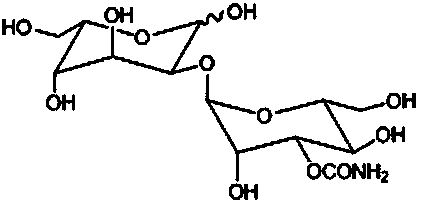
Figure 1 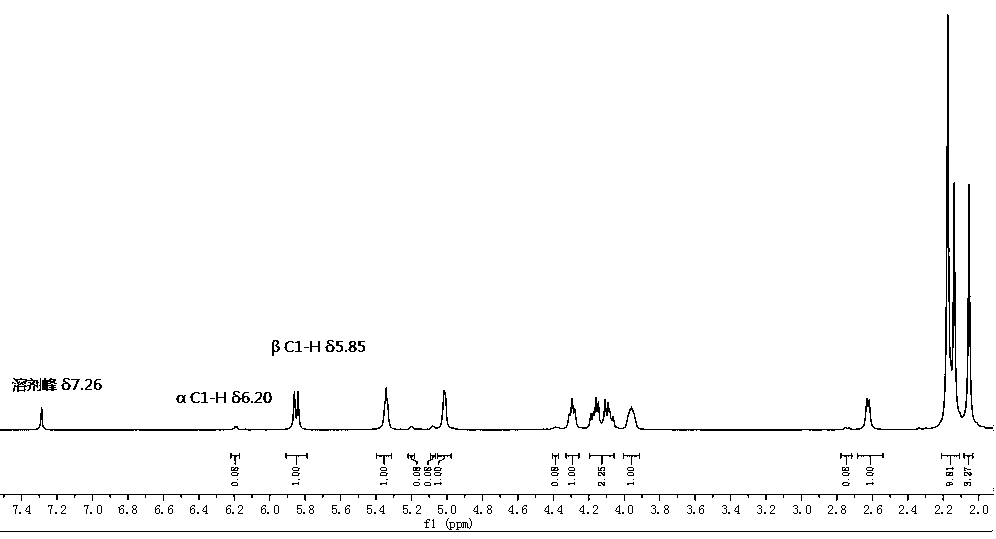
Figure 2 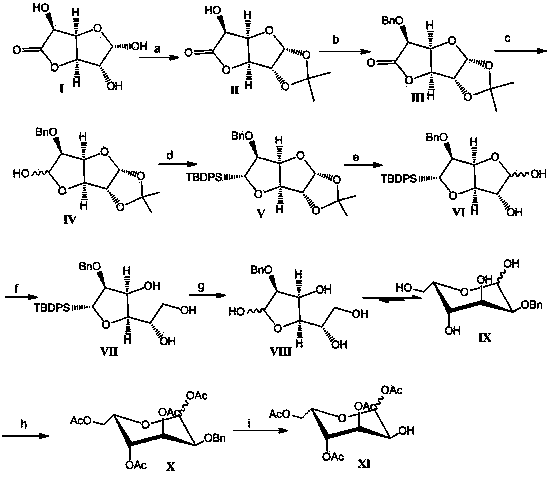
Figure 3
Abstract
Description
technical field
[0001] The invention relates to the technical field of compound preparation, in particular to bleomycin A 2 The technical field of preparation of L-gulose in disaccharide units, more specifically refers to a method for synthesizing 1,3,4,6-tetraacetyl-L-gulose. Background technique
[0002] Bleomycin is a class of glycopeptide antibiotics with similar structure produced by Streptomyces verticillium. It can be used for anti-tumor by mediating the oxidative cleavage of DNA and RNA of tumor cells. It is commonly used clinically in Hodgkin's lymphoma Tumors, squamous cell tumors, etc. In addition, because bleomycin can specifically target human and animal tumor cells, it is clinically used as a tumor diagnostic drug. Structurally, the bleomycin molecule consists of a hexapeptide and a disaccharide moiety, where the disaccharide moiety is thought to not only form a molecular cavity to assist the process of oxidative cleavage, but also play an important role in c...
Examples
Embodiment 1
[0043] 1.1 Preparation of compound Ⅱ
[0044] Dissolve 1.5g of compound I in 15ml of acetone at room temperature, add 1.25ml of concentrated sulfuric acid dropwise after cooling in an ice bath, and stir the reaction mixture at room temperature for 1-2 hours. Add NaHCO to the reaction solution 3 50g of powder, until pH ≥ 7, filtered out the solid, spin-dried the solvent, and crystallized with ethyl acetate to obtain a white solid, namely compound II, 1.56g, yield 85%.
[0045] [a] D 25 +55.3 (c 0.92 CHCl3).
[0046] 1 H NMR (400 MHz, CDCl 3 ) δ 5.99 (d, J = 3.5 Hz, 1H), 4.95 (dd, 4.2, 3.5, 1H), 4.83-4.82 (m, 2H), 4.50 (dd, J = 9.0, 4.2 Hz, 1H), 2.86 (d, J = 9.0 Hz, 1H), 1.53 (s, 3H), 1.36 (s, 3H).
[0047] MS (EI): m / e = 216.
[0048] 1.2 Preparation of compound Ⅱ
[0049] Dissolve 1.5g of compound I in 15ml of acetone at room temperature, add 1.25ml of concentrated sulfuric acid dropwise under ice-bath cooling, and warm the reaction mixture to room temperature an...
Embodiment 2
[0059] 2.1 Preparation of Compound III
[0060] 10.7 g of compound II was dissolved in 50 ml of ethyl acetate, 7 g of silver oxide and 7 ml of benzyl bromide were added at room temperature, and the reaction mixture was stirred overnight at room temperature. The solid in the reaction mixture was filtered off, and the filtrate was concentrated and purified by column chromatography to obtain an oily substance, namely compound III, 13 g, with a yield of 86%.
[0061] [a] D 26 +44.5 (c 0.92, CHCl3).
[0062] 1 H NMR (400 MHz, CDCl 3 ) δ 7.37 (m, 5H), 6.04 (d, J = 3.6 Hz, 1H), 4.92 (s, 2H), 4.86 (dd, J = 4.3, 2.9HZ, 1H), 4.79 (d, J = 3.6 Hz, 1H), 4.71 (d, J = 2.9 Hz, 1H), 4.25 (d, J = 4.3 Hz, 1H), 1.50 (s, 3H), 1.34 (s, 3H).
[0063] MS (EI): m / e=306.
[0064] 2.2 Preparation of Compound III
[0065] 10.7g of compound II was dissolved in 50ml of DMF, 7g of silver oxide and 7ml of benzyl bromide were added at room temperature, and the reaction mixture was stirred at...
Embodiment 3
[0075] 3.1 Preparation of mixture IV
[0076] 1g compound III was dissolved in 8ml CH 2 Cl 2 Cool to -78°C, and slowly add 7.4ml of 1.1M DIBAL-H dropwise to the reaction solution. The reaction mixture was stirred at -40°C for 2 hours, 15ml of saturated sodium potassium tartrate solution was added to the reaction solution, stirred overnight at room temperature, allowed to stand, and separated into layers, the organic phase was separated, dried and purified by column chromatography to obtain an oily mixture IV (poor To isomers) 0.9g, yield 90%, the mixture was directly used in the next reaction.
[0077] 3.2 Preparation of mixture IV
[0078] 1g compound III was dissolved in 8ml CH 2 Cl 2 Cool to -78°C, slowly add 6.8ml of 1.1M DIBAL-H dropwise to the reaction solution. The reaction mixture was stirred at -40°C for 2 hours, 15ml of saturated sodium potassium tartrate solution was added to the reaction solution, stirred overnight at room temperature, allowed to stand, separ...