
Method for extracting aucubin from folium cortex eucommiae
A technology for extracting aucubin and Eucommia leaves, which is applied in the field of extracting aucubin, which can solve the problems of low product purity, large amount of wastewater, and low extraction rate of aucubin, and achieve simple membrane operation process and no wastewater discharge , Membrane flux stable effect for a long time
Patent Information
- Authority / Receiving Office
- CN · China
- Patent Type
- Patents(China)
- Current Assignee / Owner
- Publication Date
- 2015-04-08
- Estimated Expiration
- Not applicable · inactive patent
Smart Images
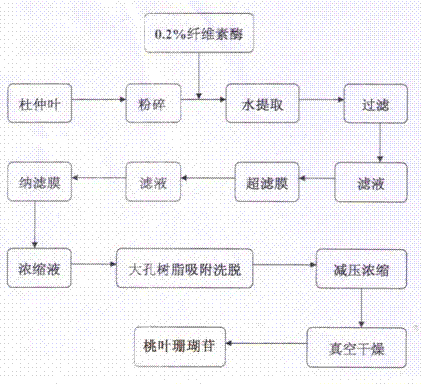
Figure 1 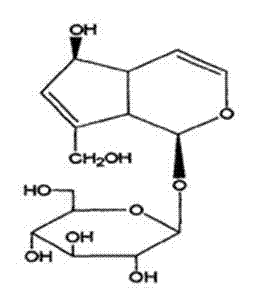
Figure 2
Abstract
Description
technical field
[0001] The invention relates to a method for extracting and separating effective plant components in the pharmaceutical industry, in particular to a process for extracting aucubin from leaves of Eucommia ulmoides. . Background technique
[0002] The chemical name of aucubin (aucubin, AU) is β-D-glucopyranoside, which is an iridoid glycoside compound, the molecular formula is C15H2209, the molecular weight is 346.331, the CAS number is 479-98-1, and the melting point is 181°C , Soluble in water, ethanol and methanol, almost insoluble in chloroform, ether and petroleum ether. This compound is mainly found in Eucommia ulmoides ( Lucommia ulmoides Oliver ), the dogwood plant Peachleaf coral ( Aucubachinensis Benth ), plantain plant car ( Plantago asiatica L ) and other plants, it is one of the active ingredients of Chinese herbal medicines such as eucommia, plantain, and rehmannia glutinosa. It has many pharmacological activities such as liver protection an...
Examples
Embodiment Construction
[0026] Example 1, see the attached figure 1 10Kg of dried eucommia leaves was taken, crushed and passed through a 100-mesh sieve, added 120Kg of water, adjusted to a temperature of 55°C, kept at a constant temperature and adjusted to a pH value of 4.5, then added 20g of cellulase, extracted for 60min under this condition, filtered, The filter residue was extracted for the second time according to the above extraction conditions, the two filtrates were combined, and filtered conventionally, the extraction rate of aucubin was 96.0%; the operating conditions were P=0.3Mpa, T=45°C, pH=4.5, Q=70L 8L / m 2 h; at operating conditions P=1.5Mpa, T=50°C, pH=4.5, Q=20L / min, the ultrafiltration filtrate is passed through a 200 molecular weight nanofiltration membrane again, and the ultrafiltration filtrate is concentrated by 16. 8 times, the removal rate of inorganic salt ions is 63%, and the average flux of the nanofiltration membrane is 18.4 L / m 2 h, the COD of the nanofiltration filtr...