
Passive ultrahigh-frequency electronic-label structure used for automobile
An electronic tag and ultra-high frequency technology, which is applied in the direction of record carriers used in machines, instruments, computer components, etc., can solve the problems of small gain, short recognition distance, narrow bandwidth, etc., and achieve stable antenna performance, high sensitivity, and high Good frequency characteristics
Patent Information
- Authority / Receiving Office
- CN · China
- Patent Type
- Applications(China)
- Current Assignee / Owner
- Publication Date
- 2014-07-30
- Estimated Expiration
- Not applicable · inactive patent
Smart Images
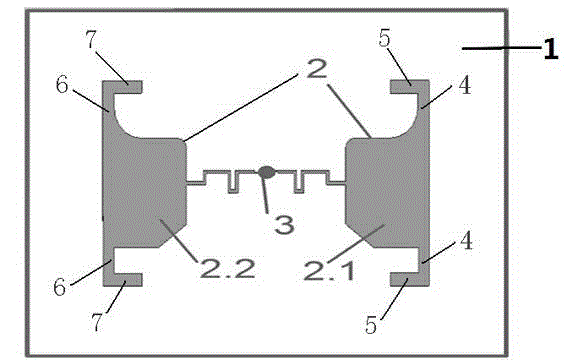
Figure 1
Abstract
Description
technical field
[0001] The invention relates to the field of electronic tags, in particular to a passive ultra-high frequency electronic tag structure for automobiles. Background technique
[0002] At present, passive UHF technology is widely used in logistics and warehousing management, intelligent parking lot management, product anti-counterfeiting detection, vehicle management and other fields, especially in vehicle management applications, due to the complexity of the vehicle operating environment, RFID tags are usually required It is mounted on the front windshield of the car, so the label design performance is very high, which requires the design of a special RFID label for the complex operating environment of the vehicle, so as to meet the reliable identification and management of the vehicle by the RFID system.
[0003] Although the electronic tags used in the existing passive UHF radio frequency identification vehicle management system can play a certain role in...
Examples
Embodiment Construction
[0014] The present invention will be further described below in conjunction with drawings and embodiments.
[0015] like figure 1 As shown, the present invention includes a substrate 1, a tag antenna structure 2, and an UHF radio frequency identification chip 3. The tag antenna structure 2 is printed on the substrate 1, and the UHF radio frequency identification chip 3 is welded to the tag antenna structure by welding technology. 2 feed ports.
[0016] The tag antenna structure 2 comprises a first substructure section 2.1 and a second substructure section 2.2. The first substructure section 2.1 is a "mountain" character structure rotated 90° counterclockwise, that is, the middle of the first substructure section 2.1 is a bump, and the two ends of the bump are respectively connected to the transition section 4, and the transition section 4 is connected to it. Vertical extension 5. One end of the bump has a rounded transition to the transition section 4 , and a right-angle tr...