

Application of strawberry polysaccharide in reduction of blood sugar
A raspberry polysaccharide and hypoglycemic technology, applied in the field of health care products
Patent Information
- Authority / Receiving Office
- CN · China
- Current Assignee / Owner
- Publication Date
- 2015-07-08
Smart Images

Figure 1 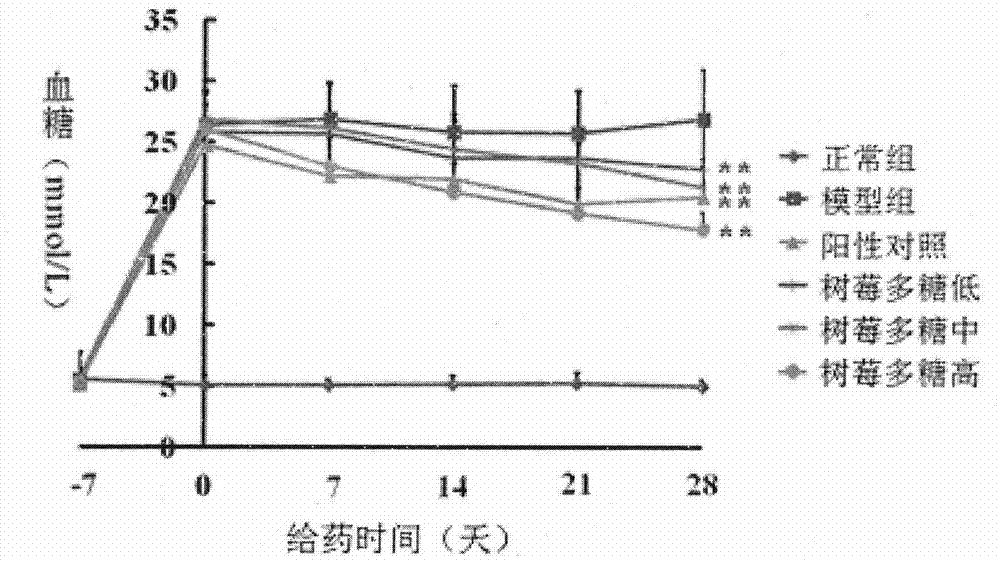
Figure 2 
Figure 3
Abstract
Description
technical field
[0001] The invention belongs to the field of health care products, and in particular relates to the use of raspberry polysaccharide in the preparation of hypoglycemic drugs. technical background
[0002] According to statistics, the number of people with diabetes in my country has reached 92.4 million, ranking first in the world (Yang W, et al. N Engl J Med, 2010, 362(12): 1090-1101). The cost of diabetes treatment in China is as high as 173.4 billion yuan per year, and the direct medical expenditure caused by diabetes has accounted for 13% of China's total medical expenditure (Alcorn T, et al. Lancet, 2012, 379(9833): 2227-2228). It can be seen that diabetes not only seriously endangers the health of the people, but also brings a heavy economic burden to the country. Therefore, it is urgent to prevent and treat diabetes.
[0003] Raspberry (Rubus idaeus L.), also known as raspberry, raspberry, raspberry, etc., belongs to the genus Rubus in the family Rosac...
Examples
Embodiment 1
[0028] The invention utilizes a rat diabetes model induced by streptozotocin (STZ) to evaluate the effect of lowering blood sugar and blood fat of raspberry polysaccharide, the main component of the raspberry polysaccharide capsule.
[0029] The process of establishing the model is as follows: Before modeling, blood was collected from the tail vein of the rats to measure blood sugar, and the body weight was weighed. After fasting for 12 hours, the rats were fasted for one-time intraperitoneal injection of STZ (dissolved in 0.1mol / L citrate buffer solution of pH 4.2, used now under light-shielding conditions) at a concentration of 60 mg / kg. ). After 96 hours, blood was taken from the tail vein to measure blood glucose. If the blood glucose value was ≥16.7mmol / L, the diabetes modeling was considered successful. The successfully modeled rats were randomly divided into 5 groups, 10 in each group, which were model group, positive control group, low-dose raspberry polysaccharide gr...