
Microsatellite marker primers used for pinctada fucata martensii microsatellite family identification, identification method and application
A technology of pearl oyster and microsatellite markers in Hepu oyster is applied in the field of microsatellite marker primers and identification for the identification of Hepu nectarine oyster microsatellite families, which can solve problems such as few reports, save cost and time, and achieve high polymorphism. , the effect of saving experimental costs
Patent Information
- Authority / Receiving Office
- CN · China
- Patent Type
- Applications(China)
- Current Assignee / Owner
- Publication Date
- 2016-05-25
Smart Images
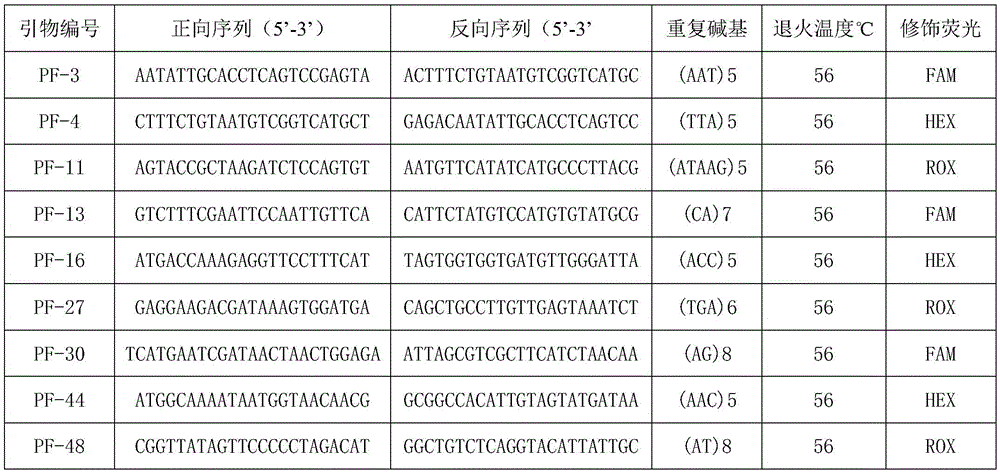
Figure 1 
Figure 2 
Figure 3
Abstract
Description
technical field
[0001] The invention belongs to the technical field of molecular markers for shellfish genetics and breeding, and in particular relates to a microsatellite marker primer for identification of Hepu pinnacle microsatellite family, identification method and application. Background technique
[0002] Hepu pearl oyster (Pinctadafucata), also known as "Martensii pinnacle oyster", is a bivalve, pearl oyster family, and lives in the shallow seabed with clear water quality and coral reefs or many gravels. It is distributed in the South China Sea and is also produced in Japan. In addition to producing pearls , the meat is edible, and the shell can be used to make buttons. It is one of the main species of Shanghai water pearls cultivated in China and the world.
[0003] Due to the lack of emphasis on selective breeding in the long-term breeding process, and the outdated breeding mode, aging breeding sites, and backward pearl breeding technology, the cultured Hepu pearl ...
Examples
Embodiment 1
[0046] Example 1 Screening and Synthesis of Microsatellite Marker Primers Used for Identification of Microsatellite Family of Hepu Pearl Oyster
[0047]The unigene containing the microsatellite repeat sequence of Hepu pinnacle was screened by transcriptome sequencing, and then microsatellite-specific primers were designed from the sequence detected to contain microsatellite sites from the Hepu pinnacle transcriptome library to detect its polymorphism After screening, 9 pairs of primers with clear bands and high polymorphism were finally selected as primers for family identification. The primers were synthesized in Shanghai Sangon Bioengineering Co., Ltd.
[0048] The microsatellite marker primers selected in the present invention are rich in polymorphism, suitable for fragment size intervals, and are not linked between markers, and are easy to type and detect at the same time, and can be used for the population genetic structure of Hepu pinnacle, genetic breeding evaluation and...
Embodiment 2
[0051] The identification method of embodiment 2 Hepu pearl oyster microsatellite family
[0052] (1) DNA extraction from parents and offspring of Hepu Pearl Oyster
[0053] (1) Establishment of Hepu pearl oyster family
[0054] Four shell-color strains of Hepu Pinctada and 1 fast-growing strain were selected, and 12 male and female Hepu Pinctada were selected for artificial breeding. The ratio of male to female was 1:1, and 12 full-sib families were established. The adductor muscle tissues of the parents of each family were clipped and placed in absolute ethanol, and the family information was recorded and stored at -20°C. The 12 families were raised in different cages. After half a year, 14 shellfish were randomly selected from each family, and their adductor muscles were fixed with absolute ethanol as samples for family identification.
[0055] (2) Extraction of Genomic DNA from Hepu Pearl Oyster parents and offspring
[0056] Using the Magen Mollusc Tissue DNA Extractio...