
A method for synthesizing high solid content and high molecular weight flocculant based on inverse emulsion
A high-molecular-weight, reverse-phase emulsion technology, applied in the direction of flocculation/sedimentation water/sewage treatment, etc., can solve problems such as widening molecular weight distribution, poor heat dissipation, accidents, etc., and achieve high relative molecular weight and good dimensional stability of polymers , the effect of improving stability
Patent Information
- Authority / Receiving Office
- CN · China
- Patent Type
- Patents(China)
- Current Assignee / Owner
- Publication Date
- 2018-05-01
Smart Images
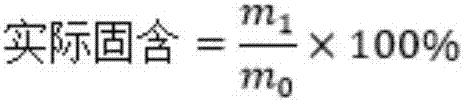
Figure 1 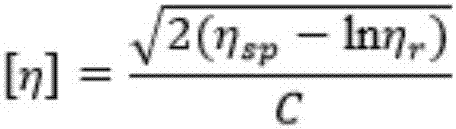
Figure 2 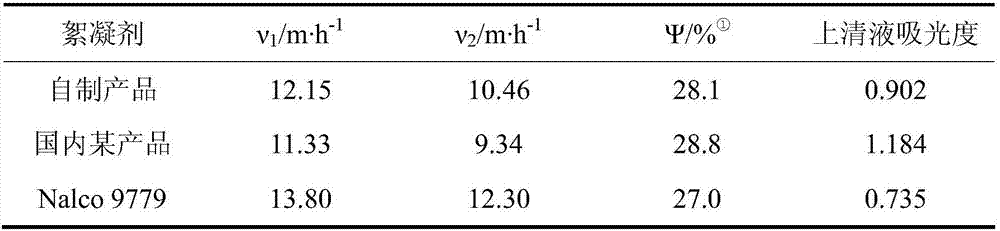
Figure 3
Abstract
Description
technical field
[0001] The invention relates to a method for synthesizing a flocculant based on an inverse emulsion, in particular to obtaining flocculation with a solid content and a high intrinsic viscosity through an inverse emulsion under the condition of using a bifunctional initiator and a Gemini type and a classic compound emulsifier agent; belongs to the technical field of polymer material preparation. Background technique
[0002] In the process of alumina production, sedimentation and separation of red mud is one of the important processes. The quality of red mud settling effect is not only related to the production quality of alumina, but also has a major impact on the entire production process and the benefits of the factory. Adding flocculants is currently the most common and effective method of strengthening red mud separation. Of course, in addition to the use of flocculant in alumina production, it is also widely used in sewage treatment, papermaking, ore dr...
Examples
Embodiment 1
[0060] Weigh 35g of 65% ammonium acrylate monomer solution, add 1.37g of 5% EDTA solution and 0.52g of sodium chloride to it to form the water phase. Weigh 10g of the oil phase Isopar M into the reaction kettle, add emulsifier Hypermer2296 2.05g, OP-100.95g to it, stir and mix well, slowly drop into the oil phase 30g of water phase and 0.624g of 2.5% bifunctional initiator agent, stir vigorously to make it fully emulsified. Nitrogen was blown into the reaction kettle for 30 minutes, and then 0.5 g of 2.5% sodium bisulfite was slowly added dropwise, and the reaction was controlled at 15° C., and the reaction time continued for 6 hours. The emulsion was taken for analysis, the solid content of the emulsion was 42.33%, the intrinsic viscosity reached 1824.65mL / g, and the mechanical and thermal stability of the emulsion were good. Compared with Comparative Example 1 and Example 3, the intrinsic viscosity and solid content of the emulsion are all improved.
Embodiment 2
[0062] Weigh 35g of 65% ammonium acrylate monomer solution, add 1.37g of 5% EDTA solution and 0.52g of sodium chloride to it to form the water phase. Weigh 10g of the oil phase Isopar M into the reaction kettle, add emulsifier Hypermer2296 2.05g, OP-100.95g to it, stir and mix well, slowly drop into the oil phase 30g of water phase and 0.5g of 2.5% difunctionality Initiator, stir vigorously to make it fully emulsified. Nitrogen was blown into the reaction kettle for 30 minutes, and then 0.4 g of 2.5% sodium bisulfite was slowly added dropwise, and the reaction was controlled at 15° C., and the reaction time continued for 3 hours. Then the reaction temperature was raised rapidly to 45° C., 0.31 g of 2.5% 2,2-azobisisobutylamidine hydrochloride (V50) was added, and the reaction was carried out at constant temperature for 4 hours. Also take the emulsion for analysis, the solid content of the emulsion is 43.10%, the intrinsic viscosity reaches 1662.02mL / g, and the mechanical stab...
Embodiment 3
[0064] Weigh 20 g of 50% ammonium acrylate solution, 20 g of 50% acrylamide solution, 1.2 g of 5% EDTA solution, and 0.6 g of sodium chloride, and mix the above four to form an aqueous phase. Weigh 10g of the oil phase Isopar M into the reaction kettle, add 2.05g of emulsifier Hypermer2296, 0.95g of OP-10 to it, stir and mix well, slowly drop into the oil phase 30g of water phase and 0.48g of 2.5% bifunctional Initiator, stir vigorously to make it fully emulsified. Nitrogen was blown into the reactor for 30 minutes, and then 0.384 g of 2.5% sodium bisulfite was slowly added dropwise to control the reaction at 15° C., and the reaction time continued for 6 hours. The emulsion was taken for analysis, the solid content of the emulsion was 32.41%, the intrinsic viscosity reached 1722.74mL / g, and the mechanical and thermal stability of the emulsion were good.