
A kind of modification method of Y-type molecular sieve
A molecular sieve and modification technology, applied in molecular sieve catalysts, chemical instruments and methods, catalyst carriers, etc., to achieve the effects of increasing acid content, reducing silicon-aluminum ratio, and large mesopore structure distribution
Patent Information
- Authority / Receiving Office
- CN · China
- Patent Type
- Patents(China)
- Current Assignee / Owner
- Publication Date
- 2019-03-19
Smart Images
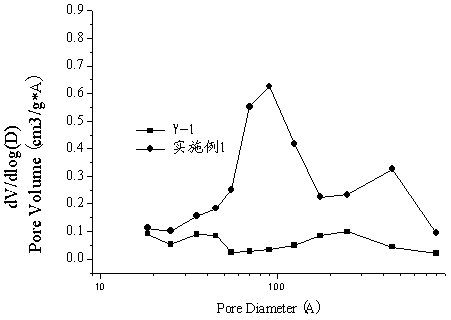
Figure 1 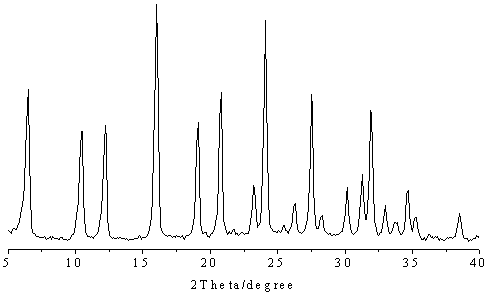
Figure 2 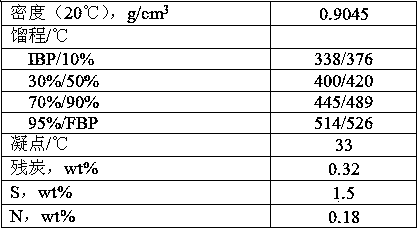
Figure 3
Abstract
Description
technical field
[0001] The invention relates to a method for modifying a Y-type molecular sieve. The Y-type molecular sieve prepared by the method has more mesoporous structure distribution, which is beneficial to the diffusion of reactants and products in the reaction process. Background technique
[0002] Y-type molecular sieve is formed by octahedral molecular sieve cages interpenetrating with each other along three crystal axis directions through twelve-membered rings. It is an excellent catalyst active component, not only has high cracking activity, but also has good selectivity. Therefore, the discovery and use of Y-type molecular sieve has epoch-making significance in the field of catalysis.
[0003] Since Y-type molecular sieves with a low silicon-aluminum ratio (the molar ratio of silicon oxide to aluminum oxide is between 3 and 4.2) do not have good hydrothermal stability, they have not been widely studied and widely used in the actual synthesis process and applica...
Examples
Embodiment 1
[0023] (1) Roast the Y-1 molecular sieve at 550°C for 4 hours, then contact the unsaturated olefin with the roasted Y-type molecular sieve, and roast it at 500°C for 2 hours in a nitrogen atmosphere to carry out the carbon deposition reaction. Obtain the Y-type molecular sieve after carbon deposition;
[0024] (2) Under stirring conditions, add the Y-type molecular sieve after carbon deposition into the pressure-resistant container of 0.50mol / L sodium hydroxide solution, the mass ratio of molecular sieve addition to water in the solution is 1:8, and Seal the system, feed nitrogen to control the system pressure to 0.4MPa, then raise the temperature to 70°C, treat at a constant temperature for 2 hours, release the pressure, filter with suction until the pH value is less than 9, dry at 120°C for 12 hours, and finally bake at 550°C After 4 hours, a modified Y-type molecular sieve was obtained. The specific properties of molecular sieves are shown in Table 1.
Embodiment 2
[0026] (1) Roast the Y-1 molecular sieve at 450°C for 6 hours, then contact the unsaturated olefin with the roasted Y-type molecular sieve, and roast it at 550°C for 2 hours in a nitrogen atmosphere to carry out the carbon deposition reaction. Obtain the Y-type molecular sieve after carbon deposition;
[0027] (2) Under stirring conditions, add the Y-type molecular sieve after the carbon deposition into the pressure-resistant container of 0.80mol / L sodium hydroxide solution, the mass ratio of the molecular sieve to the water in the solution is 1:15, and Seal the system, feed air to control the system pressure to 0.6MPa, then raise the temperature to 80°C, treat at a constant temperature for 1 hour, release the pressure, filter with suction until the pH value is less than 9, dry at 110°C for 18 hours, and finally bake at 580°C After 4 hours, a modified Y-type molecular sieve was obtained. The specific properties of molecular sieves are shown in Table 1.
Embodiment 3
[0029] (1) Roast the Y-1 molecular sieve at 600°C for 2 hours, then contact the unsaturated olefin with the roasted Y-type molecular sieve, and roast it at 480°C for 6 hours in a nitrogen atmosphere to carry out the carbon deposition reaction. Obtain the Y-type molecular sieve after carbon deposition;
[0030] (2) Under stirring conditions, add the carbon-deposited Y-type molecular sieve into a pressure-resistant container of 0.60mol / L sodium hydroxide solution. The mass ratio of the amount of molecular sieve added to the water in the solution is 1:10, and Seal the system, feed nitrogen to control the system pressure to 0.2 MPa, then raise the temperature to 60°C, treat at a constant temperature for 3 hours, release the pressure, filter with suction until the pH value is less than 9, dry at 100°C for 24 hours, and finally roast at 520°C After 4 hours, a modified Y-type molecular sieve was obtained. The specific properties of molecular sieves are shown in Table 1.