
Biodegradable polyester alloy and preparation method thereof
A technology for degrading polyester and biology, applied in the field of new materials, can solve the problems affecting the properties of alloys, high reactivity, and thermodynamic incompatibility of polyester substrates, and achieve the effect of overcoming thermodynamic incompatibility and improving compatibility.
Patent Information
- Authority / Receiving Office
- CN · China
- Patent Type
- Applications(China)
- Current Assignee / Owner
- Publication Date
- 2017-09-01
- Estimated Expiration
- Not applicable · inactive patent
Smart Images
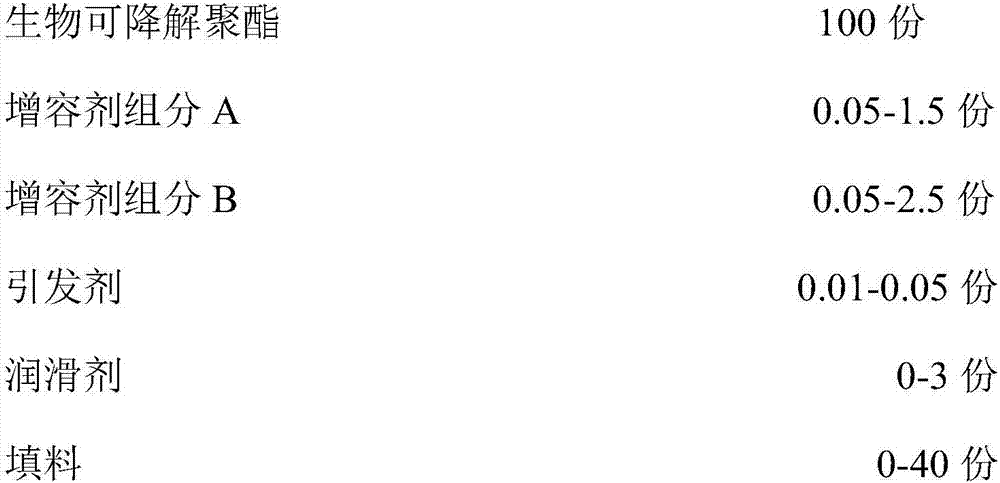
Figure 1 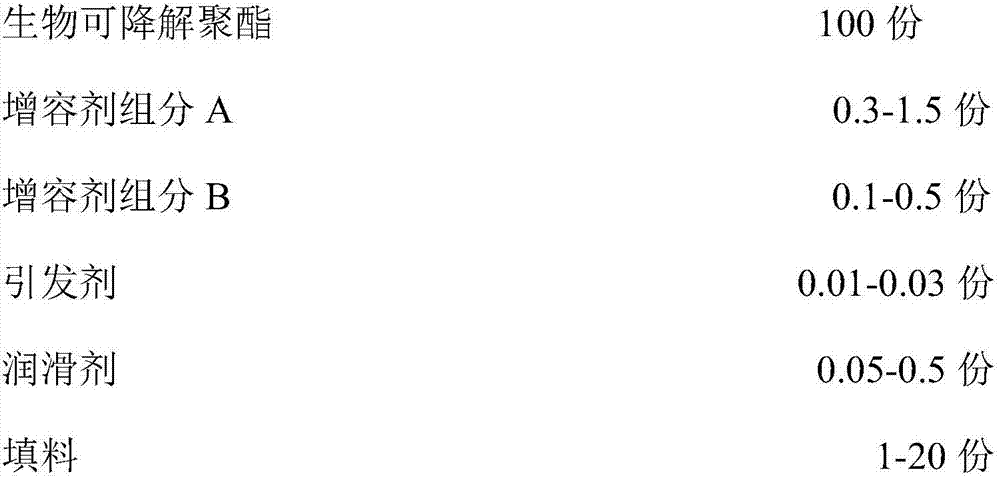
Figure 2 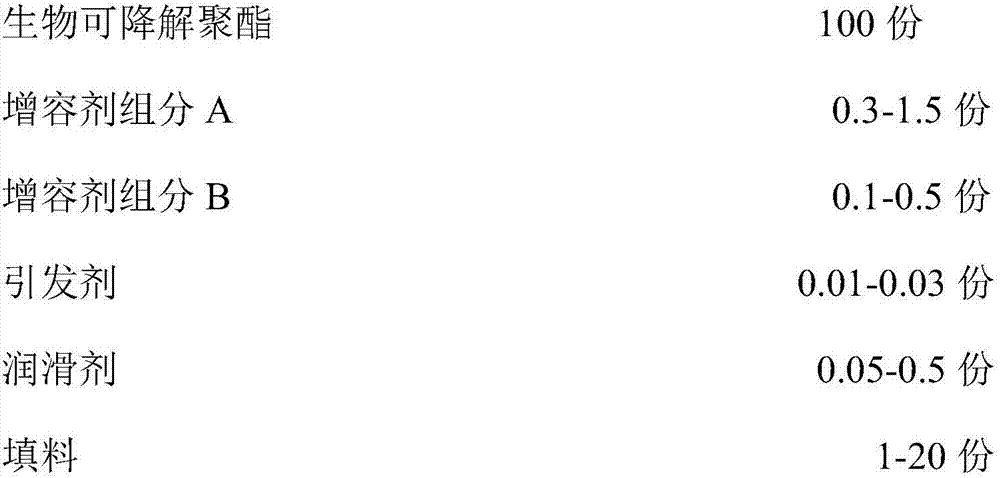
Figure 3
Abstract
Description
technical field
[0001] The invention relates to a new material technical field, in particular to a simple and economical method for compounding two or more biodegradable polyesters to prepare an alloy. Background technique
[0002] Polyethylene, polypropylene, polyvinyl chloride, polystyrene and other petroleum-based resins are widely used in various fields such as daily necessities, packaging materials, and home appliances due to their light weight, ready processing, and excellent performance. However, these resin products still show good persistence in the waste stage after use, and do not degrade for a long time, which has a serious impact on the ecosystem. In particular, a large number of disposable polymer products are discarded, causing an environmental crisis such as "white pollution".
[0003] In order to solve this problem, a variety of thermoplastic and biodegradable polyester resins have been developed, and now there are polylactic acid (PLA), polycaprolactone (P...
Examples
Embodiment 1
[0052] (1) PLA (4032D) and PBAT were vacuum-dried at a drying temperature of 60°C and a drying time of 12 hours; calcium carbonate was dried in a blast oven at 120°C for 6 hours;
[0053] (2) Styrene and glycidyl methacrylate are washed with sodium hydroxide dilute solution respectively, and then dried;
[0054] (3) Take 90 parts of PLA, 10 parts of PBAT, 0.5 part of styrene, 0.25 part of glycidyl methacrylate, 0.02 part of dicumyl peroxide, 0.1 part of calcium stearate, and 10 parts of calcium carbonate in high-mixing Mix in the machine at room temperature for 5 minutes;
[0055] (4) Add the obtained mixture to a twin-screw extruder for melting and mixing, and react to extrude and granulate. The temperature of each zone of the twin-screw machine is: 160°C in the first zone, 180°C in the second zone, 180°C in the third zone, and 190°C in the fourth zone , the fifth zone is 190°C, the head is 180°C; the screw speed is 200rpm, the length-to-diameter ratio L / D=44 / 1, and the cool...
Embodiment 2
[0058] (1) PLA (4032D) and PBS were vacuum-dried at a drying temperature of 60°C and a drying time of 12 hours; the fumed silica was dried in a blast oven at 120°C for 12 hours;
[0059] (2) Styrene and glycidyl methacrylate are washed with sodium hydroxide dilute solution respectively, and then dried;
[0060] (3) Get 88 parts of PLA, 12 parts of PBS, 0.4 part of styrene, 0.25 part of glycidyl methacrylate, 0.02 part of dicumyl peroxide, 0.1 part of calcium stearate, 5 parts of fumed silica, Mix in a high mixer at room temperature for 5 minutes;
[0061] (4) Add the obtained mixture to a twin-screw extruder for melting and mixing, and react to extrude and granulate. The temperature of each zone of the twin-screw machine is: 160°C in the first zone, 170°C in the second zone, 180°C in the third zone, and 190°C in the fourth zone , the fifth zone is 190°C, the head is 180°C; the screw speed is 200rpm, the length-to-diameter ratio L / D=40 / 1, and the cooling method of the strands:...
Embodiment 3
[0064] (1) PLA (4032D), PBAT and PBS were vacuum-dried at a drying temperature of 60°C for 12 hours; carbon fiber T500 was dried in a blast oven at 120°C for 6 hours;
[0065] (2) Styrene and glycidyl methacrylate are washed with sodium hydroxide dilute solution respectively, and then dried;
[0066] (3) Take 85 parts of PLA, 10 parts of PBAT, 5 parts of PBS, 0.5 parts of styrene, 0.5 parts of glycidyl methacrylate, 0.02 parts of dicumyl peroxide, 0.1 parts of calcium stearate, and 5 parts of carbon fiber T500 , mixed in a high mixer at room temperature for 5 minutes;
[0067] (4) Put the obtained mixture into a twin-screw extruder for melting and mixing, and react to extrude and granulate. The temperature of each zone of the twin-screw machine is: 160°C in the first zone, 175°C in the second zone, 190°C in the third zone, and 200°C in the fourth zone , the fifth zone is 190°C, the head is 180°C; the screw speed is 200rpm, the length-to-diameter ratio L / D=44 / 1, and the coolin...