
A tio for supercapacitors 2 Composite porous material with cuo and preparation method thereof
A technology of supercapacitors and porous materials, applied in the field of TiO2 and CuO composite porous materials and their preparation, can solve the problems of unstable element ions, damage to mesoporous structure, etc. Effect
Patent Information
- Authority / Receiving Office
- CN · China
- Patent Type
- Patents(China)
- Current Assignee / Owner
- Publication Date
- 2020-07-28
Smart Images
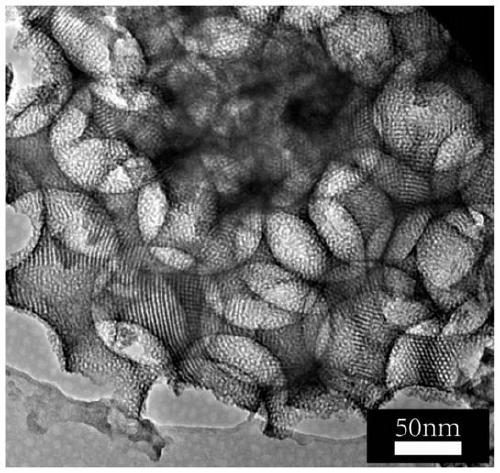
Figure 1 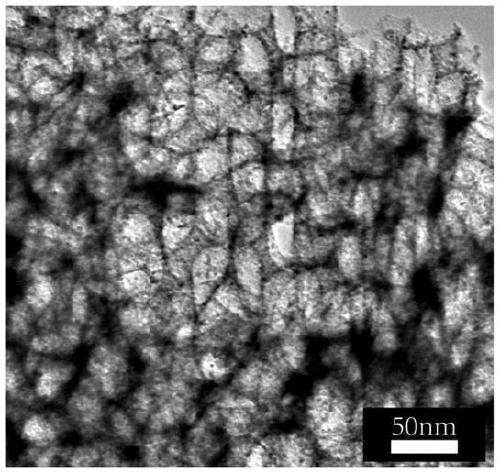
Figure 2 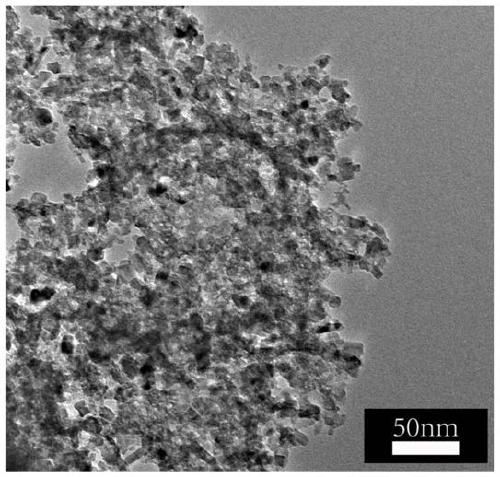
Figure 3
Abstract
Description
technical field
[0001] The invention belongs to the technical field of electrode materials, and in particular relates to a TiO used for supercapacitors 2 and CuO composite porous material and preparation method thereof. Background technique
[0002] There are various electrode materials used in supercapacitors. Among them, porous materials are considered to be an ideal electrode material due to their advantages of being easily infiltrated by solvents and facilitating ion transport and diffusion. At present, the porous materials used in supercapacitors are mostly macroporous (>50nm) structures, but the specific surface area and pore volume of this macroporous material are relatively small, which affects the infiltration of solvent molecules, and the reactive sites it can provide There are relatively few points, and its skeleton is easy to collapse, which affects the stability of the entire structure.
[0003] In order to increase the specific surface area of porous mat...
Examples
preparation example Construction
[0026] The embodiment of the present invention provides a kind of TiO2 for supercapacitor 2 and the preparation method of CuO composite porous material, comprises the following steps:
[0027] S1: The glass slide is placed in an ethanol solution of polystyrene microspheres, and the ethanol solvent is evaporated so that the polystyrene microspheres self-assemble on the surface of the glass slide to form a polystyrene film.
[0028] The polystyrene microspheres in this step are macroporous templates, and the polystyrene microspheres are arranged in an orderly manner on the surface of the glass slide through self-assembly induced by solvent evaporation to obtain a polystyrene film.
[0029] S2: Add P123 into ethanol solvent and stir to dissolve. After P123 is dissolved, add isopropyl titanate and hydrochloric acid to stir and mix, add titanium tetrachloride drop by drop and continue to stir and mix, then add copper chloride dihydrate to stir and dissolve to obtain titanium dioxid...
Embodiment 1
[0042] (1) Take 10 mL of polystyrene microsphere aqueous solution with a concentration of 0.2 g / mL, mix it with 10 mL of ethanol, and ultrasonically disperse the polystyrene microspheres for 5 min in a water bath at room temperature to obtain an ethanol solution of polystyrene microspheres, wherein , the particle size of the polystyrene microspheres is 120nm; the glass slide is placed in the ethanol solution of the obtained polystyrene microspheres, and the ethanol solvent is evaporated in a blast oven at 55° C. The surface of the glass slide self-assembled to form a polystyrene film with a thickness of 10 μm. After the polystyrene film was formed, it was kept at 80° C. for 1 hour, and then cooled naturally to room temperature.
[0043] (2) Add 1g of P123 into 10mL of ethanol solvent and stir to dissolve. After P123 is dissolved, add 0.2g of isopropyl titanate and 1mL of hydrochloric acid and stir to mix. Add 0.2mL of titanium tetrachloride drop by drop and continue to stir and...
Embodiment 2
[0047] (1) Take 10 mL of polystyrene microsphere aqueous solution with a concentration of 1.5 g / mL, mix it with 10 mL of ethanol, and ultrasonically disperse the polystyrene microspheres in a water bath at room temperature for 5 minutes to obtain an ethanol solution of polystyrene microspheres, wherein , the particle size of the polystyrene microspheres is 460nm; the glass slide is placed in the ethanol solution of the obtained polystyrene microspheres, and the ethanol solvent is evaporated in a blast oven at 55° C. The surface of the glass slide self-assembled to form a polystyrene film with a thickness of 10 μm. After the polystyrene film was formed, it was kept at 80° C. for 1 hour, and then cooled naturally to room temperature.
[0048] (2) Add 3g of P123 into 10mL of ethanol solvent and stir to dissolve. After P123 is dissolved, add 1g of isopropyl titanate and 5mL of hydrochloric acid and stir to mix. Add 2mL of titanium tetrachloride drop by drop and continue to stir and...