

A kind of asymmetric synthesis method of dexchlorpheniramine and dexbrompheniramine
A synthetic method, the technology of D-halogenated pheniramine, applied in the field of chemical synthesis, can solve the problems of a large number of split reagents and poor atom economy, and achieve high industrial production value, short route, high yield and good effect
Patent Information
- Authority / Receiving Office
- CN · China
- Patent Type
- Patents(China)
- Current Assignee / Owner
- Publication Date
- 2021-08-10
Smart Images
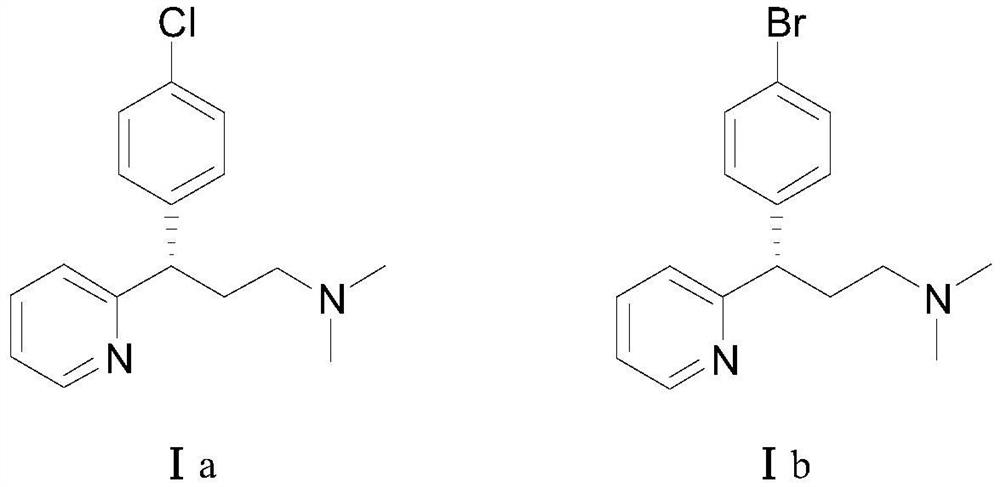
Figure 1 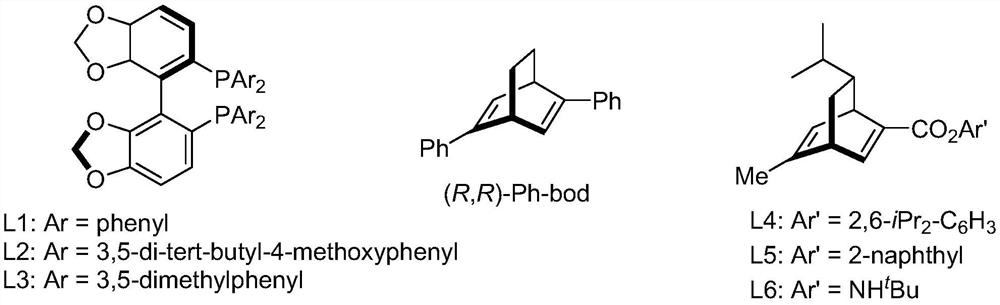
Figure 2 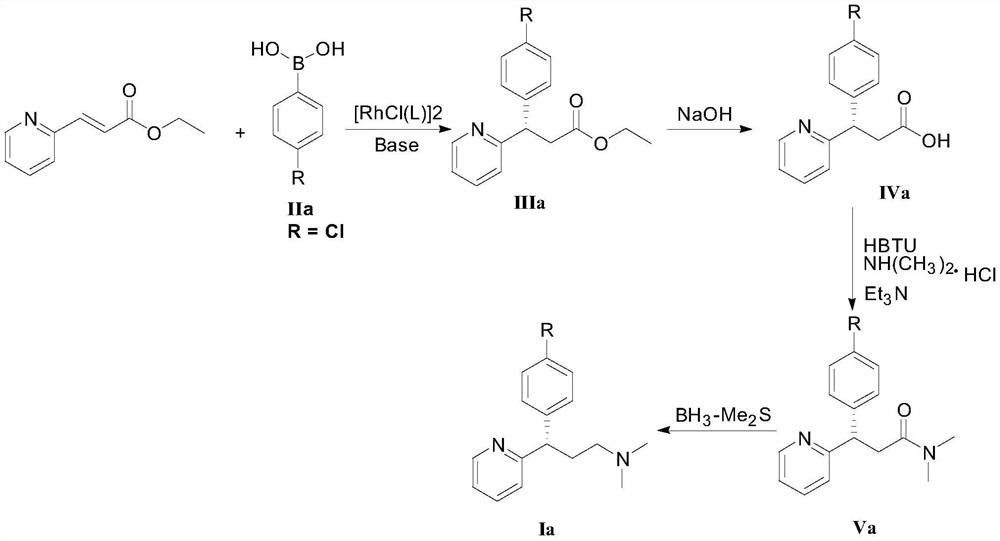
Figure 3
Abstract
Description
technical field
[0001] The invention belongs to the field of chemical synthesis, and in particular relates to an asymmetric synthesis method of dextrohalogenated pheniramine, in particular to an asymmetric synthesis of dexchloropheniramine and dexbrompheniramine. Background technique
[0002] Chlorphenamine and Brompheniramine are propylamine antihistamines. Both drugs are suitable for the treatment of allergic rhinitis, skin and mucous membrane allergy, urticaria, vasodilation rhinitis, contact dermatitis, and allergic diseases caused by drugs and food. The effects of dexchlorpheniramine (structural formula as shown in Ia) and dextrobrompheniramine (structural formula as shown in Ib) are all the same as their racemates, but the intensity of action is twice that of the latter. The chemical name of dexchlorpheniramine is (S)-N,N-dimethyl-γ-(4-chlorophenyl)-2-pyridinepropylamine, and the English name is (S)-3-(4-chlorophenyl) -N,N-dimethyl-3-(pyridin-2-yl)propan-1-amine, the...
Examples
Embodiment 1
[0047]
[0048] Ethyl 3-(2-pyridyl)acrylate (35.4 mg, 0.20 mmol), 4-chlorophenylboronic acid (compound IIa, 48.8 mg, 0.40 mmol), chiral rhodium catalyst [RhCl(L3)] 2(1.5 mg, 0.20 mmol%, that is, the molar weight of the chiral rhodium catalyst is 0.20% of the molar weight of 3-(2-pyridyl) ethyl acrylate) was added to the Schlenk tube, and tetrahydrofuran (1 mL) was sequentially added under the protection of high-purity nitrogen. And potassium hydroxide aqueous solution (0.1mL, containing potassium hydroxide 0.6mg). Move to 80°C, react for 12h, cool the reaction solution to room temperature, add water (1mL) to the Schlenk tube, extract with ethyl acetate (2mL×3), evaporate the solvent; silica gel column chromatography (petroleum ether / ethyl acetate Ester = 10 / 1, v / v) to obtain 55.6 mg of a white solid (Intermediate IIIa), with a yield of 96% and an ee value of 96%.
[0049] The relevant identification data of intermediate IIIa are as follows:
[0050] [α] D 20 =+1.1×10 2...
Embodiment 2
[0071]
[0072] Ethyl 3-(2-pyridyl)acrylate (35.4 mg, 0.20 mmol), 4-bromophenylboronic acid (compound IIb, 80.3 mg, 0.40 mmol), chiral rhodium catalyst [RhCl(L3)] 2 (1.5mg, 0.20mmol%) was added to a Schlenk tube, under the protection of high-purity nitrogen, tetrahydrofuran (1mL) and potassium hydroxide aqueous solution (0.1mL, containing 0.6mg potassium hydroxide) were sequentially added. Move to 80°C, react for 12h, cool the reaction solution to room temperature, add water (1mL) to the Schlenk tube, extract with ethyl acetate (2mL×3), evaporate the solvent; silica gel column chromatography (petroleum ether / ethyl acetate Ester = 10 / 1, v / v) to obtain 61.5 mg of a white solid (intermediate IIIb), with a yield of 92% and an ee value of 96%.
[0073] The relevant identification data of compound IIIb are as follows:
[0074] [α] D 20 =+93 (c 0.50, CHCl 3 ).
[0075] ESI-MS(m / z):334.0449.
[0076] 1 H NMR (500MHz, CDCl 3 )δ8.59(d, J=4.5Hz, 1H), 7.59(td, J=7.7, 1.6Hz, 1H)...
Embodiment 3
[0095]
[0096] Ethyl 3-(2-pyridyl)acrylate (35.4mg, 0.20mmol), 4-chlorophenylboronic acid (48.8mg, 0.40mmol), chiral rhodium catalyst [RhCl(L3)] 2 (1.5mg, 0.20mmol%) was added to the Schlenk tube, pumped, and then added toluene (1mL) and potassium hydroxide aqueous solution (0.1mL, containing 0.6mg potassium hydroxide) under the protection of high-purity nitrogen. Move to 80°C, react for 12 hours, cool the reaction solution to room temperature, add water (1 mL) to the Schlenk tube, extract with ethyl acetate (2 mL×3), evaporate the solvent to obtain intermediate IIIa. After silica gel column chromatography (petroleum ether / ethyl acetate=10 / 1, v / v), 53.9 mg of a white solid was obtained, with a yield of 93% and an ee value of 90%.