
Method for preparing quantum dot labeled anti-canine virus antibody immunochromatographic test strip, prepared test strip and application
An immunochromatographic test paper and anti-canine virus technology, applied in the field of immunoassay, can solve the problems of undeveloped veterinary canine infectious diseases, increase the difficulty of detection, time-consuming and laborious, etc., achieve simple detection procedures, improve sensitivity, and avoid non-specific effect
Patent Information
- Authority / Receiving Office
- CN · China
- Patent Type
- Applications(China)
- Current Assignee / Owner
- Publication Date
- 2020-09-15
Smart Images
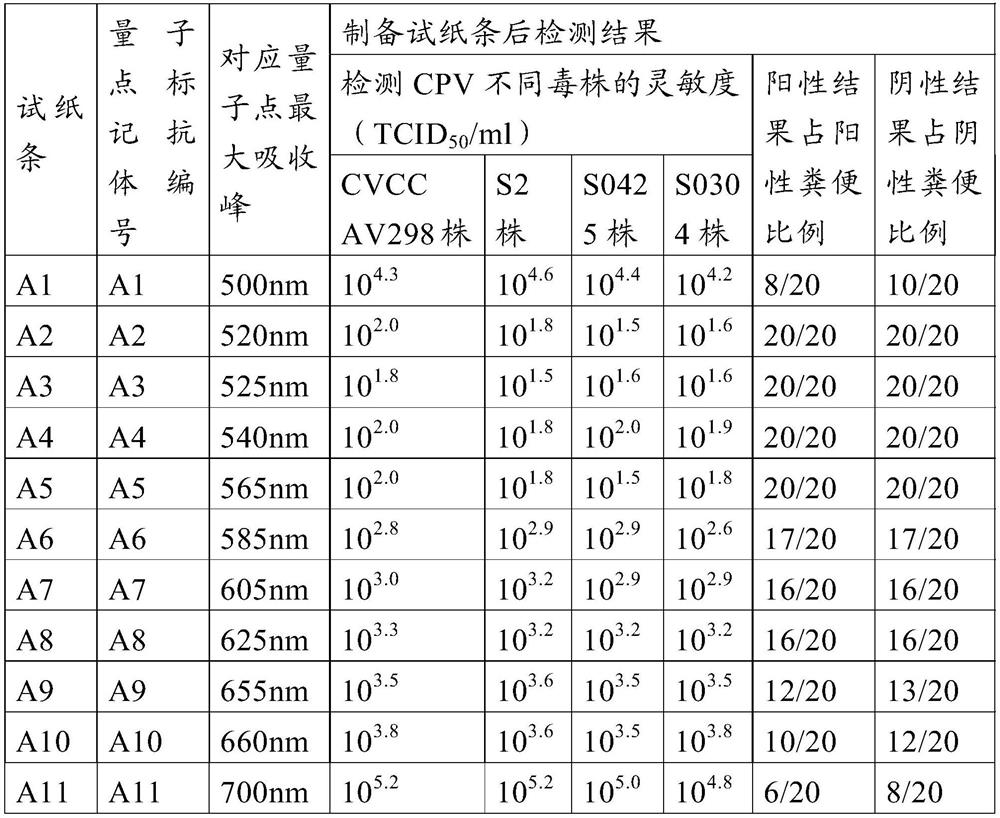
Figure 1 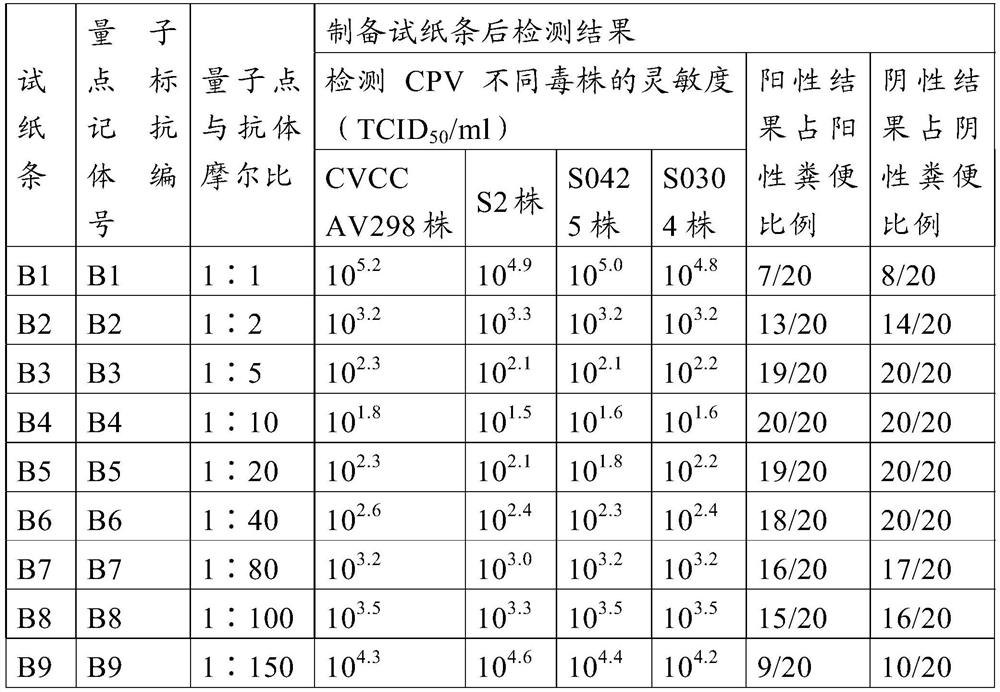
Figure 2 
Figure 3
Abstract
Description
technical field
[0001] The invention relates to the field of immunoassays, in particular to a method for preparing an anti-canine virus antibody immunochromatographic test strip containing sub-dot markers, the prepared test strip, a kit and an application. Background technique
[0002] Quantum dots (Quantum dot, QD), also known as semiconductor nanocrystals, are nano-fluorescent materials composed of II-VI or III-V elements with a radius smaller than or close to the exciton Bohr radius, mostly spherical. As a fluorescent material, quantum dots have excellent fluorescence characteristics: they have a narrow and symmetrical fluorescence emission spectrum, the emission wavelength varies with the material and particle size, they have a broad and continuous absorption spectrum, and the Stokes shift is large, so that Quantum dots are easy to realize the multicolor labeling function of single-wavelength excitation and simultaneous emission of multiple wavelengths. In addition, com...
Examples
Embodiment 1
[0083] Example 1 Optimization of Quantum Dot Labeled Antibodies and Related Solutions
[0084] 1.1 Selection of maximum absorption peak of quantum dots
[0085] Purchase a number of commercial quantum dots, the maximum absorption peak is between 500-700nm, systematically label and explore the antibodies of different animal species, the following only the maximum absorption peaks are 500nm, 520nm, 525nm, 540nm, 565nm , 585nm, 605nm, 625nm, 655nm, 660nm, and 700nm quantum dots are used as examples for illustration.
[0086] Quantum dots with different maximum absorption peaks were mixed with canine parvovirus monoclonal antibody 10B11 at a molar ratio of 1:10 and then labeled. The labeling process was as follows: ①The activator EDC and quantum dots were mixed at a molar ratio of 2000:1 at pH7.4 Mix the PBS buffer solution and shake it at room temperature for 1 hour to activate the quantum dots; ②mix the activated quantum dots with the antibody to be labeled at a molar ratio, an...
Embodiment 2
[0117] The preparation of embodiment 2 kit
[0118] 2.1 Preparation of test strips
[0119] 2.1.1 Preparation of quantum dot marker pads
[0120] The reconstituted quantum dot-labeled antibody prepared in Example 1 is identified and then adsorbed to a glass fiber membrane or a polyester film. After drying, it becomes a quantum dot-labeled mat that can be used.
[0121] In order to evaluate the influence of the concentration of the quantum dot-labeled antibody used in the preparation of the quantum dot-labeled pad, the quantum dot-labeled antibody was diluted with the quantum dot-labeled antibody reconstitution solution on the basis of A3, B4, C7, and D5 to a working concentration of 2.5, 5, and 10 , 20, 50, 100, 150, 200 μg / ml and then prepare test strips and test them. The results (see Table 7): the test strips prepared when the working concentration of the quantum dot-labeled antibody is 2.5 μg / ml and 200 μg / ml The sensitivity of the strip to detect CPV is low (10 5.0 ~10...
Embodiment 3
[0173] Embodiment 3 The preparation of other dog quantum dot test strips
[0174] In order to further evaluate whether each condition optimized in Example 2 can meet the application in the diagnosis and detection of animal diseases such as other antigens of dogs, canine distemper virus, canine adenovirus, canine adenovirus type 1, canine adenovirus type 2, The canine parainfluenza virus was debugged and evaluated one by one. The results: (1) The sensitivity was significantly improved by at least 50 times compared with the commercial colloidal gold test strip; (2) The specificity was good, and no non-specific phenomenon occurred; (3) Repeated (4) The storage period can be stored up to 27 months, which is far better than the storage period (18 months) of the existing quantum dot test strips for human use; (5) The clinical application effect is good, and can be quickly, on-site, and Accurately diagnose. The following is a brief description of canine distemper virus, canine adeno...