
Sterilization composition containing phenazino-1-carboxylic acid and ethylicin and application thereof
A kind of technology of styrazinomycin and acetoin, which is applied in the field of pesticides to achieve the effects of delaying resistance, reducing use and reducing use cost
Patent Information
- Authority / Receiving Office
- CN · China
- Patent Type
- Applications(China)
- Current Assignee / Owner
- Publication Date
- 2022-05-27
Smart Images
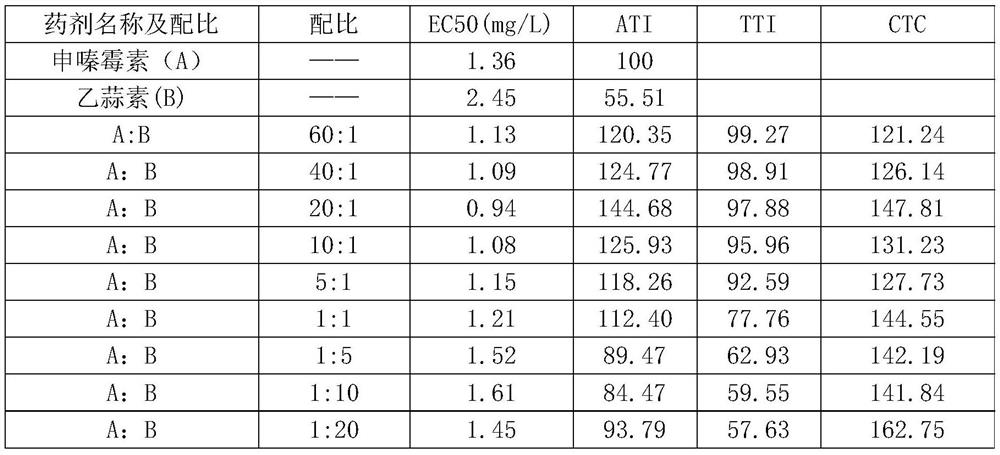
Figure 1 
Figure 2 
Figure 3
Abstract
Description
technical field
[0001] The invention belongs to the technical field of pesticides, and in particular relates to the compounding of pesticides containing the active ingredients styrazinomycin and ethiocyclin. Background technique
[0002] Shenqinmycin, English name Shenqinmycin, is a new type of microbial pesticide independently developed by China. Shenqinmycin is a microbial antibiotic secreted by Pseudomonas fluorescens strain M18. Its main active ingredient is phenazine-1 -carboxylic acid. In addition, it also has the dual functions of broad-spectrum inhibition of plant pathogens and promotion of plant growth. This antibiotic can effectively prevent and treat common diseases on rice, wheat, cotton and vegetables, such as bakanae disease, rice blast, rice koji Disease, sheath blight, fusarium wilt, ginger blast, canker, bacterial wilt and other diseases.
[0003] Ethyl allicin, English name: Ethylici, also known as antibacterial agent 402, also known as ethyl ethyl thiosu...
Examples
Embodiment 1
[0019] Bioassay Example 1: Indoor virulence assay of styrazinomycin and ethalicin against rice false smut.
[0020] First, after analyzing the action characteristics of styazinamycin and acetoallicin, it was determined that the bioassay object was Ustilaginoidea oryzae, the pathogen of rice false smut, which belongs to the subphylum Deuteromycota.
[0021] Indoor bioassay test method: refer to "NYT1156.2-2006 Pesticide Indoor Bioassay Test Guidelines Fungicide Part 2: Inhibition of Pathogenic Fungal Mycelium Growth Test Plate Method".
[0022] The growth rate assay was used to determine the inhibitory effect of chemical agents on the growth of rice false smut mycelium. On the basis of the pre-experiment, four concentration gradients were involved in the range of 10% to 90% of the growth inhibition rate of each agent on the mycelial growth of Chlorella oryzae. Dissolve with NN-dimethylformamide as solvent, dilute with 0.1% Tween 80 aqueous solution to obtain a series of gradie...
example 2
[0035] Bioassay Example 2: Indoor virulence assay of styrazinomycin and ethalicin against rice blast.
[0036] Firstly, after analyzing the action characteristics of sentazinemycin and acetocin, it was determined that the pathogen of rice blast was Pyricularia oryzae Cav., which belongs to the genus Pyricularia.
[0037] Indoor bioassay test method: refer to "NYT1156.2-2006 Pesticide Indoor Bioassay Test Guidelines Fungicide Part 2: Inhibition of Pathogenic Fungal Mycelium Growth Test Plate Method".
[0038] The growth rate assay was used to determine the inhibitory effect of the chemicals on the growth of rice blast mycelium. On the basis of the pre-experiment, four concentration gradients were involved in the range of 10% to 90% inhibition rate for the growth of Chlorella oryzae mycelium. Dissolve with NN-dimethylformamide as solvent, and dilute with 0.1% Tween 80 aqueous solution to obtain a series of gradient concentration medicinal solutions for later use. Add the medic...
example 3
[0050] Bioassay Example 3: Indoor virulence assays of styrazinemycin and etiocin against Fusarium wilt of strawberry.
[0051] First, after analyzing the action characteristics of sentazinemycin and acetoallicin, it is determined that the pathogen of strawberry fusarium wilt is Fusarium oxysporum Schl.f.sp.fragariae WinksetWillams. Subphylum fungi.
[0052] Indoor bioassay test method: refer to "NYT1156.2-2006 Pesticide Indoor Bioassay Test Guidelines Fungicide Part 2: Inhibition of Pathogenic Fungal Mycelium Growth Test Plate Method".
[0053] The growth rate assay was used to determine the inhibitory effect of the chemicals on the growth of rice blast mycelium. On the basis of the pre-experiment, four concentration gradients were involved in the range of 10% to 90% of the growth inhibition rate of each agent on the mycelial growth of Chlorella oryzae. Dissolve with NN-dimethylformamide as solvent, dilute with 0.1% Tween 80 aqueous solution to obtain a series of gradient co...