
Nickel-lanthanum oxide catalyst for methane dry reforming and preparation method thereof
A methane dry reforming and catalyst technology, which is applied in catalyst activation/preparation, metal/metal oxide/metal hydroxide catalyst, physical/chemical process catalyst, etc., and can solve the problems of carbon deposition and high temperature sintering of active components. , to achieve high catalytic stability, increase specific surface area, and solve the effects of high temperature sintering and carbon deposition
Patent Information
- Authority / Receiving Office
- CN · China
- Patent Type
- Applications(China)
- Current Assignee / Owner
- Publication Date
- 2022-07-15
Smart Images
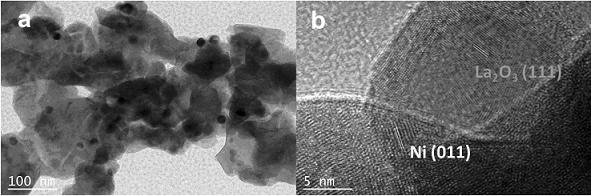
Figure 1 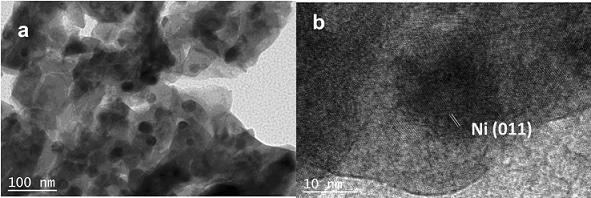
Figure 2 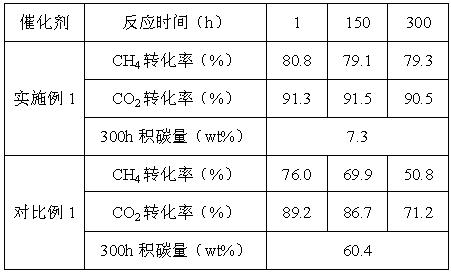
Figure 3
Abstract
Description
technical field
[0001] The invention relates to the technical field of heterogeneous catalysis, in particular to a nickel-lanthanum oxide catalyst for dry reforming of methane and a preparation method thereof. Background technique
[0002] Methane dry reforming is the simultaneous conversion of two very stable carbon-one molecule CH 4 and CO 2 for syngas (CO and H 2 )the process of. Therefore, from a theoretical perspective, this reaction is a very challenging and important research topic in carbon-chemistry. From a practical point of view, this process is not only an important process for natural gas conversion, but also a large-scale chemical utilization of CO 2 Therefore, it is of great practical significance to alleviate the energy crisis and improve the living environment of human beings.
[0003] At present, the catalysts used for this reaction can be classified into two categories: noble metals and non-precious metals, among which non-precious metal Ni-based cata...
Examples
Embodiment 1
[0032] Carrier preparation: In a 1 L beaker, 13 g La (NO 3 ) 3 ·6H 2 O was dissolved in 200 mL of water with stirring, and then 1.0 mol·L was added dropwise. -1 NH 4 HCO 3 The precipitant adjusts the pH of the mixed slurry to 8.0. After continuing to stir for 0.5 h, the reactant was filtered and washed until the pH of the filtrate was 7.0, dried in an oven at 120 °C overnight, and finally calcined in a muffle furnace at 600 °C for 2.0 h to obtain the catalyst carrier La 2 O 2 CO 3 ;
[0033] Catalyst preparation: 3.0 g of the above La was added to a 50 mL crucible under infrared light irradiation 2 O 2 CO 3 carrier, weigh 0.30g Ni (NO 3 ) 2 ·6H 2 O was dissolved in 7 mL of water to obtain a precursor solution. The precursor solution was added to the crucible and immersed while stirring. After the solvent was evaporated to dryness, it was dried in an oven at 120 °C overnight, and calcined in a muffle furnace at 750 °C for 2.0 h. in tube furnace H 2 / N 2 (volume...
Embodiment 2
[0035] Carrier preparation: In a 1 L beaker, at room temperature (around 25 °C), 24 g La (CH 3 COO) 3 ·5H 2 O was dissolved in 200 mL of water with stirring, and then 0.5 mol L was added dropwise. -1 NH 3 ·H 2 O precipitant adjusts the pH of the mixed slurry to 8.0. After stirring for 0.5 h, the reactant was filtered and washed until the pH of the filtrate was 7.0, dried in an oven at 120 °C overnight, and finally calcined in a muffle furnace at 600 °C for 3.0 h to obtain the catalyst carrier La 2 O 2 CO 3 ;
[0036] Catalyst preparation: 3.0 g of the above La was added to a 50 mL crucible under infrared light irradiation 2 O 2 CO 3 carrier, weigh 0.40g Ni (CH 3 COO) 2 ·4H 2 O was dissolved in 7 mL of water to obtain a precursor solution. The precursor solution was added to the crucible and immersed while stirring. After the solvent was evaporated to dryness, it was dried in an oven at 120 °C overnight, and calcined in a muffle furnace at 800 °C for 2.0 h. in tu...
Embodiment 3
[0038] Carrier preparation: In a 1 L beaker, add 10 g LaCl at room temperature (around 25 °C) 3 Stir to dissolve in 200 mL of water, and then dropwise add 2.0 mol L -1 (NH 4 ) 2 CO 3 The precipitant adjusts the pH of the mixed slurry to 9.0. After continuing to stir for 0.5 h, the reactant was filtered and washed until the pH of the filtrate was 7.0, dried in an oven at 120 °C overnight, and finally calcined in a muffle furnace at 600 °C for 4.0 h to obtain the catalyst carrier La 2 O 2 CO 3 ;
[0039] Catalyst preparation: 3.0 g of the above La was added to a 50 mL crucible under infrared light irradiation 2 O 2 CO 3 Carrier, weigh 0.43g NiCl 2 ·6H 2 O was dissolved in 7 mL of water to obtain a precursor solution. The precursor solution was added to the crucible and immersed while stirring. After the solvent was evaporated to dryness, it was dried in an oven at 120 °C overnight, and calcined in a muffle furnace at 600 °C for 2.0 h. in tube furnace H 2 / N 2 (vol...