
Continuous preparation process of high purity nanometer alumina
A nano-alumina, preparation technology, applied in the direction of alumina/aluminum hydroxide, etc., can solve the problems of unstable product quality and low product purity, achieve the effect of improving conversion rate, overcoming low product purity, and ensuring uniformity
Patent Information
- Authority / Receiving Office
- CN · China
- Patent Type
- Applications(China)
- Current Assignee / Owner
- Publication Date
- 2006-08-02
Smart Images
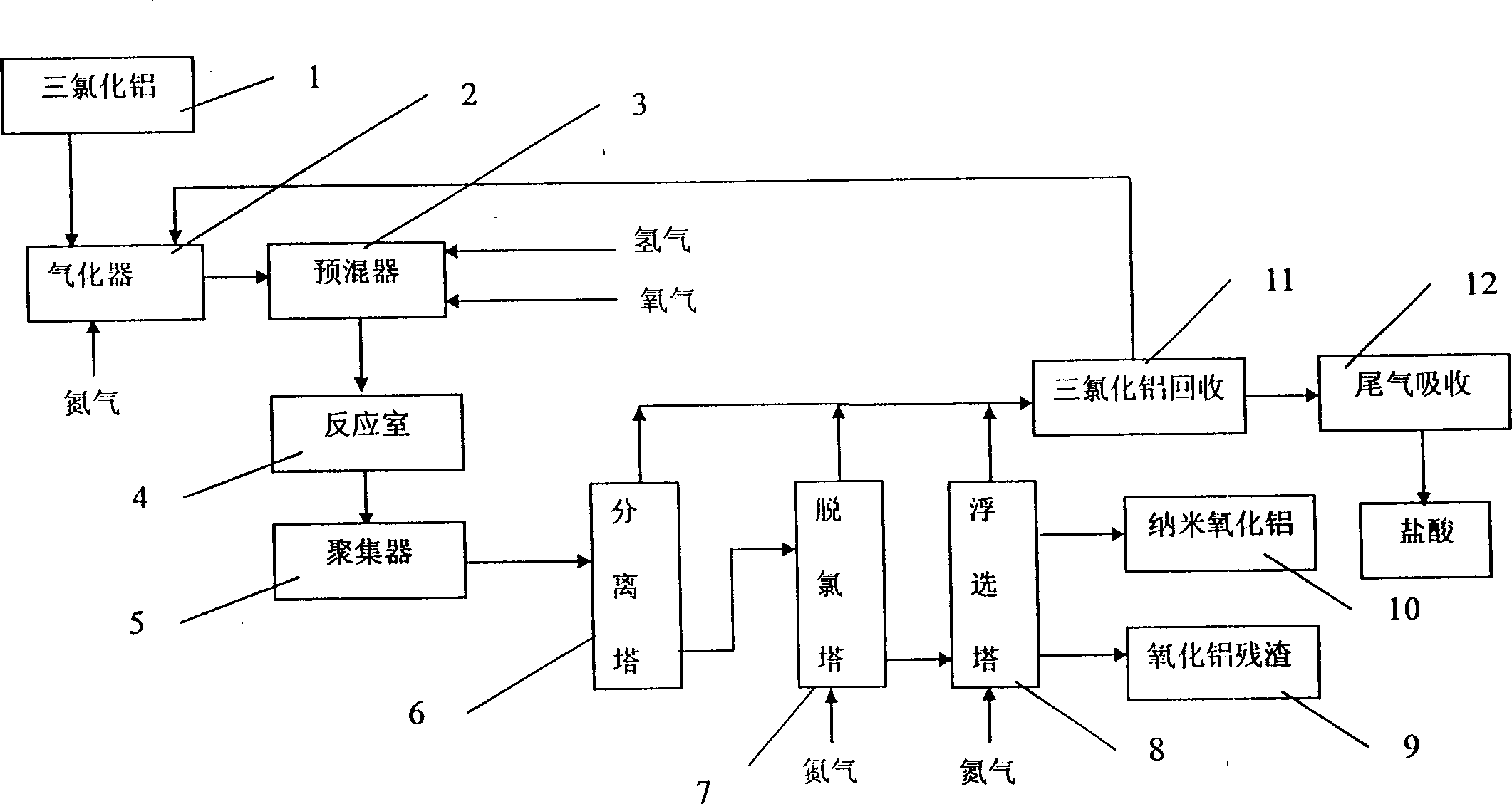
Figure 1
Abstract
Description
Technical field
[0001] The invention relates to a continuous preparation process of high-purity nano alumina. Background technique
[0002] As a new type of high-functional fine inorganic material, nano-alumina is widely used in the fields of catalysis, ceramics, cutting tools, aerospace and functional materials due to its high hardness, high heat resistance and corrosion resistance. The preparation methods of high-purity nano alumina currently reported mainly include sol-gel method, liquid phase precipitation method, micro-emulsion method, aluminum alkoxide hydrolysis method, aluminum ammonium sulfate thermal decomposition method, critical liquid drying method, electrochemical method, etc. . These methods all need to first precipitate the aluminum ions in the solution to prepare the alumina precursor, and then obtain the nano-alumina products through processes such as cleaning, drying, and high-temperature calcination. Therefore, these preparation methods can be summarized as pr...
Examples
Embodiment 1
[0022] Press the aluminum trichloride, hydrogen, and air to 5.5m 3 / h, 9.0m 3 / h、23.0m 3 The flow rate of / h (standard volume) is input to the premixer, and the reaction is carried out according to the above process. The temperature at the bottom of the reaction chamber (the entrance of the accumulator) is 950℃, the temperature in the first half of the accumulator is 950~600℃, and the temperature in the second half is 600~ 300°C. The temperature of the dechlorination tower is 350~500℃. The obtained nano alumina indicators are as follows:
[0023] Alumina content (%) 99.85 (atomic absorption spectrophotometer method)
[0024] Average particle size of primary particles (nm) 30 (electron microscope statistical method)
[0025] Chlorine content (%) 0.012 (potentiometric titration)
Embodiment 2
[0027] Press the aluminum trichloride, hydrogen, and air to 5.5m 3 / h、10m 3 / h、28m 3 The flow rate of / h (standard volume) is input to the premixer, and the reaction is carried out according to the above process. The temperature at the bottom of the reaction chamber (at the entrance of the accumulator) is 800℃, the temperature in the first half of the accumulator is 800~550℃, and the temperature in the second half is 550~ 300°C. The temperature of the dechlorination tower is 350~500℃. The obtained nano alumina indicators are as follows:
[0028] Alumina content (%) 99.90 (atomic absorption spectrophotometer method)
[0029] Average particle size of primary particles (nm) 12 (electron microscope statistical method)
[0030] Chlorine content (%) 0.018 (potentiometric titration).