
3-substituted 1,2,3.4-tetrahydro-quinazine derivative, its synthesis and use
A technology of tetrahydroquinoline and derivatives, which is applied in the field of 3-substituted 1, can solve the problems of limited synthesis conditions of quinoline derivatives, difficulty in preparing 3-aryl groups, and difficult operation, so as to avoid hydrogenation and reduction response, treatment of cerebral ischemia, effects of mild conditions
Patent Information
- Authority / Receiving Office
- CN · China
- Current Assignee / Owner
- Publication Date
- 2006-08-16
- Estimated Expiration
- Not applicable · inactive patent
Smart Images
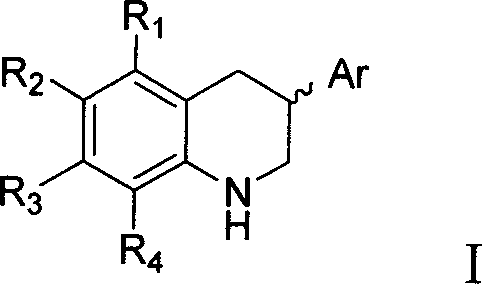
Figure 1 
Figure 2 
Figure 3
Abstract
Description
technical field
[0001] The present invention relates to 3-substituted 1,2,3,4-tetrahydroquinoline derivatives and their synthesis methods and applications, more specifically, to 1,2,3,4-tetrahydroquinoline derivatives substituted by aryl at the 3-position Hydroquinoline derivatives and their synthesis methods and uses. Background technique
[0002] Tetrahydroquinoline and tetrahydroisoquinoline widely exist in nature, 1,2,3,4-tetrahydroquinoline compounds have the activities of inhibiting vasodilation, antiarrhythmia and antitumor, and also have the effect of immunosuppressant , is also a more characteristic dye intermediate.
[0003] Many tetrahydroquinoline derivatives are considered to be strong affinity ligands at the glycine position of the DMAD receptor, and are also a convenient factor for the transmission of norepinephrine, and they are also inotropic sensitizers that do not affect the operation of calcium ions in cells, so It is a potential drug for treating cereb...
Examples
preparation example Construction
[0024] The synthesis method comprises: under alkaline conditions, substituted o-nitrobenzaldehyde or o-aminobenzaldehyde and aryl acetonitrile derivatives are condensed into an acrylonitrile compound of structural formula A; the acrylonitrile compound of structural formula A is The reduction reaction reduces to the propionitrile compound of the structural formula B; then the ring is closed under catalytic hydrogenation conditions to generate 3-substituted 1,2,3,4-tetrahydroquinoline derivatives.
[0025] Wherein, in the substituted o-nitrobenzaldehyde or o-aminobenzaldehyde and aryl acetonitrile derivatives condensed into the acrylonitrile compound of structural formula A, the base used can be an inorganic base, such as potassium carbonate; it can also be an organic base, Such as organic amines, sodium or potassium alcoholate. The amount of base is 10%-100% molar ratio of any reactant.
[0026] The acrylonitrile compound of structural formula A is reduced into the propionitri...
Embodiment 1
[0031] The preparation of the acrylonitrile compound of structural formula A
[0032] (1) Preparation of (Z)-3-(2-nitrophenyl)-2-phenylacrylonitrile (A-1)
[0033] Completely dissolve 0.23g (10mmol) of sodium in 50mL of absolute ethanol, add 15.12g (100mmol) of 2-nitrobenzaldehyde and 11.71g (100mmol) of phenylacetonitrile under stirring, stir at room temperature for 4h, filter, and wash with absolute ethanol to obtain Bright yellow solid 23.00g, yield 92.0%.
[0034] 1 HNMR (300MHz, CDCl 3 )δ7.42-7.53 (m, 3H), 7.64 (t, J=8.2, 1H), 7.73 (dd, J=1.7, 8.1, 2H), 7.80 (t, J=7.6, 1H), 7.95 (d , J=7.6, 1H), 8.06 (s, 1H), 8.26 (d, J=8.3, 1H); MS (EI): m / e (%) 250 (16M + ), 119(100), 92(84).
[0035] (2) Preparation of (Z)-2-(4-methoxyphenyl)-3-(2-nitrophenyl)-acrylonitrile (A-2)
[0036] 2-nitrobenzaldehyde and 4-methoxyphenylacetonitrile were carried out according to the method described in Example 1.(1) to obtain compound A-2 with a yield of 74.2%.
[0037] 1 HNMR (300MHz, C...
Embodiment 2
[0096] The preparation of the propionitrile compound of structural formula B
[0097] (1) Preparation of 3-(2-nitrophenyl)-2-phenylpropionitrile (B-1)
[0098] Dissolve 5.00g (20mmol) (Z)-3-(2-nitrophenyl)-2-phenyl-acrylonitrile in 20mL of anhydrous tetrahydrofuran, and add 1.13g (30mmol) sodium borohydride in batches under an ice-water bath , stirred at room temperature; after TLC monitoring of no raw materials, quenched with 1mol / L HCl, concentrated under reduced pressure to remove tetrahydrofuran, then extracted with ethyl acetate, washed with saturated sodium chloride solution, dried the organic phase with anhydrous magnesium sulfate, filtered, and concentrated under reduced pressure to obtain yellow Solid 4.80g, yield 92.0%. The next reaction was carried out directly without purification.
[0099] 1 HNMR (300MHz, CDCl 3 )δ 3.22 (dd, J=10.3, 13.3, 1H), 3.54 (dd, J=5.2, 13.1, 1H), 4.39 (dd, J=5.1, 10.8, 1H), 7.32-7.53 (m, 7H) , 7.60-7.66 (m, 1H), 8.08 (d, J=8.1, 1H); M...