
Pyrido[3,4-d]pyrimidine derivative and pharmaceutically acceptable salt thereof
a technology of pyrimidine and derivative, which is applied in the direction of heterocyclic compound active ingredients, drug compositions, cardiovascular disorders, etc., can solve the problems of excessive cell cycle progression, and achieve the effect of superior cdk4/6 inhibitory activity
Patent Information
- Authority / Receiving Office
- US · United States
- Patent Type
- Patents(United States)
- Current Assignee / Owner
- Publication Date
- 2018-11-13
Smart Images
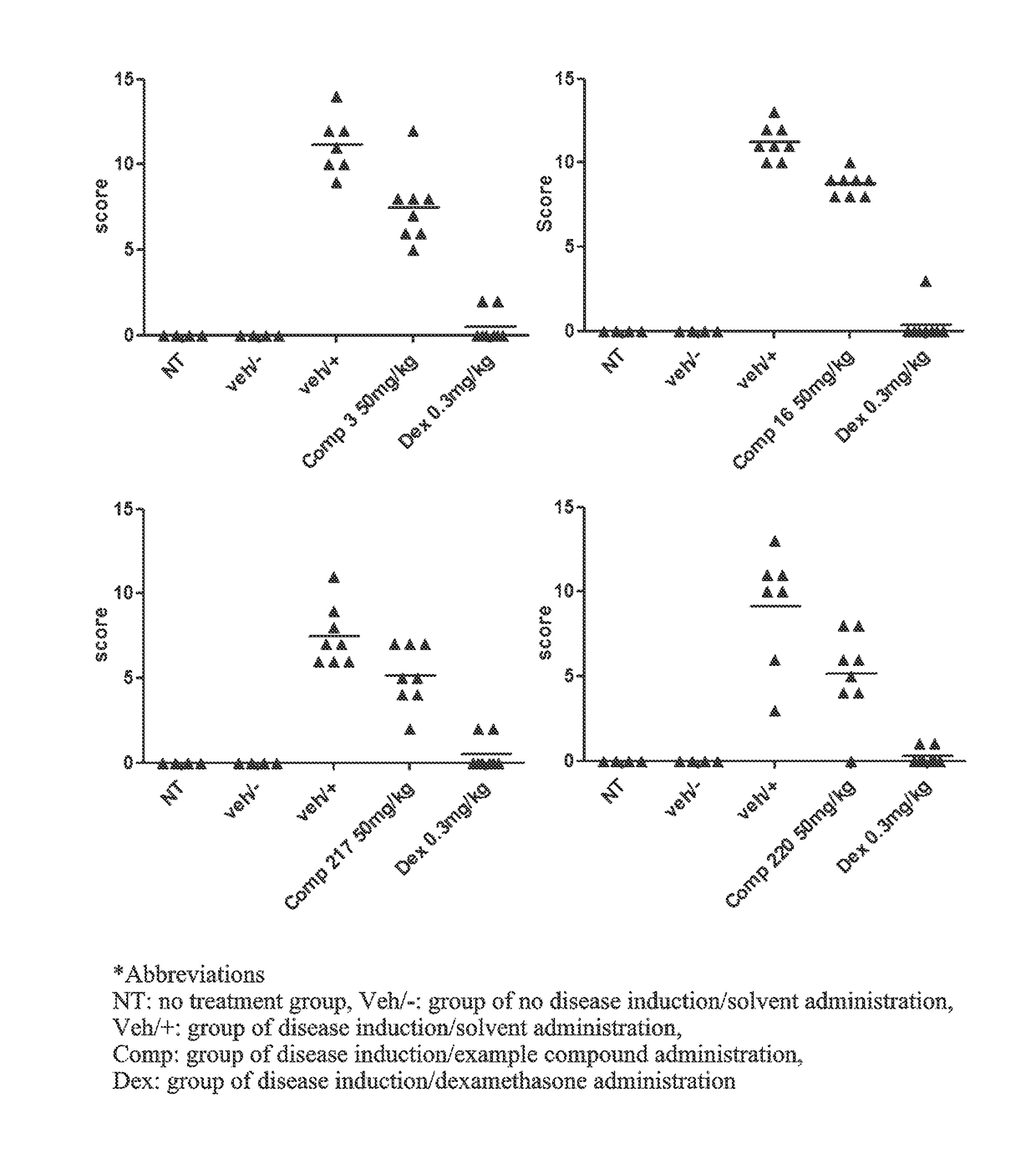
Figure 1 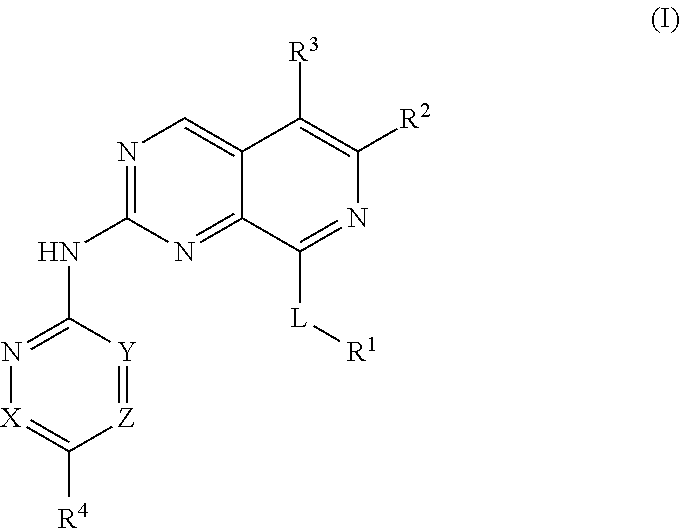
Figure 2 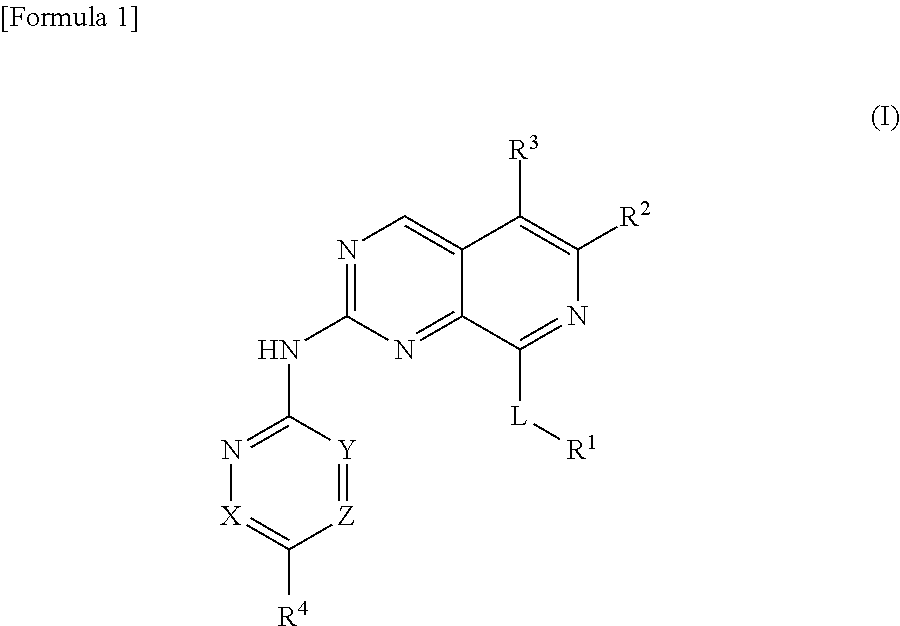
Figure 3
Abstract
Description
CROSS REFERENCE TO RELATED APPLICATIONS
[0001] This application is a National Stage of International Application No. PCT / JP2016 / 065770 filed May 27, 2016, claiming priority based on Japanese Patent Application No. 2015-110684 filed May 29, 2015, the contents of all of which are incorporated herein by reference in their entirety.TECHNICAL FIELD
[0002] The present invention relates to a pyrido[3,4-d]pyrimidine derivative and a pharmaceutically acceptable salt thereof. In particular, the present invention relates to a compound that exhibits an inhibitory activity against cyclin-dependent kinase 4 and / or cyclin-dependent kinase 6 (hereinafter referred to as “CDK4 / 6”) and that is useful for the prevention or treatment of rheumatoid arthritis, arteriosclerosis, pulmonary fibrosis, cerebral infarction, or cancer.BACKGROUND ART
[0003] Cell growth, which is a process involving proliferation and division of cells, occurs in response to various stimuli.
[0004] Pathological conditions caused by hyperpr...
Examples
reference example 1
Synthesis of 5-bromo-2-(methylthio)pyrimidine-4-carboxylic acid
[0283]
[0284]Mucobromic acid (300 g, 1.16 mol) was added to an aqueous solution (2.5 L) of 2-methyl-2-pseudothiourea sulfate (324 g, 1.16 mol) at room temperature. The resultant suspension was cooled to 0° C. with stir, and triethylamine (486 mL, 3.49 mol) was added dropwise thereto over four hours. The resultant reaction mixture was stirred overnight, and the completion of the reaction was confirmed by silica gel TLC. The reaction mixture was then acidified with concentrated hydrochloric acid (about 250 mL). The resultant yellow solid was collected by filtration and washed twice with water (500 mL) and then twice with diethyl ether (500 mL). The solid was dried under reduced pressure to yield the title compound (160 g, 55%).
reference example 2
Synthesis of methyl 5-bromo-2-methylthiopyrimidine-4-carboxylate
[0285]
[0286]A solution of 5-bromo-2-(methylthio)pyrimidine-4-carboxylic acid (110 g, 0.44 mol) in methanol (1.1 L) was cooled to 0° C. with stir, and thionyl chloride (50 mL, 0.66 mol) was added dropwise thereto. The resultant reaction mixture was slowly heated, and the reaction was allowed to proceed under reflux for four hours. The completion of the reaction was confirmed by LC / MS and TLC, and the reaction mixture was cooled to room temperature. The volatiles were removed through evaporation under reduced pressure, and the residue was dissolved in ethyl acetate (1 L). The resultant solution was washed three times with 10% aqueous sodium carbonate solution (200 mL) and then twice with saturated brine (200 mL). The resultant organic phase was dried over anhydrous magnesium sulfate, and solid was separated by filtration. The filtrate was then concentrated under reduced pressure, and the resultant crude product was purifi...
reference example 3
Synthesis of Mixture of 5-bromo-2-methylthiopyrimidine-4-carbaldehyde and (5-bromo-2-methylthiopyrimidin-4-yl)methoxymethanol
[0287]
[0288]A solution (375 mL) of methyl 5-bromo-2-methylsulfanylpyrimidine-4-carboxylate (25 g, 95 mmol) in THF was cooled to −78° C. and stirred under a nitrogen atmosphere. DIBAL-H (84 mL, 143 mmol, 1.7M toluene solution) was added dropwise to the THF solution, and the mixture was stirred at −78° C. for four hours. The completion of the reaction was confirmed by TLC, and the reaction was quenched through dropwise addition of methanol at −78° C. The resultant reaction mixture was allowed to warm slowly to 0° C. and diluted with ethyl acetate, and the mixture was filtrated through celite. The filtrate was washed twice with saturated brine (200 mL), and the resultant organic phase was dried over anhydrous magnesium sulfate. The resultant solid was separated by filtration, and the filtrate was concentrated to yield the title compound mixture (25 g, crude produ...