
Systems and methods for gated offer eligibility verification
Patent Information
- Authority / Receiving Office
- US · United States
- Current Assignee / Owner
- Publication Date
- 2022-05-17
Smart Images
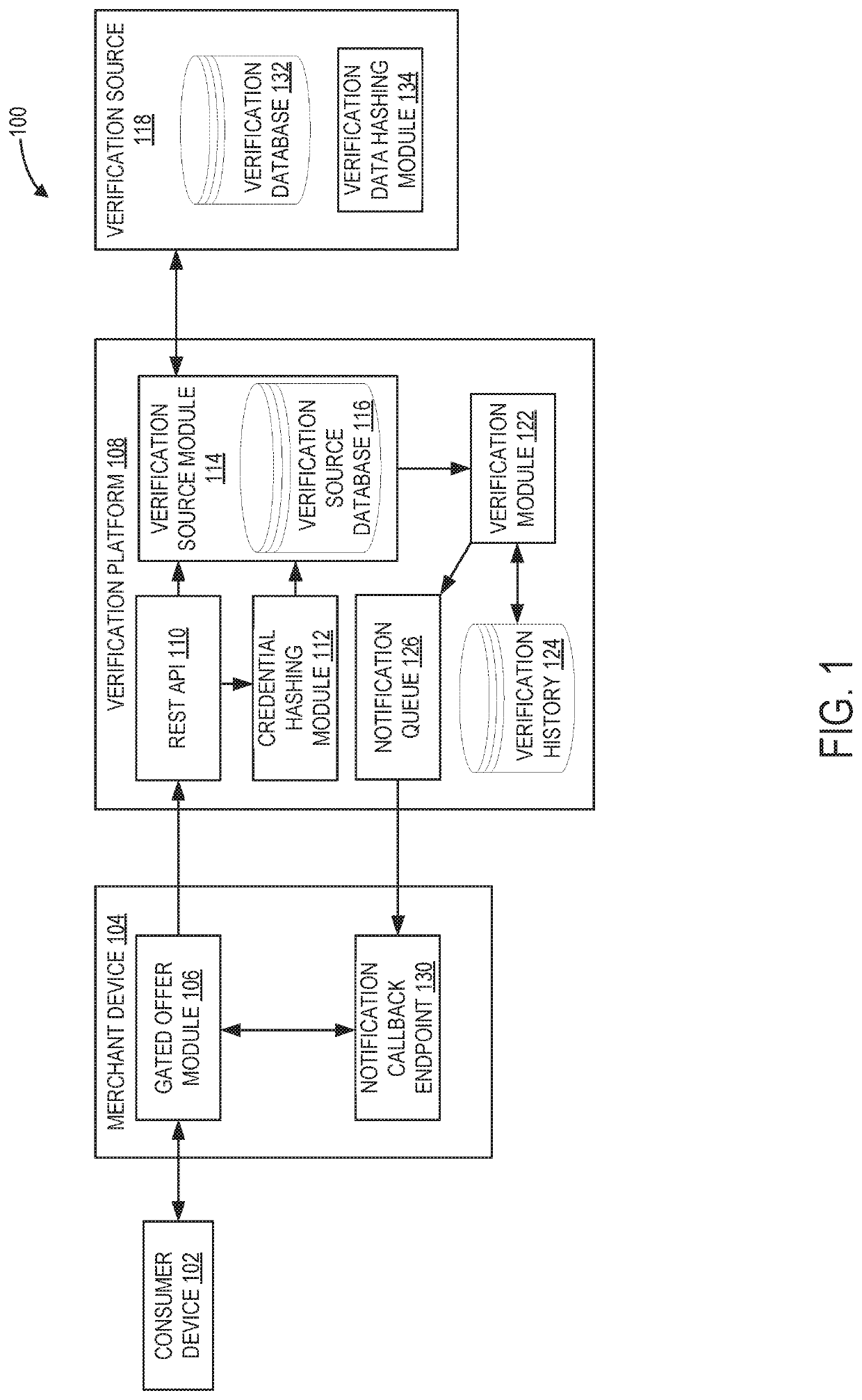
Figure 1 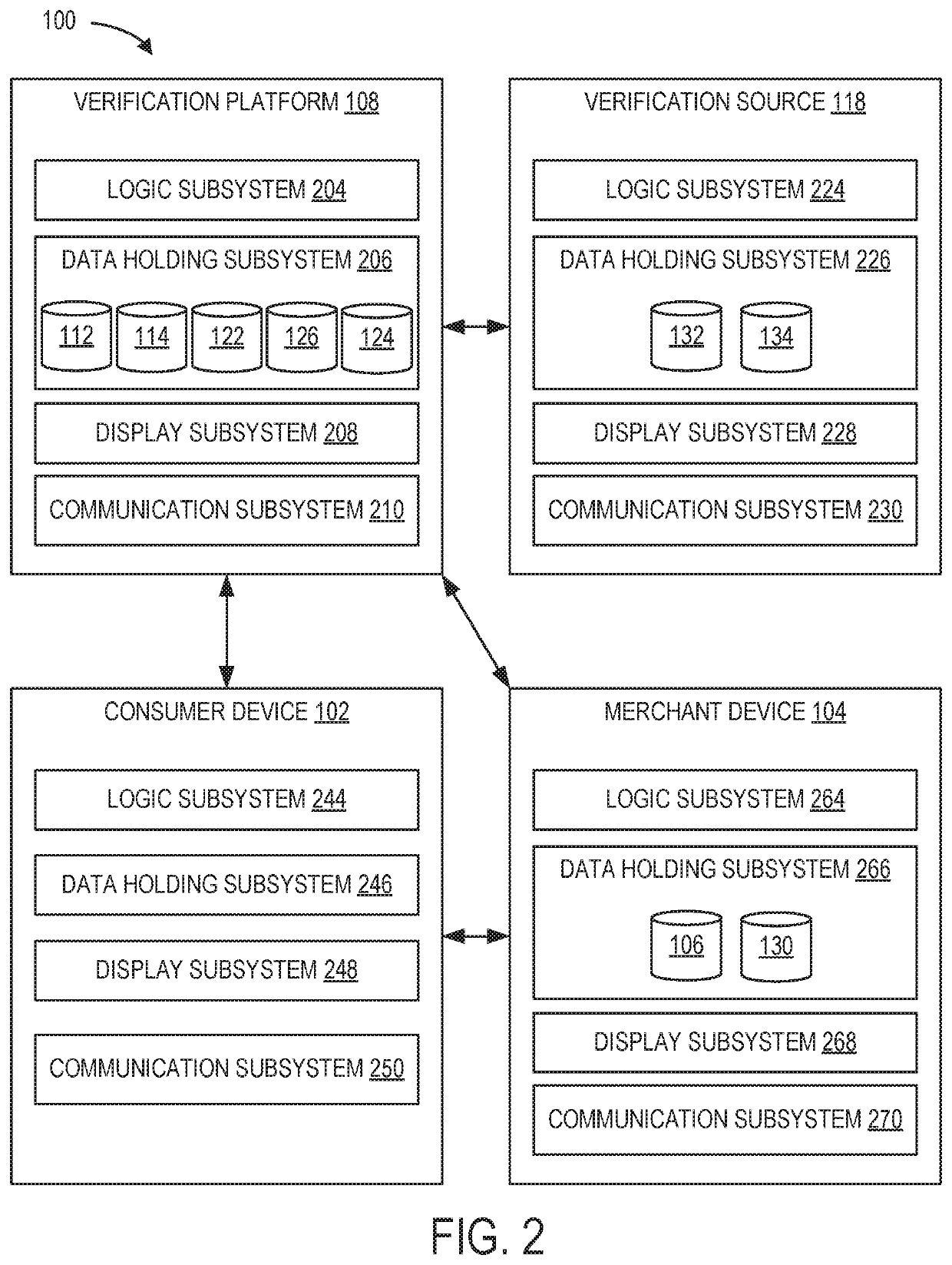
Figure 2 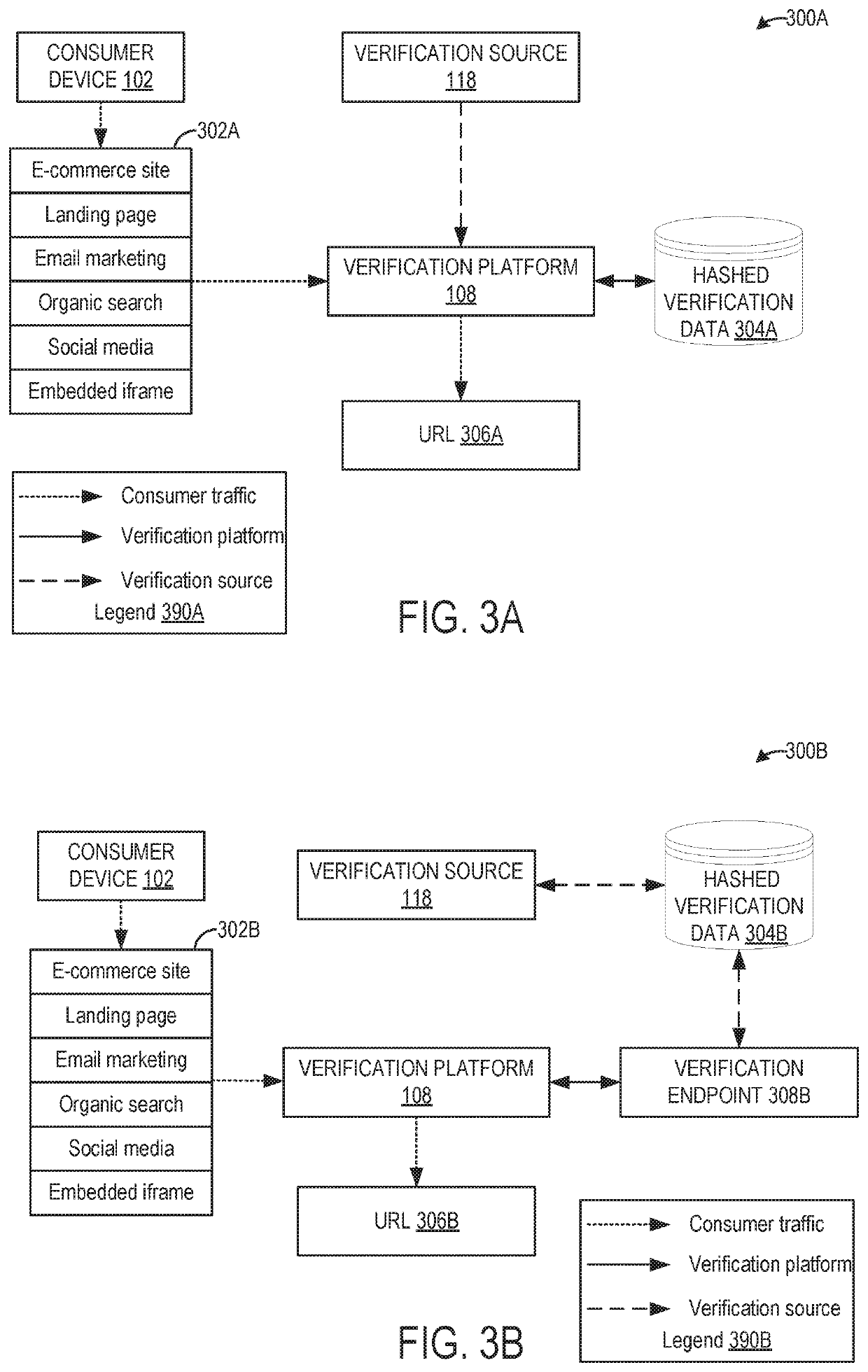
Figure 3
Abstract
Description
TECHNICAL FIELD
[0001] Embodiments of the subject matter disclosed herein relate to gated offer eligibility determination, and more particularly, to systems and methods for automatically determining gated offer eligibility of a consumer using a verification platform.BACKGROUND AND SUMMARY
[0002] Gated offers may be provided by merchants to attract new customers, increase customer satisfaction, increase customer loyalty, or influence a consumer's spending behavior. In one example, merchants may use gated offers to attract a particular demographic of consumer by tailoring a gated offer specifically for the demographic. Gated offers are targeted, gated promotions designed for members of a particular group / demographic based on their occupation, life stage or affiliation, such as “college student” or “member of the military.” One reason gated offers have been shown to increase customer satisfaction and brand loyalty are the positive feelings evoked in the consumer in response to receiving a ...
Examples
second embodiment
[0021]FIGS. 3A and 3B illustrate a first and second embodiment, respectively, of consumer traffic during an eligibility status verification process. FIGS. 3A and 3B show how a consumer, via a consumer device 102, may be directed to verification platform 108 through a plurality of channels (302A and 302B) to obtain access to a gated offer. The user may submit credentials to the verification platform, to evidence eligibility for the gated offer, and the verification platform 108 may then determine an eligibility status based on the credentials, and may, in some examples, direct the consumer to a pre-determined URL (such as URL 306A and / or 306B) based on the eligibility status.
[0022]The verification platform 108 may receive an eligibility claim from the merchant device 104 and supporting credentials from the consumer device 102, and may execute a method, such as method 400 shown in FIG. 4, to intelligently select one or more verification sources based on the eligibility claim and the c...
first embodiment
[0024]FIG. 5 shows a method 500 for comparing consumer credentials against verification data from a selected verification source. Method 500 may be executed as part of method 400. Method 500 comprises hashing credentials using a seed hash to obtain hashed credentials, and comparing the hashed credentials against a hashed dataset, previously obtained by the verification platform from the selected verification source. The verification platform may acquire the hashed dataset during the on-boarding process of the selected verification source, according to one or more of the steps of methods 600A and 600B, shown in FIGS. 6A, and 6B, respectively. Hashing is a one way (substantially irreversible), repeatable, mapping of an input string to an output string (wherein the output string is referred to as a hash), and therefore provides a way to compare data in an obfuscated form. As it is computationally impractical to derive the input string from the output hash alone, hashing provides a secu...