
Novel beta-lactam compounds and process for producing the same
Patent Information
- Authority / Receiving Office
- US · United States
- Current Assignee / Owner
- Publication Date
- 2004-05-27
- Estimated Expiration
- Not applicable · inactive patent
Smart Images
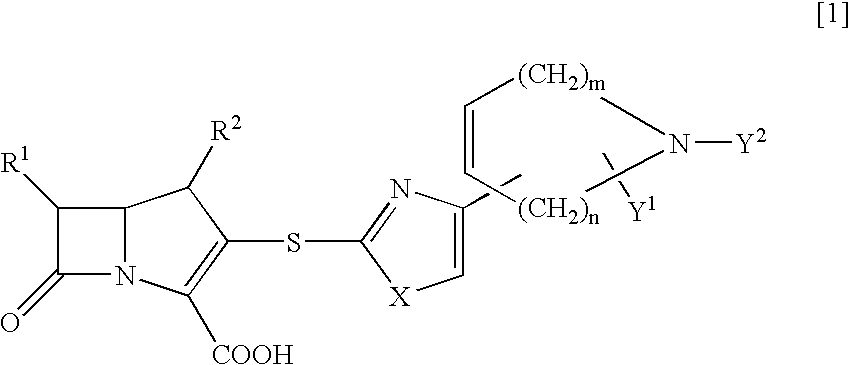
Figure 1 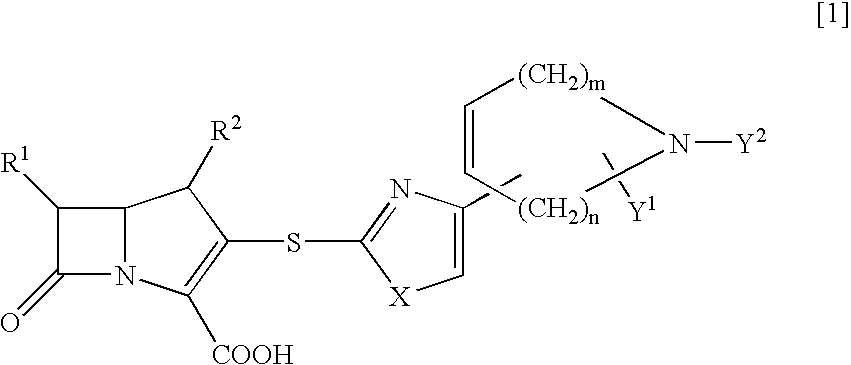
Figure 2 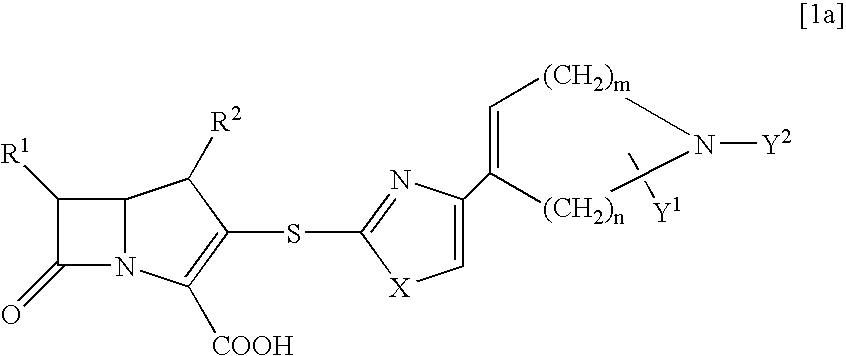
Figure 3
Abstract
Description
[0001] The present invention relates to a novel .beta.-lactam compound represented by the formula [1] as described below.
[0002] By the wide clinical application of the third-generation cephalosporins, Gram-positive bacteria have become to be frequently isolated. Particularly, methicillin-resistant Staphylococcus aureus (hereinafter, abbreviated as MRSA) has been more frequently isolated, and becomes a serious problem in clinical field, because infectious diseases caused by MRSA are difficult to be treated. Although vancomycin has been broadly used for infectious diseases caused by MRSA in these days, it has a defect in difficulty of administration because of its side effects, and further glycopeptide-resistant bacteria are supposed to increase in future by administration thereof. Moreover, it has recently been reported increase in isolation of methicillin-resistant and coagulase-negative Staphylococci (MRCNS). Under these circumstances, it has been desired to develop a safer medicam...
Examples
example 2
[0118] 86
[0119] a) In the same manner as in Example 1, by using allyl (2R)-2-methyl-4-(2-mercapto-1,3-thiazol-4-yl)-2,5-dihydro-1H-pyrrole-1-ca-rboxylate as a thiol compound, there was obtained allyl (4R,5S,6S)-3-[(4-{(5R)-1-[(allyloxy)carbonyl]-5-methyl-2,5-dihydro-1H-pyr-rol-3-yl}-1,3-thiazol-2-yl)sulfanyl]-4-methyl-7-oxo-6-{(1R)-1-[(trimethyls-ilyl)oxy]ethyl}-1-azabicyclo[3.2.0]hept-2-ene-2-carboxylate.
[0120] .sup.1H NMR (300 MHz, CDCl.sub.3) .delta. 0.11 (9H, s), 1.08-1.12 (3H, m), 1.22-1.25 (3H, m), 1.37-1.43 (3H, m), 3.24 (1H, dd, J=6.2, 2.9 Hz), 3.37-3.58 (1H, m), 4.17-4.24 (2H, m), 4.40-4.87 (7H, m), 5.21-5.50 (4H, m), 5.91-6.05 (2H, m), 6.34-6.38 (1H, m), 7.10-7.14 (1H, m).
[0121] b) To a solution of allyl (4R,5S,6S)-3-[(4-{(5R)-1-[(allyloxy)carbo-nyl]-5-methyl-2,5-dihydro-1H-pyrrol-3-yl}-1,3-thiazol-2-yl)sulfanyl]-4-met-hyl-7-oxo-6-[(1R)-1-[(trimethylsilyl)oxy]ethyl]-1-azabicyclo[3.2.0]hept-2--ene-2-carboxylate (42 mg, 0.070 mmol) in ethyl acetate (4 ml) was added water and...
example 3
[0123] 87
[0124] a) A solution of lithium hexamethyldisilazide in THE (1M, 1.26 ml, 1.26 mmol) was added at 0.degree. C. to a solution of allyl (6S)-6-methyl-4-(2-mercapto-1,3-thiazol-4-yl)-3,6-dihydro-1(2H)-pyridine carboxylate (373 mg, 1.26 mmol) in THF (15 ml) and the mixture was stirred for 10 minutes. To the reaction solution was added at 0.degree. C. a solution of allyl (4R,5R,6S)-3-[(diphenoxyphosphino)oxy]-4-methyl-7--oxo-6-{(1R)-1-[(trimethylsilyl)oxy]ethyl}-1-azabicyclo[3.2.0]hept-2-ene-2--carboxylate in acetonitrile (30%, 4.80 g, 2.52 mmol) and the solution was allowed to stand in a refrigerator for 60 hours. To the reaction solution was added ice water and the reaction mixture was extracted with ethyl acetate. The organic layer was washed with a saturated aqueous sodium chloride solution and dried over anhydrous sodium sulfate. After removal of the solvent in vacuo, the residue was purified with silica gel chromatography (hexane / ethyl acetate) to give allyl (4R,5S,6S)-3-[...
example 4
[0130] 88
[0131] a) In the same manner as in Example 1, by using allyl (6R)-6-methyl-4-(2-mercapto-1,3-thiazol-4-yl)-3,6-dihydro-1(2H)-pyridine carboxylate as a thiol compound, there was obtained allyl (4R,5S,6S)-3-[(4-{(6R)-1-[(allyloxy)carbonyl]-6-methyl-1,2,3,6-tetrahydro--4-pyridinyl}-1,3-thiazol-2-yl)sulfanyl]-4-methyl-7-oxo-6-{(1R)-1-[(trimet-hylsilyl)oxy]ethyl}-1-azabicyclo[3.2.0]hept-2-ene-2-carboxylate.
[0132] .sup.1H NMR (300 MHz, CDCl.sub.3) .delta. 0.09 (9H, s), 1.04-1.10 (3H, m), 1.15-1.29 (6H, m), 2.34-2.57 (2H, m), 2.96-3.11 (1H, m), 3.19-3.24 (1H, m), 3.38-3.58 (1H, m), 4.13-4.38 (3H, m), 4.59-4.85 (5H, m), 5.16-5.48 (4H, m), 5.85-6.02 (2H, m), 6.61 (1H, m), 7.08-7.10 (1H, m).
[0133] b) In the same manner as in Example 2, by using allyl (4R,5S,6S)-3-[(4-{(6R)-1-[(allyloxy)carbonyl]-6-methyl-1,2,3,6-tetrahydro--4-pyridinyl}-1,3-thiazol-2-yl)sulfanyl]-4-methyl-7-oxo-6-{(1R)-1-[(trimet-hylsilyl)oxy]ethyl}-1-azabicyclo[3.2.0]hept-2-ene-2-carboxylate, there was obtained (4R,...