
High throughput screening of potential displacer molecules
a potential displacer and high throughput technology, applied in the direction of immunoglobulins, peptides, separation processes, etc., can solve the problems of physical and chemical similarities between the desired product and the impurities that require laborious multiple separations, and the productivity of synthetic processes is often limited, so as to achieve rapid assessment of the potential efficacy of each candida
Patent Information
- Authority / Receiving Office
- US · United States
- Patent Type
- Applications(United States)
- Current Assignee / Owner
- Publication Date
- 2005-08-11
- Estimated Expiration
- Not applicable · inactive patent
Smart Images
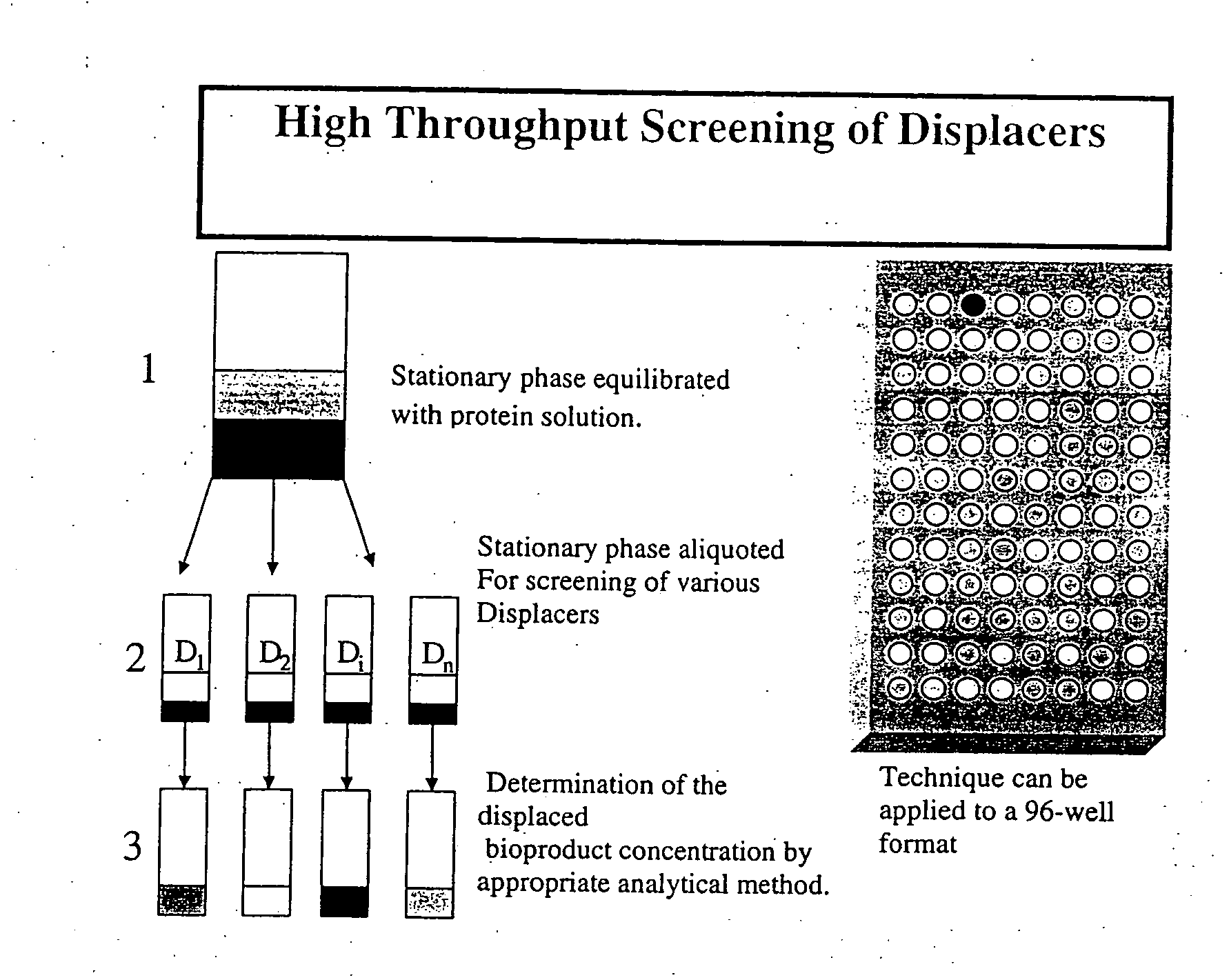
Figure 1 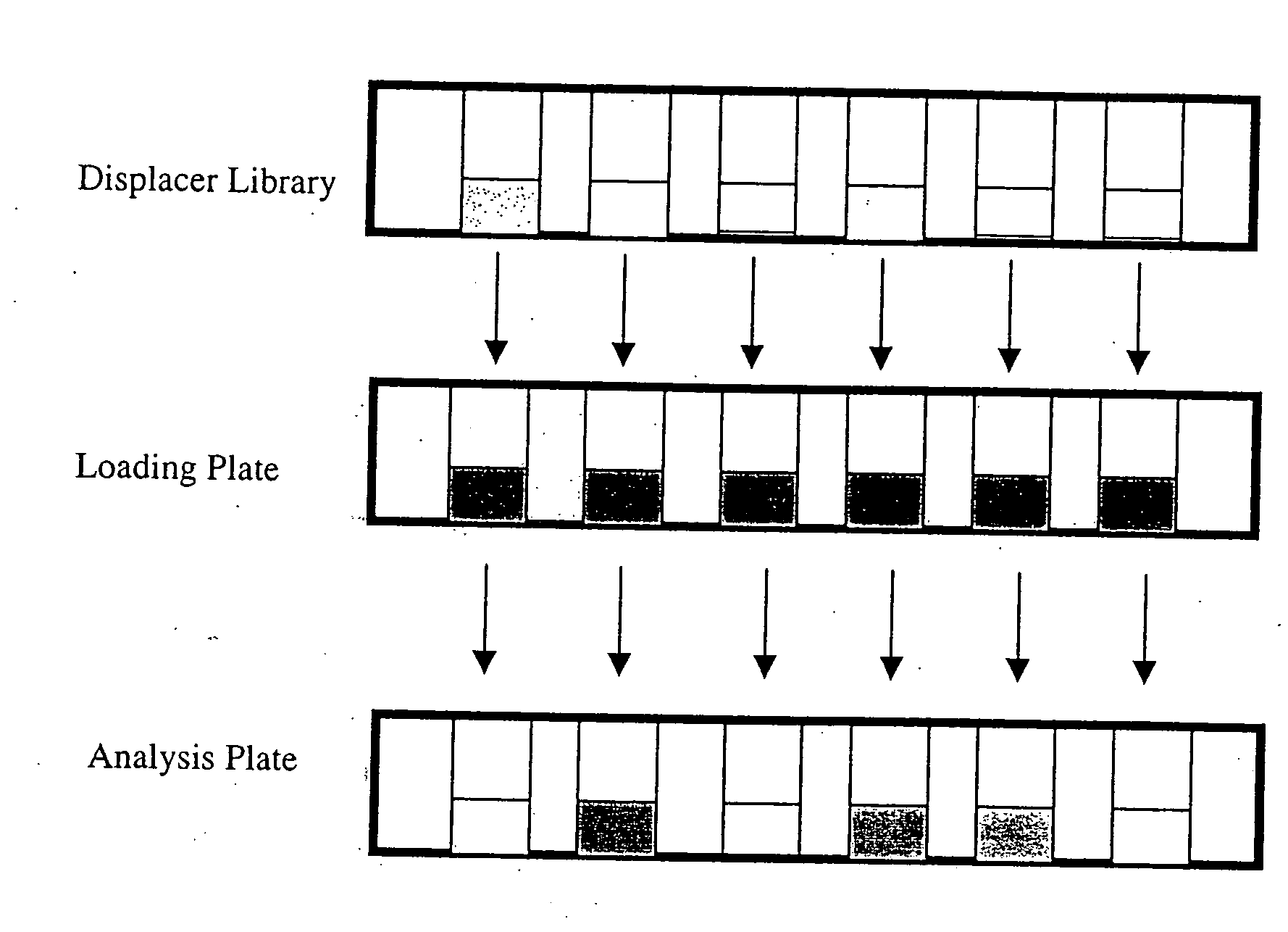
Figure 2 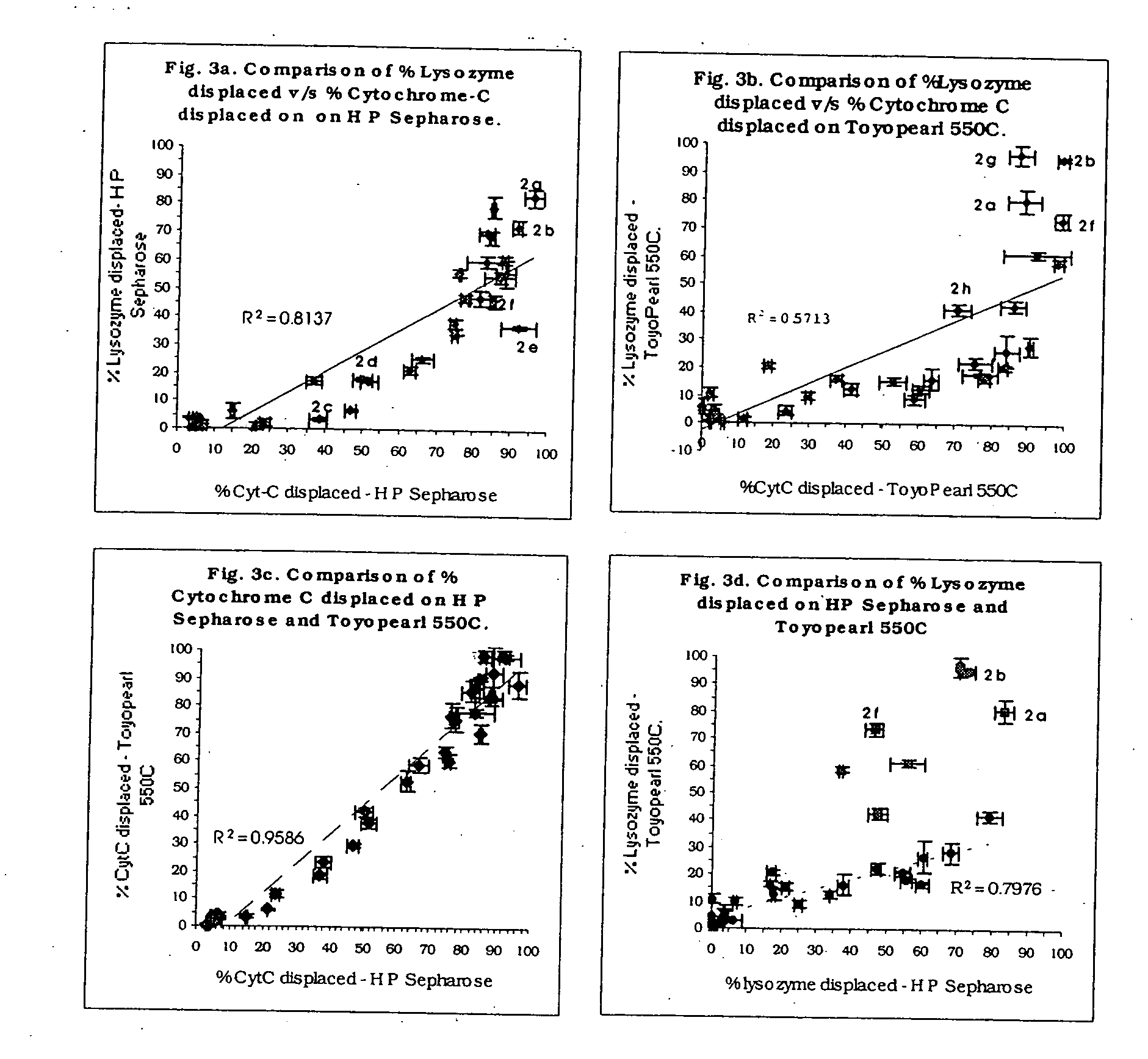
Figure 3
Abstract
Description
CROSS-REFERENCE TO RELATED APPLICATIONS
[0001] This application is a continuation-in-part of U.S. application Ser. No. 09 / 791,317, filed on Feb. 23, 2001, which claims the benefit of U.S. Provisional Application No. 60 / 184,357, filed Feb. 23, 2000. The entire disclosure of U.S. application Ser. No. 09 / 791,317 and U.S. Provisional Application No. 60 / 184,357 is incorporated herein by reference.STATEMENT AS TO RIGHTS UNDER FEDERALLY SPONSORED RESEARCH
[0002] This invention was made with support from the National Institutes of Health under Grant No. GM47372-04A2. The United States government may have certain rights in the invention.BACKGROUND OF THE INVENTION
[0003] Biological macromolecules such as proteins and polynucleotides have become of increasing commercial interest in medicine as pharmaceutical products. Productivity of synthetic processes is frequently limited by purification methods available. Products of biosyntheses are frequently contaminated by structurally similar impurit...
Examples
example 1
High Throughput Screening of Displacer Candidates for Protein Separation by Ion Exchange Chromatography
Materials
[0071] High Performance S P Sepharose stationary phase material was obtained from Amersham Pharmacia (Uppsala, Sweden). Toyopearl 550 C strong cation exchange resin was obtained from TosoHaas (Montgomeryville, Pa., USA). Phenomenex Jupiter C4 10 μm (250×4.6 mm) column was obtained from Phenomenex, Torrance, Calif., USA.
[0072] The potential displacer molecules 2,2 dimethyl-1, 3 propanediamine, 3,3′-diamino-N-methyl-dipropylamine, 5-amino-1,3,3-trimethyl cyclohexane methylamine, butylamine, N,N,N′,N′-tetrakis-(3-aminopropyl)-1,4-butanediamine (DAB(Am)4, polypropyleneaminetetramine dendrimer Gen. 1) diethylenetriamine, hydroxylamine, malonamamidine, malonamide, methylamine, N-methyl-1,3-propanediamine, N,N′-bis-(2-aminoethyl)-1,3-propanediamine, N,N′-bis-(3-aminopropyl)-1,3-propanediamine, N,N′-diethyl-1,3-propanediamine, N,N′N″-trimethyl bis(hexamethylene)triamine, 2-(am...
example 2
High Throughput Screening of Displacer Candidates for Chemically Selective Separation of Proteins by Ion Exchange Chromatography
[0083] A solution of α-chymotrypsinogen A and Ribonuclease A in 50 mM phosphate buffer, pH 6.0 was prepared to a final concentration of 1.5 mg / ml of each protein. HP Sepharose (3 ml) was washed with the buffer and was equilibrated with 36 ml of protein solution above for four hours. The supernatant was removed and analyzed by linear gradient reversed phase chromatography using UV detection at 280 nm. A portion (25 μl) of the stationary phase resin with the two proteins were transferred to vials. As before, 300 μl of a 10 mM displacer solution were added to each aliquot and the system was allowed to equilibrate for 4 hours at 20° C. The supernatant was analyzed by linear gradient reversed phase chromatography using UV detection at 280 nm. The mass of protein in the supernatant was determined and the percent protein displaced was calculated. Results are show...
example 3
Chemically Selective Displacement Chromatography of Apoferritin / Amyloglucosidase Mixture
Experimental Protocol
Materials
[0085] Source 15Q (15 μm) strong anion exchange stationary phase material was donated by Amersham Biosciences (Uppsala, Sweden) and the stationary phase was slurry packed into a 50×5 mm I.D. column. TSK-Gel G3000SWXL size exclusion column (300×7.8 mm I.D.) and a TSK-Gel SWXL (40×6 mm I.D.) guard column were donated by TOSOH BIOSEP (Montgomeryville, Pa., USA). Amyloglucosidase and apoferritin were purchased from Sigma (St. Louis, Mo., USA) and ICN Biomedicals, Inc. (Aurora, Ohio, USA), respectively. Sodium chloride and sodium sulfate were purchased from Fisher Scientific (Pittsburgh, Pa., USA). Tris-HCl and Tris-base were purchased from Sigma. Tartrazine and sucrose octasulfate (SOS) were purchased from Aldrich (Milwaukee, Wis., USA) and Toronto Research Chemicals, Inc. (Ontario, Canada), respectively.
Apparatus
[0086] Linear gradients were run on a Pharmacia fa...