
Detection of protease-resistant prion protein following a spontaneous transformation reaction
Patent Information
- Authority / Receiving Office
- US · United States
- Current Assignee / Owner
- Publication Date
- 2006-07-27
- Estimated Expiration
- Not applicable · inactive patent
Smart Images
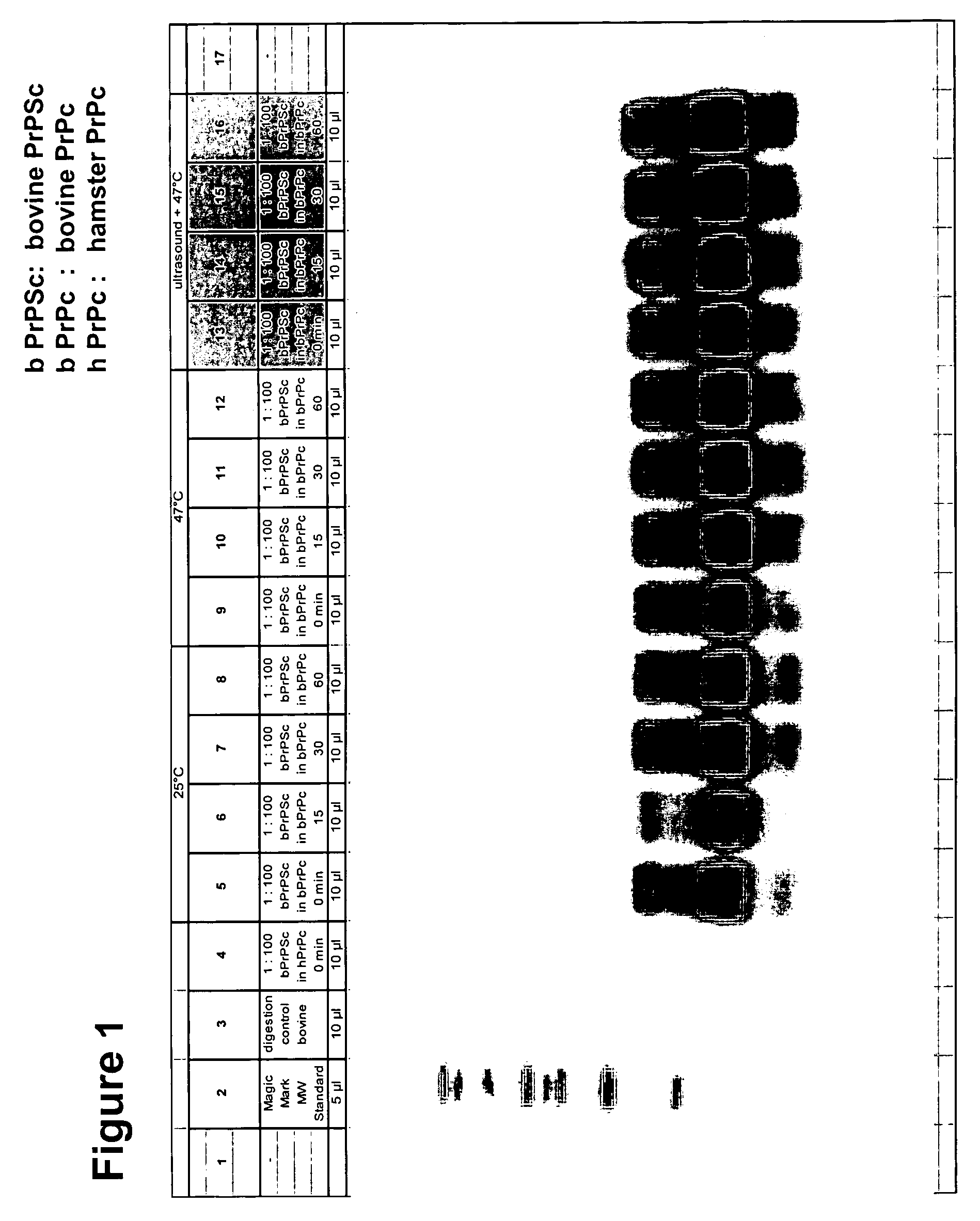
Figure 1 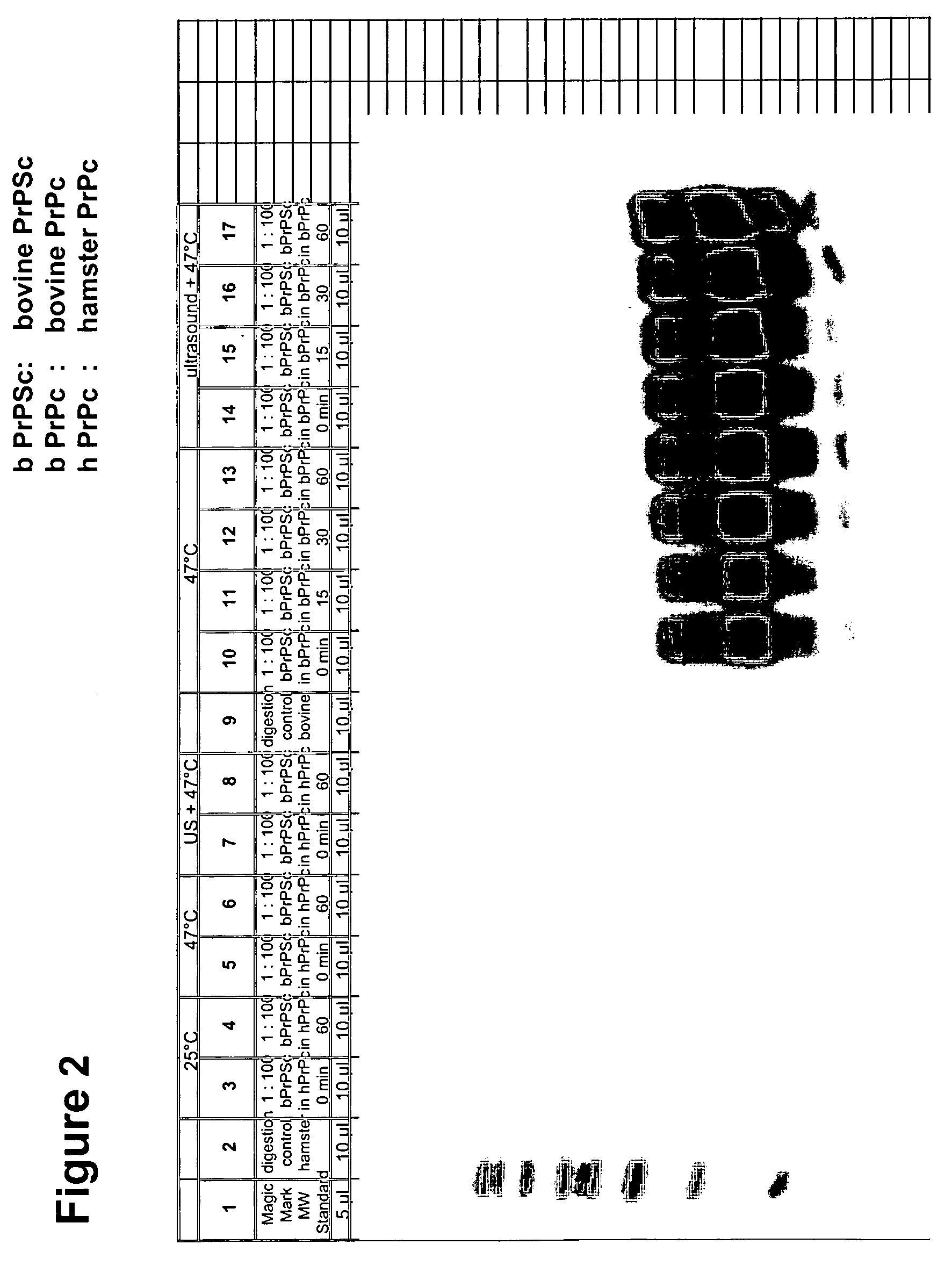
Figure 2 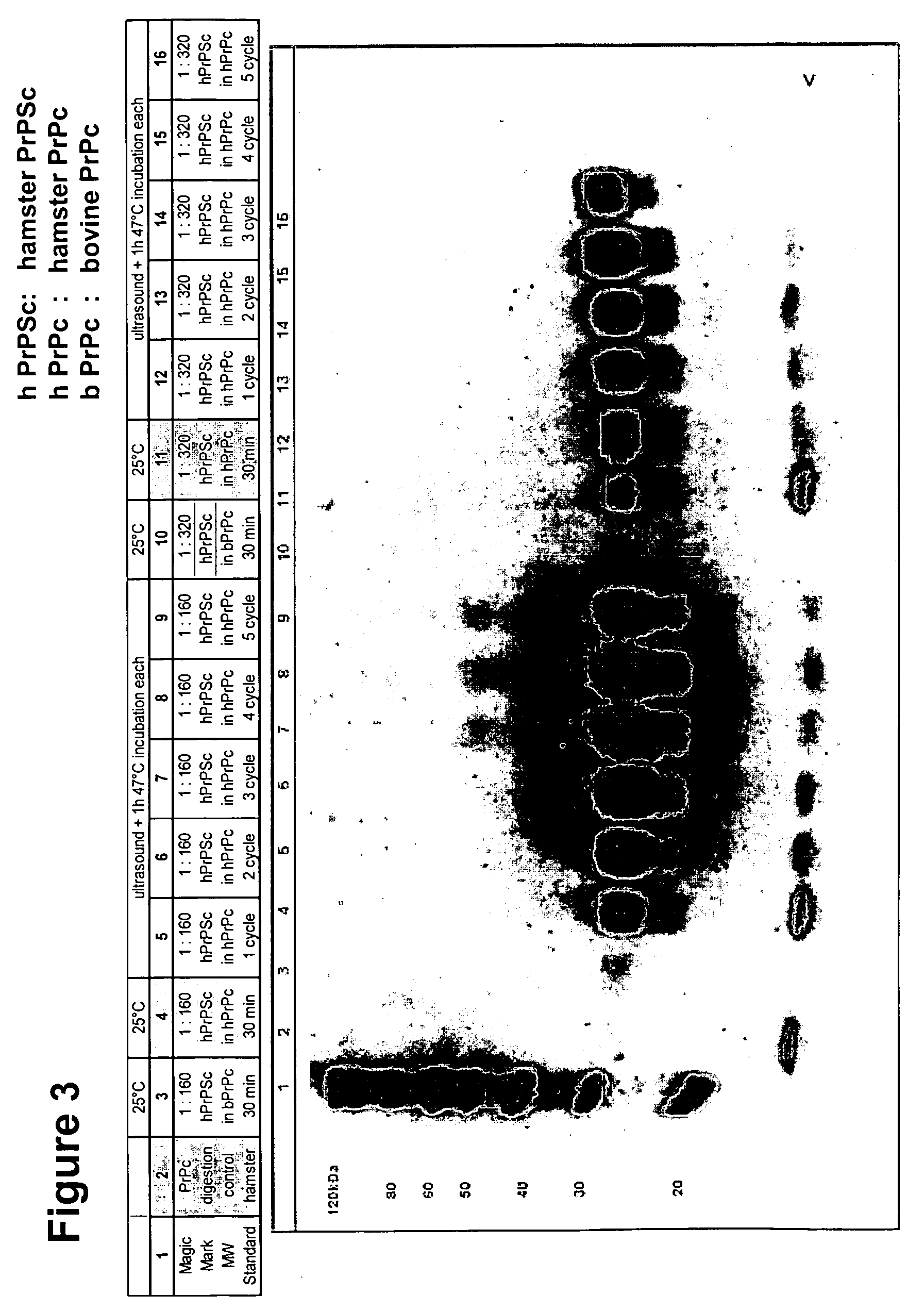
Figure 3
Abstract
Description
RELATED APPLICATIONS
[0001] This application is a continuation of PCT / EP2004 / 006750 filed Jun. 22, 2004, which claims priority to DE 10328125.8 filed Jun. 23, 2003.FIELD OF THE INVENTION
[0002] The present invention relates to a method for detecting infectious or pathogenic prion protein with an improved degree of sensitivity. For this, protease-resistant prion protein is formed de novo by means of a spontaneous transformation reaction, with nonpathogenic prion protein PrPc in the sample interacting with protease-sensitive low molecular weight PrPSc aggregates to form higher molecular weight protease-resistant PrPSc aggregates. BACKGROUND OF THE INVENTION
[0003] Prions are the infectious particles which are responsible for transmissible spongiform encephalopathies (TSEs), such as kuru, variant Creutzfeld-Jakob disease (vCJD), spongiform encephalopathy in cattle (BSE), chronic wasting disease (CWD) and scrapie. The main constituent of prions is the glycoprotein PrPSc, which is a conf...
Examples
specific embodiments
EXAMPLE 1
Amplifying Bovine PrPSc by Means of a Spontaneous Transformation Reaction
[0042] BSE-bovine brain homogenate (20% in 10% sucrose, Ribolyser), which was obtained from the obex region of the medulla oblongata (VLA case 99 / 00946), was diluted 100-fold with ice-cold:
(a) normal bovine brain homogenate which was obtained from the obex region of the medulla oblongata (10% homogenate in PBS buffer containing protease inhibitor cocktail complete, Roche Diagnostics, +0.5% Triton X100), or
(b) 10% normal hamster brain homogenate (10% homogenate in PBS buffer containing protease inhibitor cocktail complete, Roche Diagnostics, +0.5% Triton X100).
[0043] The hamster homogenate (hamster PrPc) was used as a control for comparison with bovine PrPc.
[0044] The homogenates were prepared using a Ribolyser appliance in homogenization vessels containing Hybaid ceramic beads. After homogenizing normal brains in PBS buffer containing protease inhibitor cocktail complete, Triton-X100, as previo...
example 2
Amplifying Hamster PrPSc by Means of a Spontaneous Transformation Reaction
[0052] Hamster scrapie brains were homogenized in Hank's balanced salt solution using a sterile tissue comminutor to obtain a 10% homogenate; the homogenate was then centrifuged at about 2000 g for 15 min. The supernatant which resulted was stored at −70° C.
[0053] 10% homogenates of normal hamster brain were prepared in ice-cold PBS buffer, containing protease inhibitor cocktail, Roche Diagnostics, using an Ultraturrax homogenizer. Triton-X100 was added to a final concentration of 0.5% and the samples were centrifuged at 3000 g for 3 min in an Eppendorf centrifuge. A 10% homogenate of bovine brain from the obex region of the medulla oblongata was prepared as a control.
[0054] Supernatants from normal brains were mixed with hamster scrapie brain homogenate (1:160, 1:320). 60 μl aliquots were subjected to the following treatment steps and investigated in FIG. 3:
Molecular weight markers: FIG. 3, lane 1
Norma...