
Catalyst deterioration detection device
a detection device and catalyst technology, applied in mechanical equipment, machines/engines, electric control, etc., can solve the problems of catalyst not being able to reduce lean components in exhaust gas, catalyst discharged from catalyst contains a large amount of nox, and the oxygen release period and oxygen storage period are not varied, so as to eliminate the variation in the oxygen release period and oxygen storage period, the effect of accurately determining the oxygen storage amoun
Patent Information
- Authority / Receiving Office
- US · United States
- Patent Type
- Applications(United States)
- Current Assignee / Owner
- Publication Date
- 2009-11-26
- Estimated Expiration
- Not applicable · inactive patent
Smart Images
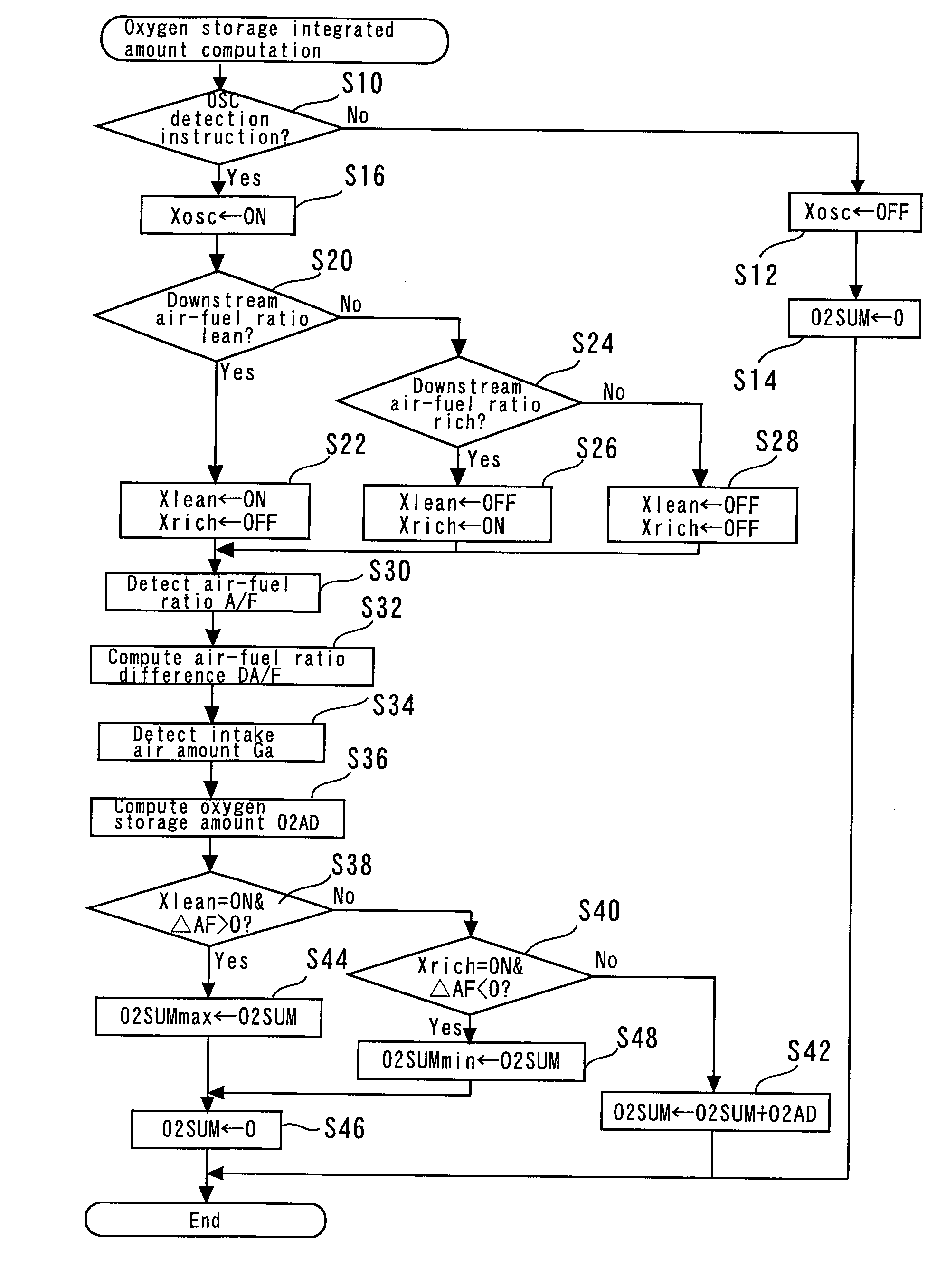
Figure 1 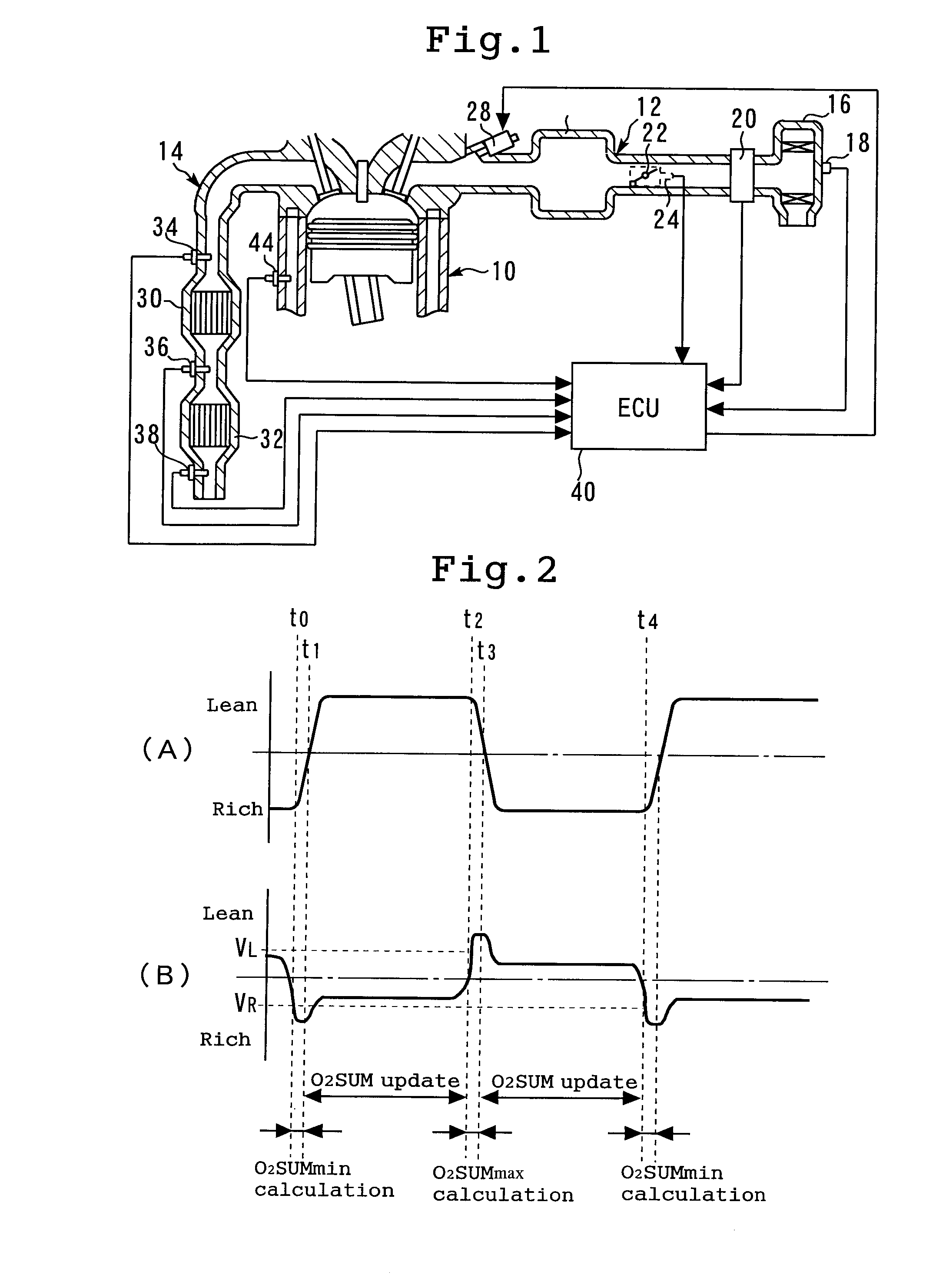
Figure 2 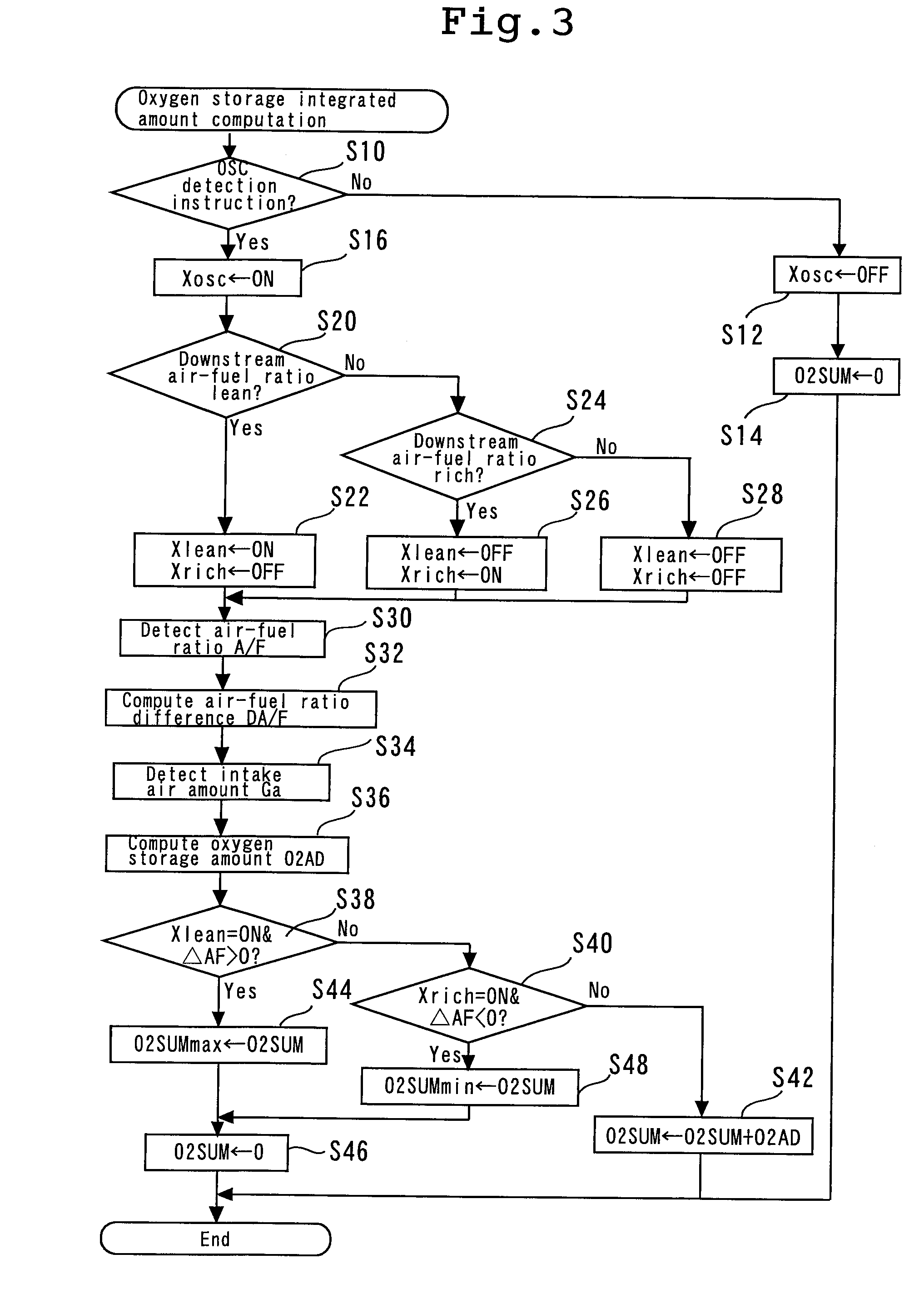
Figure 3
Abstract
Description
TECHNICAL FIELD
[0001] The present invention relates to a catalyst deterioration detection device, and more particularly to a catalyst deterioration detection device for detecting the deterioration of a catalyst that purifies exhaust gas of an internal combustion engine.BACKGROUND ART
[0002] A catalyst for exhaust gas purification is positioned in an exhaust path of a vehicle-mounted internal combustion engine. The catalyst is capable of storing an appropriate amount of oxygen. If the exhaust gas to be purified by the catalyst contains HC, CO, and other unburned components, the oxygen stored by the catalyst oxidizes such unburned components. If, on the other hand, the exhaust gas contains NOx and other oxides, the catalyst reduces such oxides. The resulting oxygen is then stored in the catalyst.
[0003] The catalyst positioned in the exhaust path purifies the exhaust gas by oxidizing or reducing the components of the exhaust gas as described above. Thus, the purification capability of the ...
Examples
first embodiment
[System Configuration of First Embodiment]
[0065]FIG. 1 is a schematic diagram illustrating the structure of an internal combustion engine 10 having a catalyst deterioration detection device according to a first embodiment of the present invention and the structures of its peripheral parts. Referring to FIG. 1, the internal combustion engine 10 communicates with an intake path 12 and an exhaust path 14. The intake path 12 has an air filter 16, which is positioned at an upstream end. The air filter 16 incorporates an intake temperature sensor 18, which detects intake air temperature (that is, ambient temperature). An air flow meter 20 is positioned downstream of the air filter 16. The air flow meter 20 is a sensor that detects the amount of intake air Ga that flows in the intake path. A throttle valve 22 is installed downstream of the air flow meter 20. A throttle sensor 24 is positioned near the throttle valve 22 to detect the opening of the throttle valve 22. A fuel injection valve ...
second embodiment
[0137]The catalyst deterioration detection device according to a second embodiment of the present invention and a system around it have the same configuration as described in conjunction with the first embodiment (see FIG. 1). In the second embodiment, too, the ECU 40, which serves as the catalyst deterioration detection device, detects the deterioration of the upstream catalyst 30 by detecting the oxygen storage capacity of the upstream catalyst 30. More specifically, the second embodiment exercises air-fuel ratio forced control in the same manner as the first embodiment, detects the oxygen storage capacity of the catalyst during the execution of such control, and judges the deterioration of the catalyst in accordance with the oxygen storage capacity.
[0138]More specifically, the catalyst deterioration detection device according to the second embodiment exercises the same control as the catalyst deterioration detection device according to the first embodiment except that the former ...
third embodiment
[0163]The catalyst deterioration detection device according to a third embodiment of the present invention and a system including the catalyst deterioration detection device have the same configuration as described in conjunction with the first embodiment (see FIG. 1). The catalyst deterioration detection device according to the third embodiment exercises air-fuel ratio forced control to switch to a rich or lean air-fuel ratio as is the case with the catalyst deterioration detection device according to the first or second embodiment, determines the oxygen storage capacity OSC by detecting the oxygen storage integrated amount O2SUMmax, O2SUMmin in the maximum or minimum oxygen storage state, and judges the deterioration of the upstream catalyst 30 in accordance with the oxygen storage capacity OSC. The catalyst deterioration detection device according to the third embodiment exercises the same control as the device according to the second embodiment except that the former uses a pred...