
Functional nanoparticle-based antibiotics and preparation method thereof
a technology of functional nanoparticles and antibiotics, applied in antibacterial agents, peptide/protein ingredients, therapy, etc., can solve the problems that cureable diseases such as throat disease, pulmonary tuberculosis, ear inflammation, etc., will not be able to be cured by any medicine in the future, and achieve the effect of short time and large specific surface area
Patent Information
- Authority / Receiving Office
- US · United States
- Patent Type
- Applications(United States)
- Current Assignee / Owner
- Publication Date
- 2010-11-04
- Estimated Expiration
- Not applicable · inactive patent
Smart Images
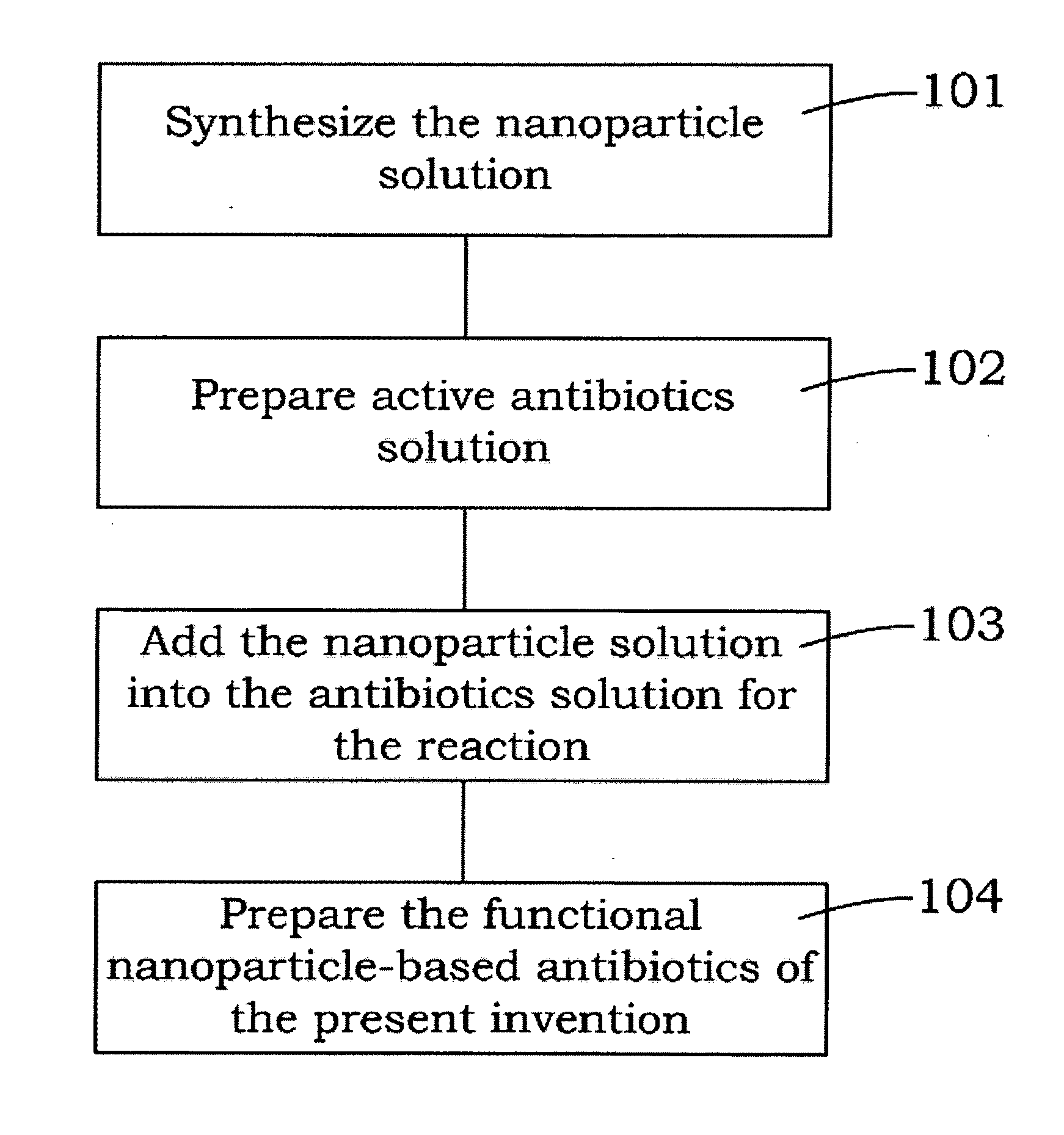
Figure 1 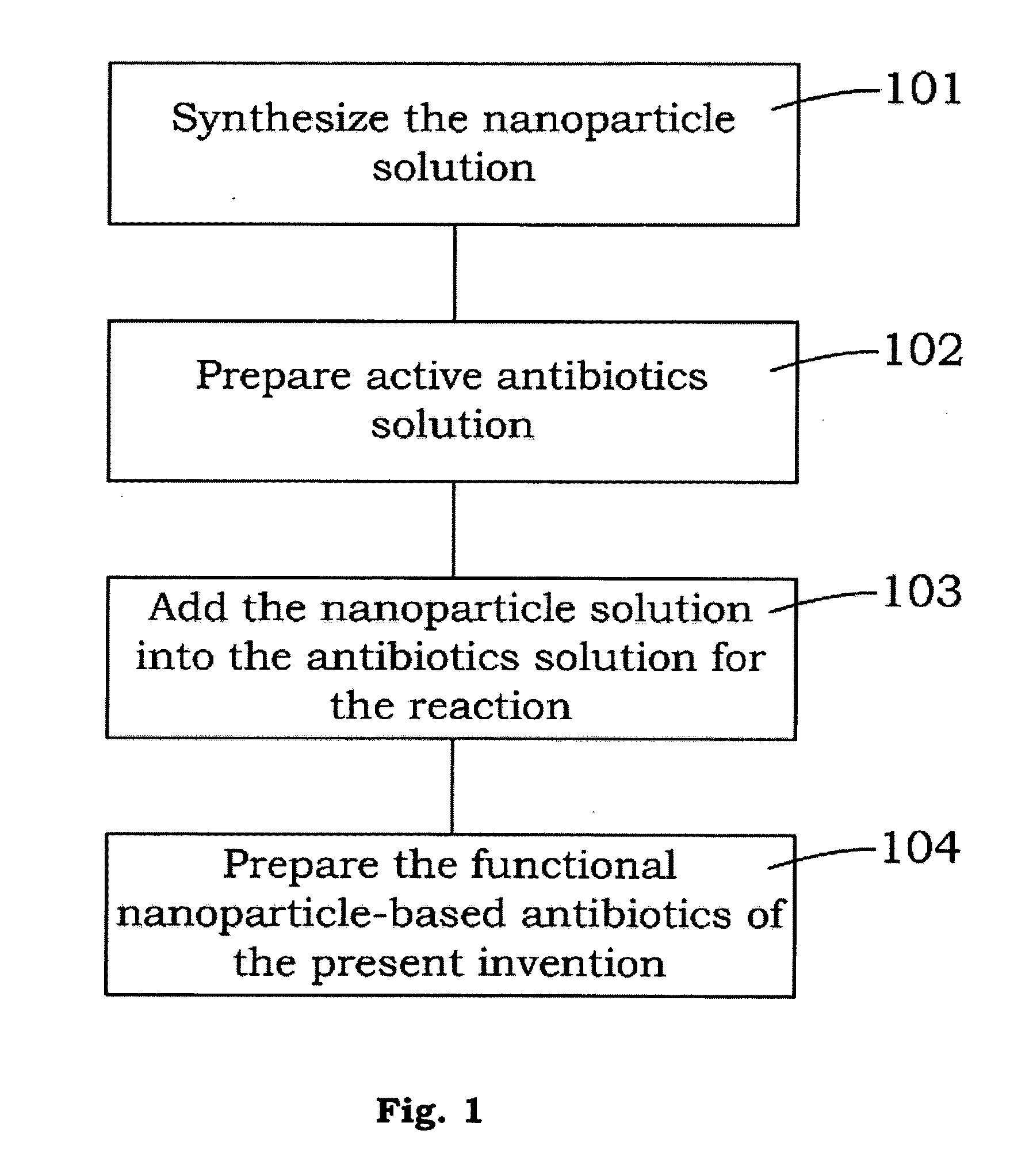
Figure 2 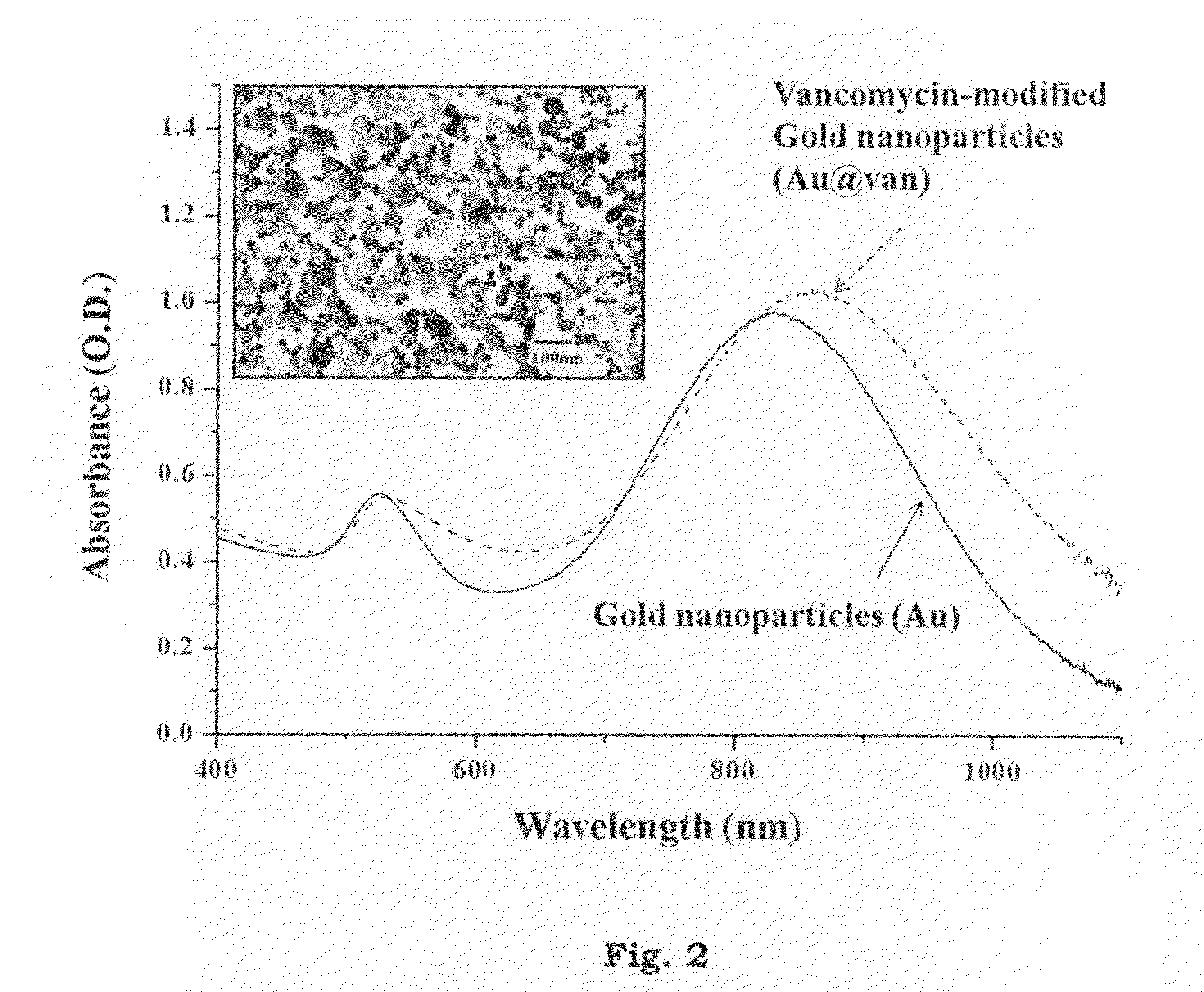
Figure 3
Abstract
Description
BACKGROUND OF THE INVENTION
[0001] 1. Field of the Invention
[0002] The present invention relates to a novel functional nanoparticle-based antibiotics and preparation method thereof, especially relates to an antibiotics-modified nanoparticle.
[0003] 2. Description of the Prior Art
[0004] No matter the internal medicine therapy or surgery, the antibiotics are usually used to prevent the infection of pathogenic bacteria. The so-called antibiotics are the materials extracted from the fungi originally, which can kill bacteria or inhibit the cell growth of bacteria. The penicillin is the first antibiotic which is applied extensively in human medical history. Its discovery is a great breakthrough to the therapy of disease. Many incurable diseases would be able to be cured by this antibiotic, so it is nearly considered as a catholicon.
[0005] At present, there are nearly more than 1,000 kinds of antibiotics that can kill the bacteria effectively, including the antibiotics extracted from the cultivat...
Examples
embodiment 1
The synthesis of the Gold Nanoparticle with NIR Adsorption
[0044]FIG. 1 shows the flow chart for the synthesis of functional nanoparticle of the present invention. Please refer to Step 101: First, 0.0402 g of sodium oxalate (Na2C2O4) is dissolved into 3 ml of deionized water to form 0.1 M oxalic acid solution. 65 μl of the solution is taken and dropped into a quartz bottle, which is covered a layer of tinfoil on the outside of quartz bottle to avoid the irradiation of light, with 9.7 ml of deionized water. The solution is shaken slightly, and then added dropwise into gold chloride trihydrate (HAuCl4) solution (0.01 M, 0.3 ml). The bottle is sealed with the parafilm, then put under the ultraviolet light (306 nm of wavelength, 8 W), and irradiated for 50 minutes at 250 rpm / min to complete the preparation of gold nanoparticles. Finally, the solution is isolated by the centrifuge for 20 minutes at 2,500 rpm to remove the supernatant; 0.2 ml gold nanoparticle solution is kept for the furt...
embodiment 2
The Modification of Gold Nanoparticles by Vancomycin
[0045]As shown in Step 102 of FIG. 1, referring to the method of Sundram et al. to prepare the solution of vancomycin dimmers bearing a disulfide linkage (J. Am. Chem. Soc. 1996, 118, 13107-13108). 0.6 ml vancomycin dimer solution (0.1 mg / ml) is added into a 20 ml glass bottle. The gold nanoparticle solution (0.2 ml) is added dropwise into the bottle slowly. The bottle is then slightly shaken for 12 hours at 50 rpm / min (as shown in Step 103 of FIG. 1). After that, the vancomycin-modified gold nanoparticle solution (Au@van) is separated by the centrifuge for 20 minutes at 6,000 rpm to remove the supernatant, 0.6 ml of deionized water is used for rinsing, and then the solution is isolated by the centrifuge at 6,000 rpm again. Finally, the precipitate of Au@van is resuspended in 0.2 ml of deionized water to complete the preparation of vancomycin-modified gold nanoparticles (as shown in Step 104 of FIG. 1).
[0046]FIG. 2 shows the ultrav...
embodiment 3
Test for the Survival Rate of Bacteria
[0049]First, use the inoculating ring to remove the bacteria colony from the cultivation plate into the Tryptic Soy Broth (TSB) medium (12 g of TSB powder and 2 g of yeast are dissolved in 400 ml of deionized water, sterilized at high temperature and high pressure, and then cooled down to the room temperature). The inoculated medium is cultivated at 37□ and 150 rpm for 8 hours. Some bacteria solution is taken out, diluted with the sterilized TSB to the light absorption value of O.D.600=1. Then, 1 ml of solution is put into the Eppendorf tube. The solution is centrifuged for 5 minutes at 2,100 rpm. After the supernatant is removed, 1 ml of sterilized PBS buffer solution (about 0.1 mM) is added. The surplus TSB is washed out by vortex, and this washing step is repeated twice. Finally, the bacteria solution is resuspended in 1 ml of PBS buffer solution, where the PBS buffer solution is prepared by mixing 40.5 ml, 0.2 M of Sodium hydrogen phosphate ...