
Use of vaginally-administered insulin sensitizing agents
a vaginal and insulin-sensitive technology, applied in the field of vaginal insulin-sensitive agents, can solve the problems of gastrointestinal irritation, abandoning treatment, and severe adverse effects, and achieve the effects of reducing systemic exposure, increasing insulin-sensitive sensitivity, and reducing testosterone plasma levels
Patent Information
- Authority / Receiving Office
- US · United States
- Patent Type
- Applications(United States)
- Current Assignee / Owner
- Publication Date
- 2012-01-05
- Estimated Expiration
- Not applicable · inactive patent
Smart Images
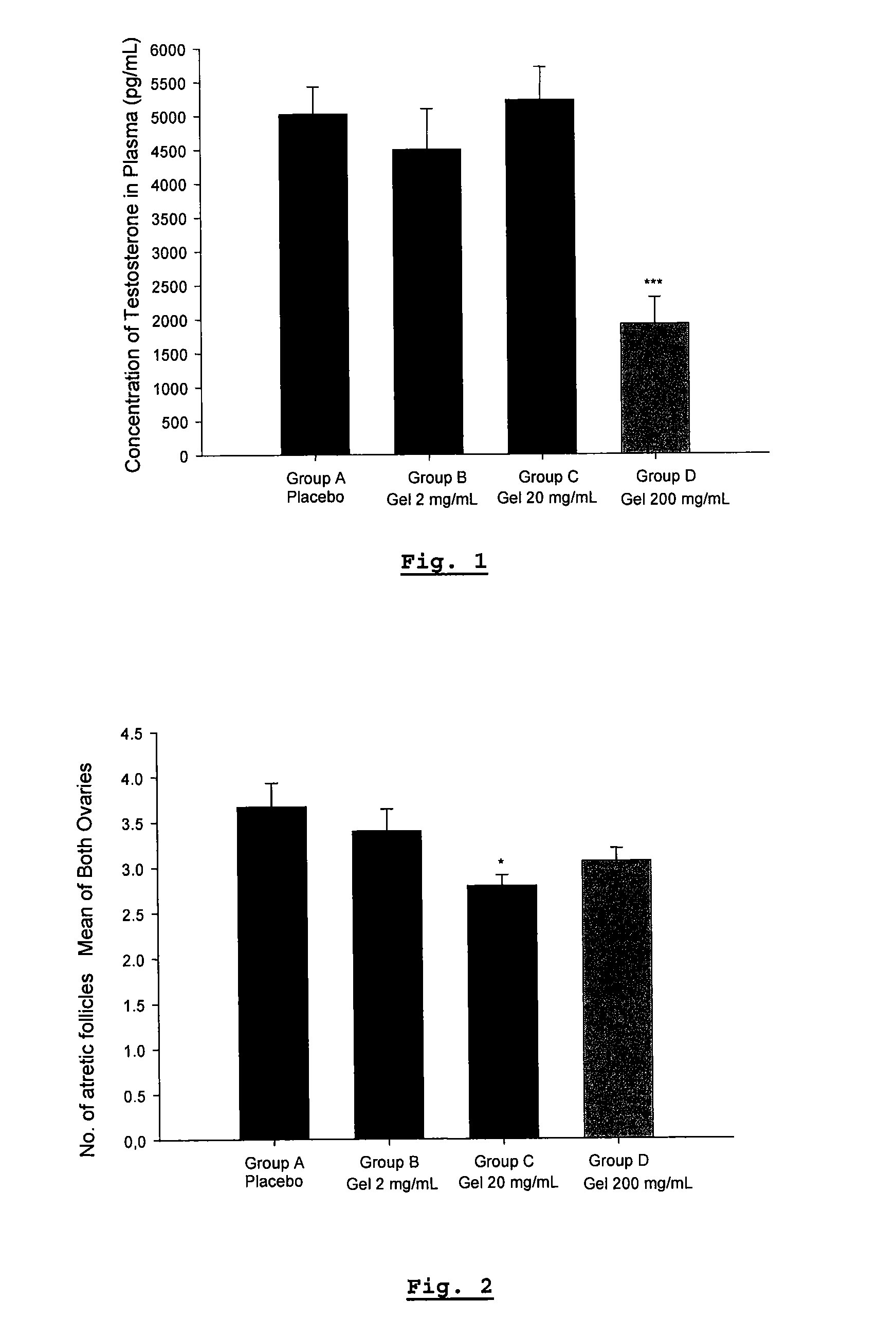
Figure 1
Abstract
Description
FIELD OF THE INVENTION
[0001] This invention relates to the use of vaginal insulin sensitising agents for the prevention and / or treatment of hyperandrogenism and / or polycystic ovary syndrome and / or related disorders.BACKGROUND OF THE INVENTION
[0002] In general terms, hyperandrogenism is any clinical or laboratory evidence of an excess of androgens in women. The most frequent clinical evidence of hyperandrogenism in women of childbearing age is hirsutism or acne, with or without anovulation symptoms—such as amenorrhoea or dysfunctional uterine bleeding.
[0003] There may be five different causes of hyperandrogenism in women of childbearing potential:
[0004] polycystic ovary syndrome;
[0005] idiopathic hirsutism;
[0006] enzyme deficiencies in the synthesis of steroid hormones;
[0007] androgen-secreting tumours;
[0008] other endocrine disorders such as Cushing's syndrome, etc.
[0009] Nevertheless, most women with hyperandrogenism symptoms suffer from polycystic ovary syndrome (80%).
[0010] Polycystic ovar...
Examples
example
[0054]The following test illustrates the invention and must not be considered limiting of the scope of the application.
[0055]The study objective was to assess the effect of metformin in a model for polycystic ovary syndrome (PCOS) induced by dehydroepiandrosterone (DHEA) in rats.
[0056]Experimental Method
[0057]The formulations to be tested were:[0058]Gels with Metformin at a concentration of 2 mg / mL (FT-147), 20 mg / mL (FT-148) and 200 mg / mL (FT-149).[0059]Gel without Metformin (Placebo; FT-150).
[0060]The gels were prepared according to the following formulae:
2 mg / mL gel (FT-147)20 mg / mL gel (FT-148)200 mg / mL gel (FT-149)Metformin0.1g1g10gSodium methylparaben34.3mg34.3mg34.3mgCitric acid1g1g1g40% Sodium hydroxideq.s. pH = 5.5 approx.q.s. pH = 5.5 approx.q.s. pH = 5.5 approx.Natrosol0.85g0.85g0.85gWaterq.s. 50gq.s. 50gq.s. 50g
[0061]Female 2-3 weeks-old Sprague-Dawley rats were used.
[0062]The animals remained in quarantine for 7 days in the same conditions in which the study was perform...