
Method for estimating MIMO channel using loosely synchronous codes, and apparatus using the same
a technology of synchronous code and mimo channel, applied in the field of method and apparatus for estimating a multiple input multiple output (mimo) channel, can solve the problems of disadvantageous complex system and inability to increase the number of transmission antennas to be greater, so as to reduce the channel estimation time and improve the channel estimation accuracy
Patent Information
- Authority / Receiving Office
- US · United States
- Patent Type
- Applications(United States)
- Current Assignee / Owner
- Publication Date
- 2012-01-26
- Estimated Expiration
- Not applicable · inactive patent
Smart Images
Figure 1 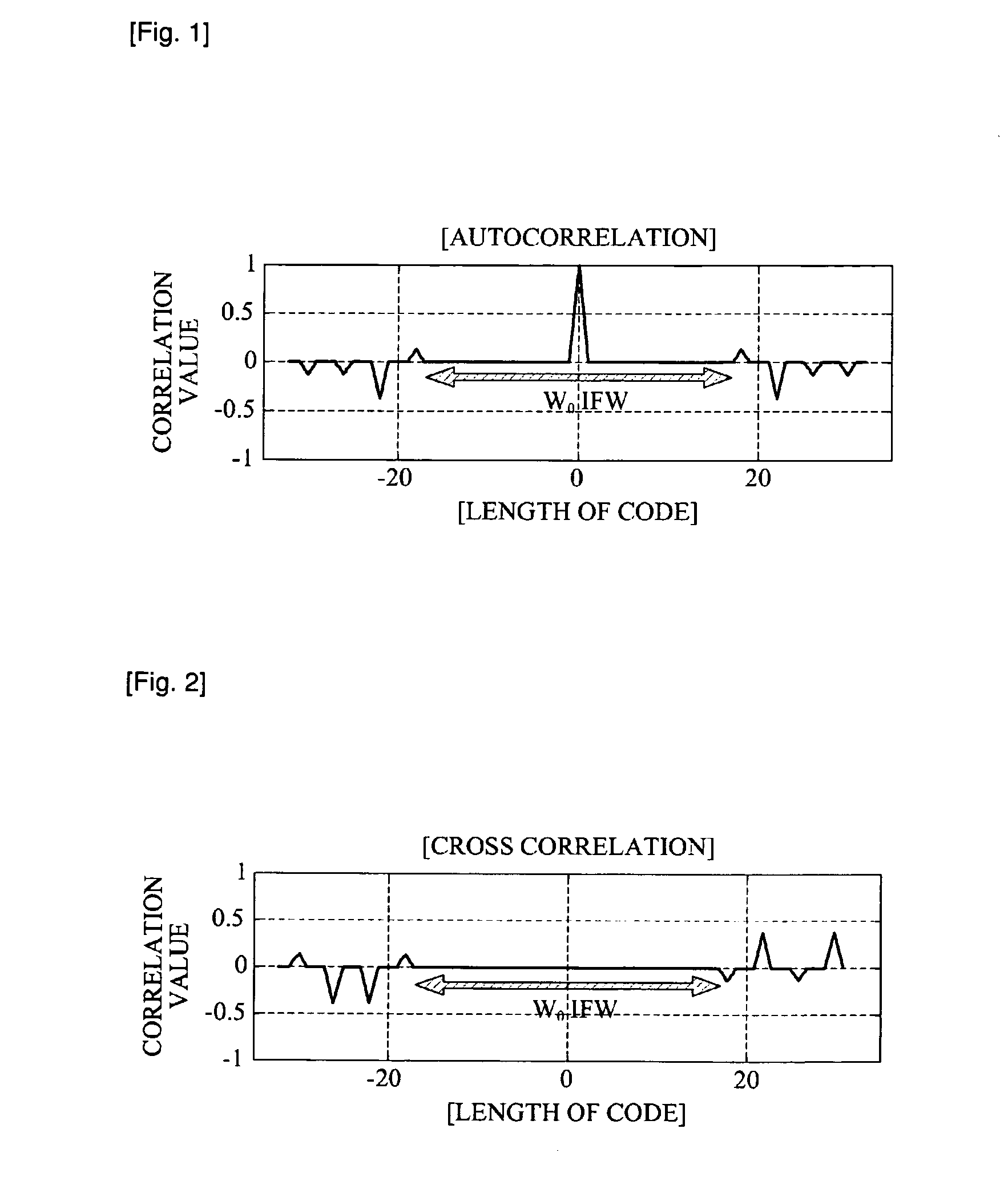
Figure 2 
Figure 3
Abstract
Description
TECHNICAL FIELD
[0001] The present invention relates to a method and apparatus for estimating a Multiple Input Multiple Output (MIMO) channel, and more particularly, to a method and apparatus for estimating a MIMO channel, which simultaneously transmits a Loosely Synchronous (LS) code via two or four transmission antennas, thereby reducing a channel estimation time and improving accuracy of the channel estimation.
[0002] This work was supported by the IT source technology development program of MIC / IITA. [2005-S-001-03, Development of Wireless Vector Channel Model for next generation mobile communication]BACKGROUND ART
[0003] Performance of a Multiple Input Multiple Output (MIMO) system is significantly influenced by a channel environment, and thus an accurate channel estimation is required in order to use the MIMO system.
[0004] Accordingly, a MIMO channel estimation apparatus such as a MIMO channel sounder is required to provide channel information suitable for a system design.
[0005] A MIM...
Examples
Embodiment Construction
[0026]Reference will now be made in detail to embodiments of the present invention, examples of which are illustrated in the accompanying drawings, wherein like reference numerals refer to the like elements throughout. The embodiments are described below in order to explain the present invention by referring to the figures.
[0027]A basic principle of the present invention is to use characteristics of a Loosely Synchronous (LS) code.
[0028]In general, in a Time-Division Multiplexing (TDM) system, the LS code has an Interference Free Window (IFW) as illustrated in FIGS. 1 and 2.
[0029]The LS code has characteristics in that each of an autocorrelation value and a cross correlation value of the LS code is ‘0’ in the IFW.
[0030]Accordingly, as illustrated in FIGS. 1 and 2, the LS code shows characteristics that the autocorrelation value is ‘0’ in a phase difference of a maximum of n-chips before and after ‘0’ with respect to ‘0’ of a phase difference.
[0031]Also, the cross correlation value i...