
Mexiletine prodrugs
Patent Information
- Authority / Receiving Office
- US · United States
- Current Assignee / Owner
- Publication Date
- 2012-08-02
- Estimated Expiration
- Not applicable · inactive patent
Smart Images
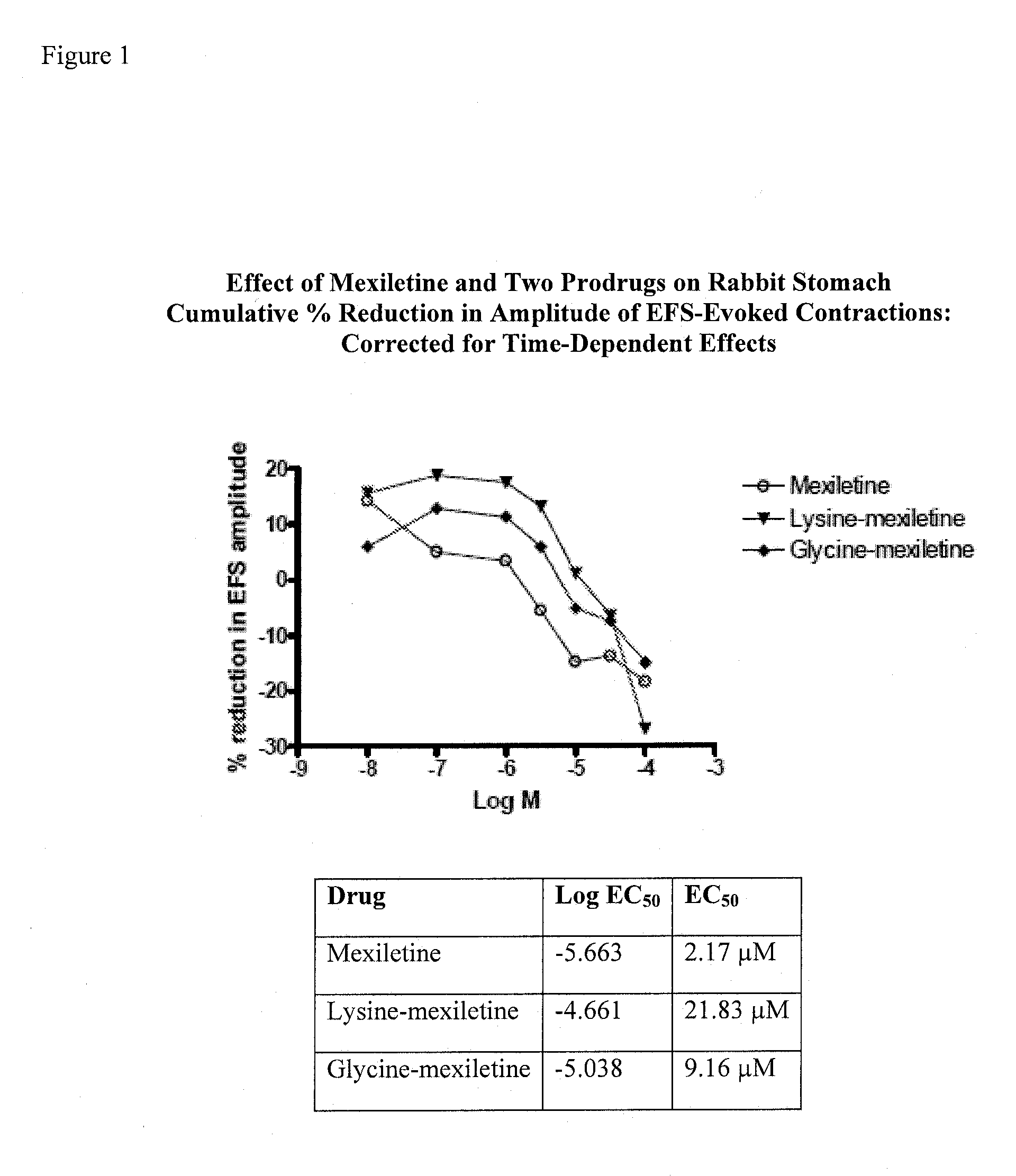
Figure 1 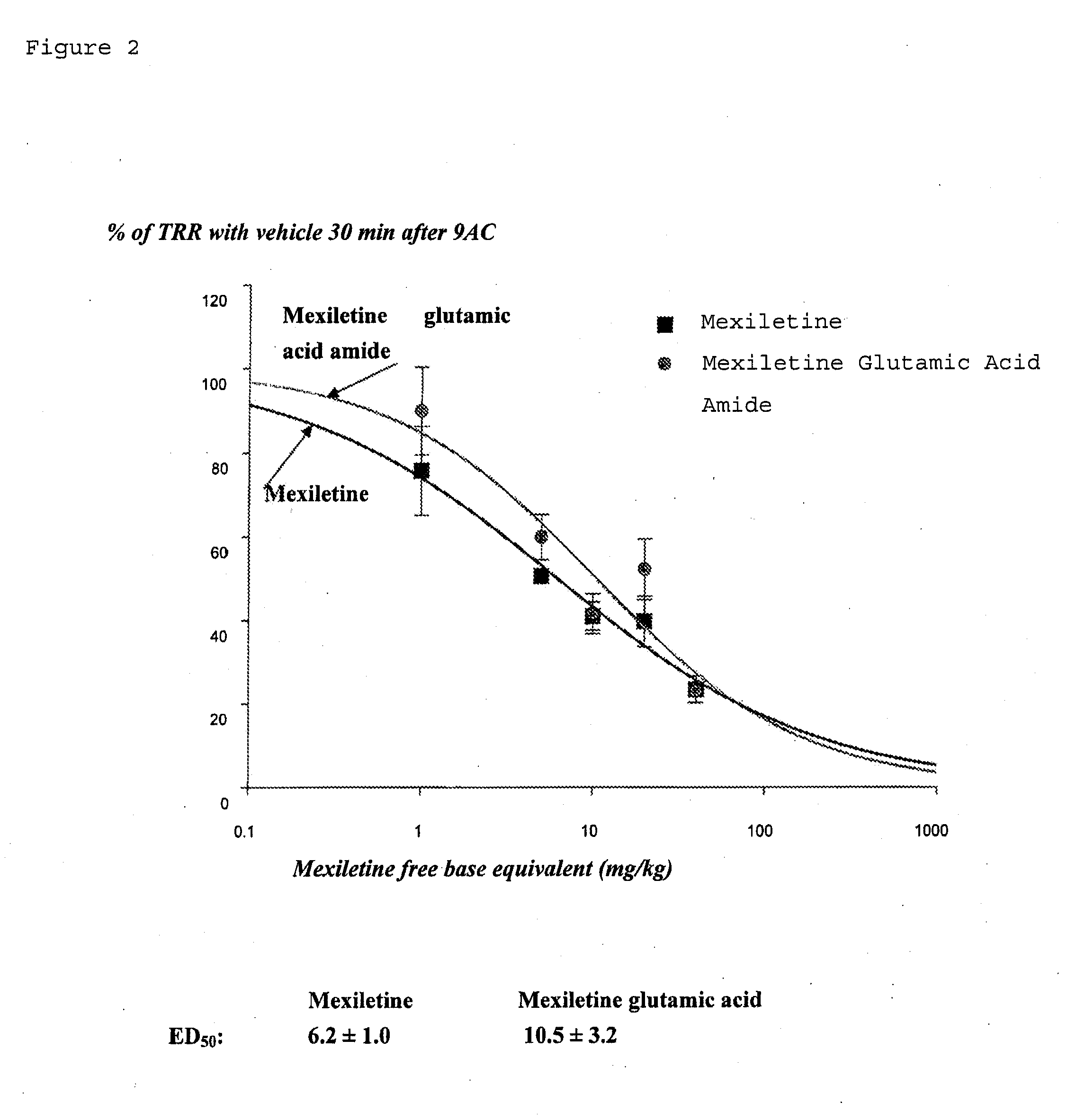
Figure 2 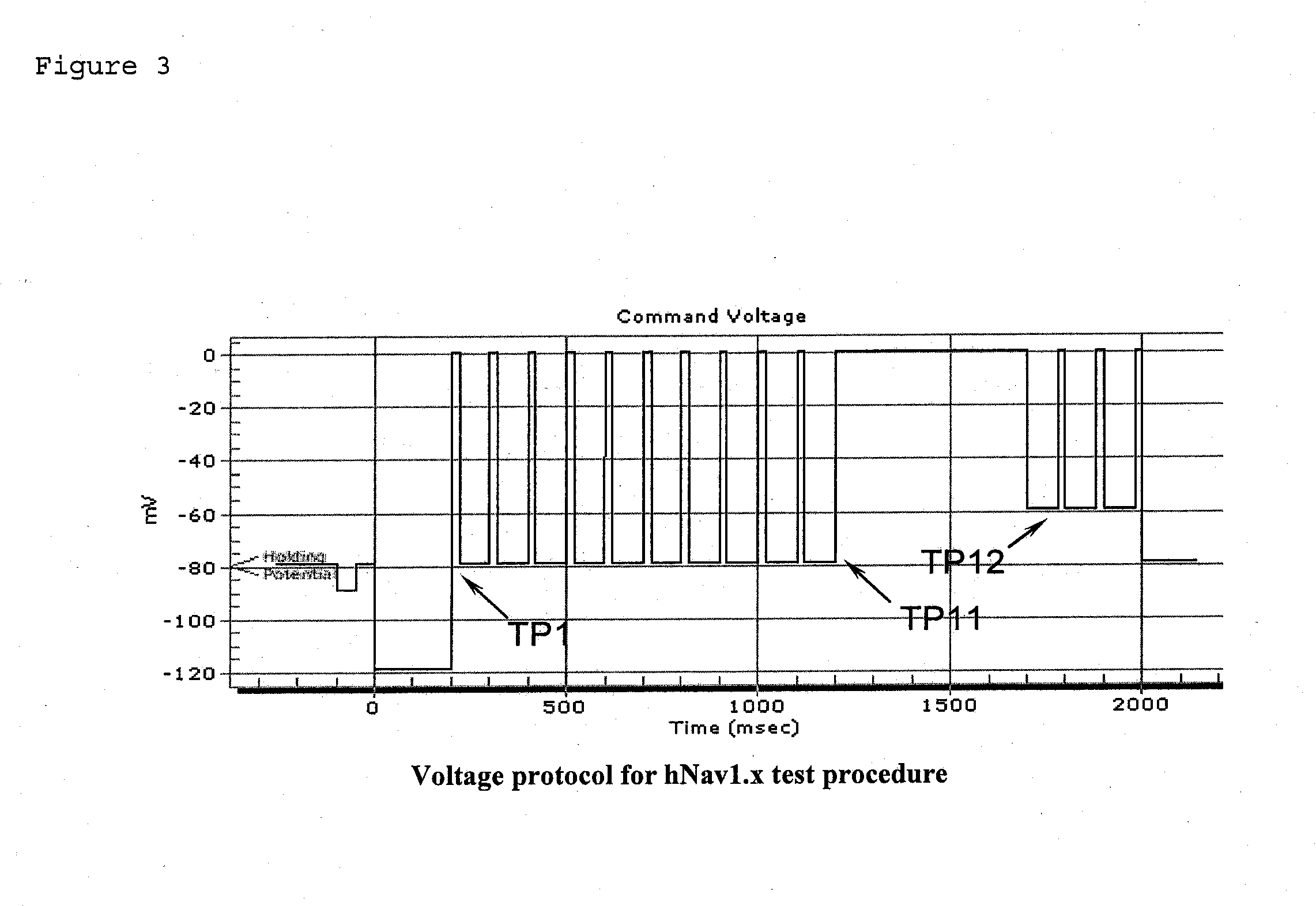
Figure 3
Abstract
Description
[0001] This application claims priority to U.S. Provisional Application No. 61 / 426,980, filed Dec. 23, 2010; Great Britain Provisional Application No. GB 1021891.5, filed Dec. 23, 2010; and Great Britain Provisional Application No. 1111379.2, filed Jul. 4, 2011. The contents of these applications are hereby incorporated by reference in their entirety.FIELD OF THE INVENTION
[0002] The present invention relates to various prodrugs of mexiletine and pharmaceutically acceptable salts thereof and their use in the treatment of muscle myotonias and dystonia and neuropathic pain.BACKGROUND OF THE INVENTION
[0003] Myotonia is an abnormal delay in the relaxation of muscles after contraction. It is a key symptom in a number of muscle diseases called myotonic disorders. It can be mild or severe, interfering with daily activities such as walking, climbing stairs or opening and closing the eyelids. It can be worse after periods of rest or triggered by cold but improves after the muscles have warmed-up...
Examples
example 1
Synthesis of (Rac)-Mexiletine-(S)-Lysine Ditrifluoroacetate
[0351]The synthesis of mexiletine-(S)-lysine-ditrifluoroacetate was achieved in two distinct steps as shown in the scheme below. Initially, the activated ester of (S)-lysine, N,N′-di-t-butyloxycarbonyl-(S)-lysine succinimide, was coupled to (rac)-mexiletine hydrochloride in the presence of N-methylmorpholine (NMM) to yield the N-protected prodrug, (rac)-mexiletine-N,N′-di-t-butyloxycarbonyl-(S)-lysine, after purification by chromatography (Scheme 1).
[0352]Subsequent deprotection of the BOC groups was then achieved using trifluoroacetic acid to give the desired (rac)-mexiletine-(S)-lysine-ditrifluoroacetate as a viscous glassy oil. The oil was found to foam on drying under high vacuum, but collapsed on standing in air. For the purposes of clarity, only one enantiomer of mexiletine is shown.
Synthetic Route for (Rac)-Mexiletine(S)-Lysine Ditrifluoroacetate
Detail
[0353]To (rac)-mexiletine HCl (200 mg, 0.93 mmol) and 4-methylmorph...
example 2
Synthesis of (Rac)-Mexiletine-Glycine Trifluoroacetate
[0357]N-t-butyloxycarbonyl-glycine succinimide was coupled to (rac)-mexiletine hydrochloride in the presence of NMM, to yield the N-protected prodrug, (rac)-mexiletine-N-t-butyloxycarbonyl-glycine in good yield after purification by chromatograph (see scheme below)
[0358]Subsequent deprotection of the BOC groups was then achieved using trifluoroacetic acid. Trituration with diethyl ether and filtration gave the required (rac)-mexiletine glycine trifluoroacetate as a white solid in excellent yield (see scheme below). Note, for the purposes of clarity, only one enantiomer of mexiletine is shown in the scheme below.
Synthetic route for glycine-(rac)-mexiletine trifluoroacetate
[0359]Subsequent deprotection of the BOC groups was achieved using trifluoroacetic acid and filtration from diethyl ether give glycine-(rac)-mexiletine trifluoroacetate as a white solid in excellent yield.
Detail
[0360]To (rac)-mexiletine hydrochloride (3.08 g, 14....
example 3
Synthesis of Mexiletine-(S)-Homoarginine Amide Dihydrochloride
[0364]The synthesis of mexiletine-(S)-homoarginine amide dihydrochloride was accomplished in five distinct steps as shown in the scheme below. The ‘activated ester’ N-Boc-(S)-homoarginine-(NO2) N-hydroxysuccinimide ester was made via a DCC coupling between N-hydroxysuccinimide and N-Boc-(S)-homoarginine-(NO2). Subsequent reaction with mexiletine hydrochloride yielded the N-protected prodrug, N-Boc-(S)-homoarginine-(NO2)-mexiletine in good yield after purification using a Biotage Isolera automated chromatography system under reversed-phase conditions.
Synthetic route for mexiletine-(S)-homoarginine amide dihydrochloride
[0365]The nitro-group was reduced via catalytic hydrogenation using palladium on carbon to give N-Boc-(S)-homoarginine-mexiletine. Removal of the Boc group was accomplished with trifluoroacetic acid. The crude product was subjected to salt exchange with 2M hydrogen chloride in diethyl ether and purified using...