
Carbazole derivative and semiconductor nanocrystal
a carbazole derivative and nanocrystal technology, applied in the direction of non-metal conductors, conductors, group 3/13 element organic compounds, etc., can solve the problem that elements having satisfactorily high light emission efficiency cannot be provided, the proposal is unsatisfactory in light emission efficiency, and cannot specifically describe light emission efficiency or service life, etc. problems, to achieve the effect of high light emission efficiency, high light emission efficiency and high durability
Patent Information
- Authority / Receiving Office
- US · United States
- Patent Type
- Applications(United States)
- Current Assignee / Owner
- Publication Date
- 2013-01-31
- Estimated Expiration
- Not applicable · inactive patent
Smart Images
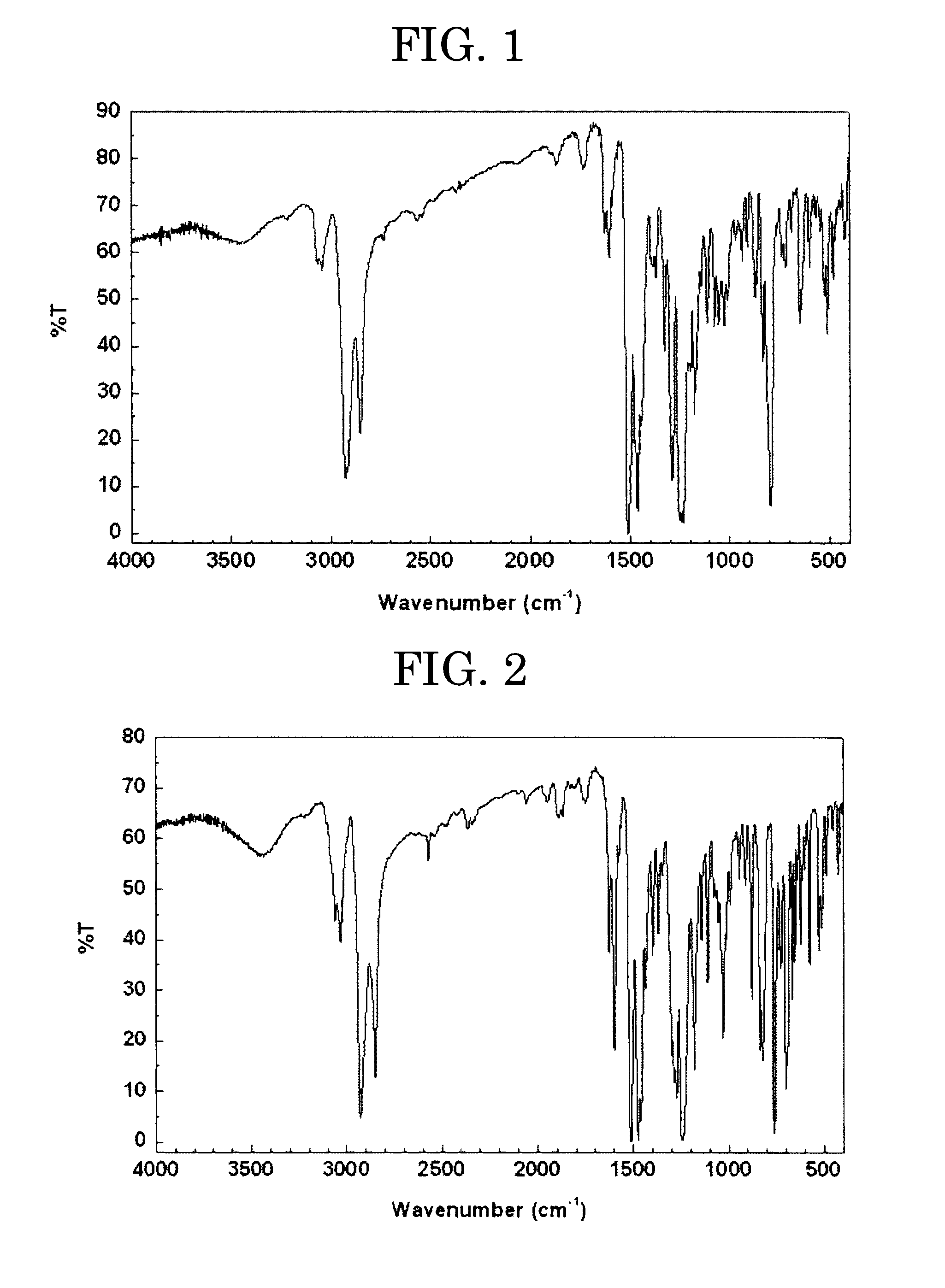
Figure 1 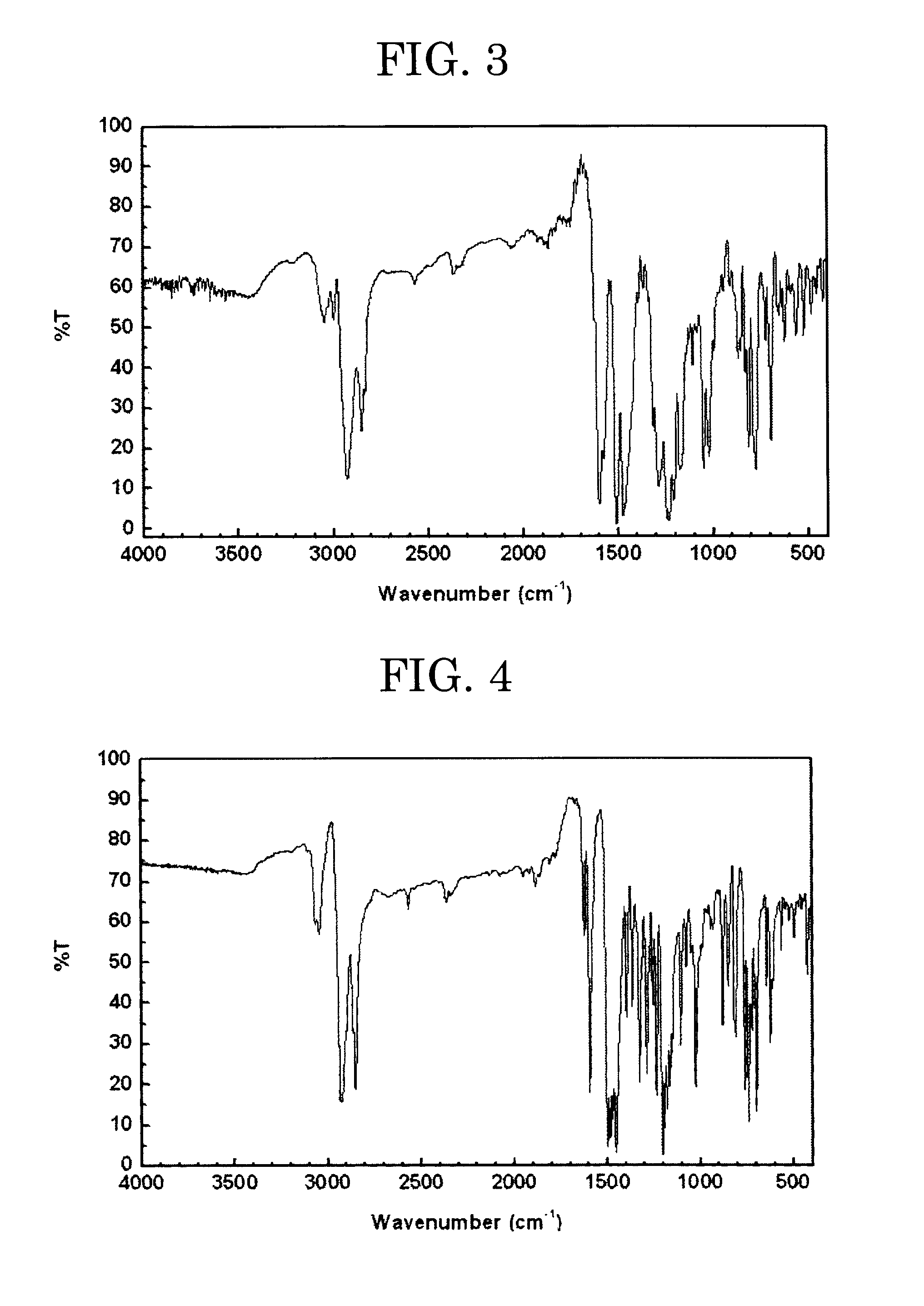
Figure 2 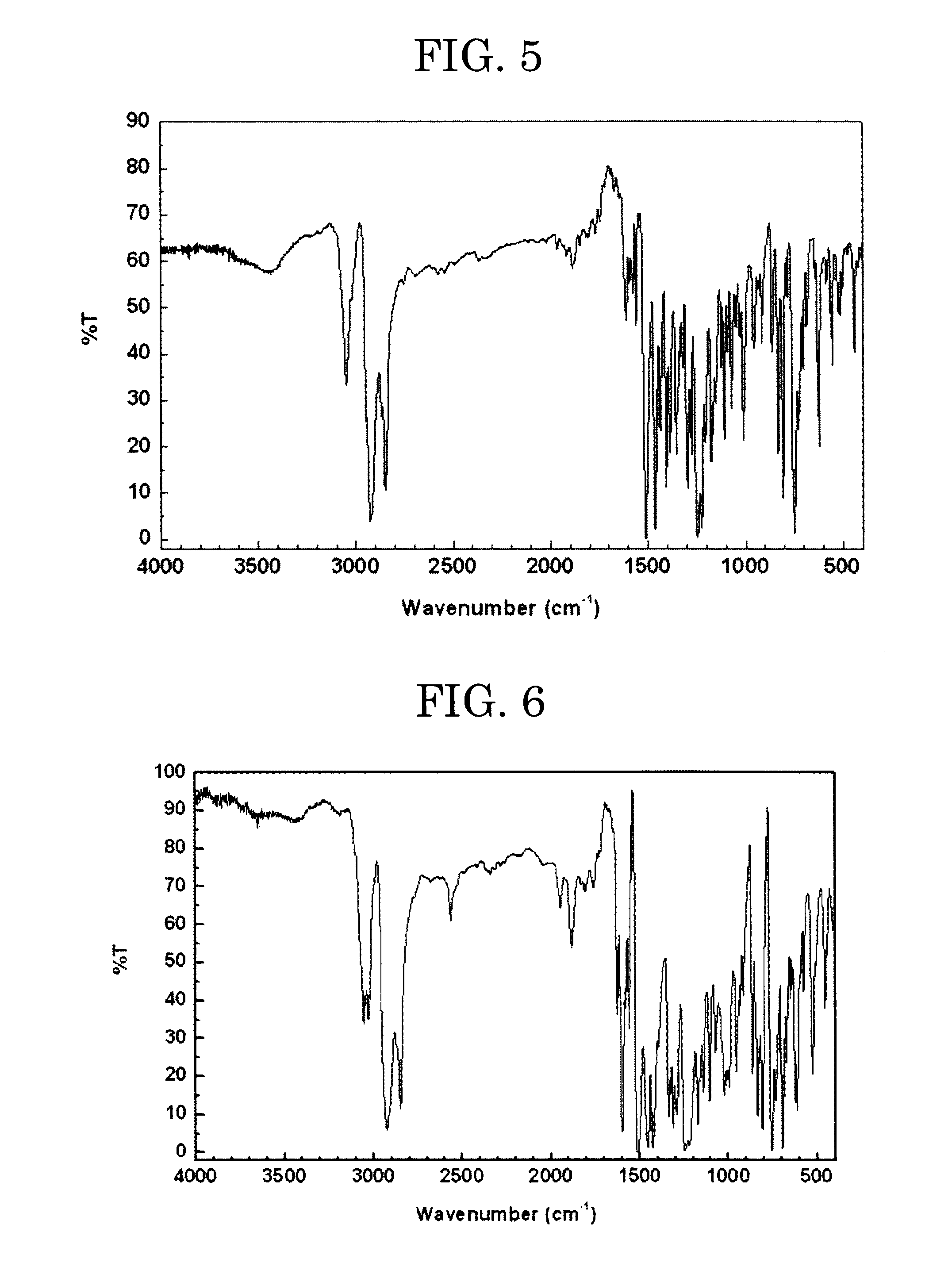
Figure 3
Abstract
Description
BACKGROUND OF THE INVENTION
[0001] 1. Field of the Invention
[0002] The present invention relates to a novel carbazole derivative and a semiconductor nanocrystal containing this novel carbazole derivative bonded via a coordination bond or intermolecular force, where the semiconductor nanocrystal is effectively used for quantum dot-type organic EL elements with high light emission efficiency.
[0003] 2. Description of the Related Art
[0004] In recent years, quantum dot-type organic EL elements have been proposed which use quantum dots of a semiconductor nanocrystal as a light emitting material. Nanoscaled small materials show intermediate behaviors between those as atoms or molecules and those as macroscopic solids (bulk form). Nanoscaled materials whose charged carriers and excitons are confined in all three-dimensional directions are called quantum dots, which increase in effective band gap with decreasing of their size. That is, when the size of quantum dots decreases, their absorption and...
Examples
synthesis example 2
of the Compound Represented by General Formula (3)
[0084]The compound represented by General Formula (3) can be synthesized in the following manner.
[0085]In the above reaction scheme, Rx represents a halogen atom, and Ar1, Ar4, X, Y and Z have the same meaning as defined above.
[0086]First, carbazole derivative (B-1) and aryl halide Rx-Ar4—OCH3 are subjected to Ullmann reaction or Buchwald-Hartwig amination reaction, to thereby produce carbazole derivative (B-2). Here, the carbazole derivative (B-1) is the same as the carbazole derivative (A-2).
[0087]Next, boron tribromide is used to perform demethylation of the carbazole derivative (B-2), to thereby produce carbazole derivative (B-3).
[0088]In addition, the carbazole derivative (B-3) and alcohol bromide Br—Y—OH are subjected to etherification reaction, to thereby produce carbazole derivative (B-4).
synthesis example 3
of the Compound Represented by General Formula (3)
[0089]The compound represented by General Formula (3) can be synthesized in the following manner.
[0090]In the above reaction scheme, Ar1, Ar3, X, Y and Z have the same meanings as defined above.
[0091]First, in the presence of a base such as pyridine, p-toluenesulfonyl chloride is used to perform sulfonylation of the hydroxyl group of carbazole derivative (C-1), to thereby produce carbazole derivative (C-2).
[0092]Next, potassium thioacetate is used to perform methylthioesterification of the carbazole derivative (C-2), to thereby produce carbazole derivative (C-3).
[0093]In addition, a base such as sodium hydroxide is used to hydrolyze the carbazole derivative (C-3), to thereby produce carbazole derivative (C-4).
synthesis example 4
of the Compound Represented by General Formula (5)
[0094]The compound represented by General Formula (5) can be synthesized in the following manner.
[0095]In the above reaction scheme, R1, Ar1, Ar3, X, Y and Z have the same meanings as defined above.
[0096]First, in the presence of protonic acid, tetralone compound (D-1) and phenylhydrozine compound (D-2) are reacted together, to thereby produce hydrazone compound (D-3).
[0097]Next, the hydrazone compound (D-3) is cyclized in the presence of Lewis acid such as ZnCl2, to thereby produce cyclic compound (D-4).
[0098]In addition, a catalyst such as Pd / C is used to oxidize the cyclic compound (D-4), to thereby produce benzocarbazole derivative (D-5).
[0099]Next, the benzocarbazole derivative (D-5) and aryl iodide I—Ar4—X—Y—OH are subjected to Ullmann reaction or Buchwald-Hartwig amination reaction, to thereby produce benzocarbazole derivative (D-6).
[0100]Furthermore, in the presence of a base such as pyridine, p-toluenesulfonyl chloride is us...