
Biomarkers for epicardial adipose tissue
a biomarker and epicardial fat technology, applied in the field of lipid biomarkers and biomarker combinations, can solve the problems of inability to identify epicardial fat markers, time-consuming methods, and expensive methods, and achieve the effect of fast and reliable identification and quantification
Patent Information
- Authority / Receiving Office
- US · United States
- Current Assignee / Owner
- Publication Date
- 2016-10-20
Smart Images
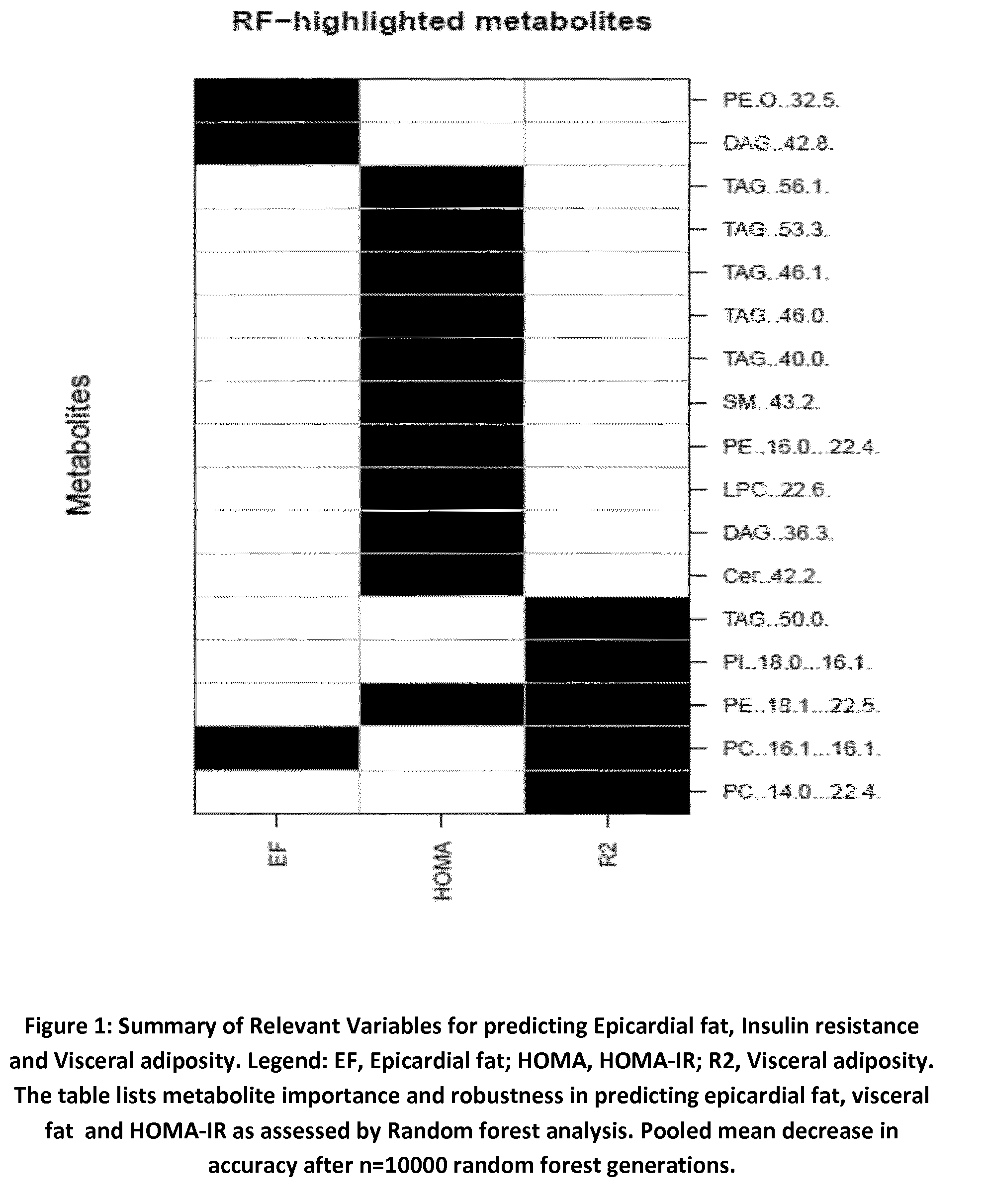
Figure 1
Abstract
Description
FIELD OF THE INVENTION
[0001] The present invention provides a number of lipid biomarkers and biomarker combinations that can be used to predict levels of epicardial adipose tissue in a subject.BACKGROUND
[0002] Visceral fat tissue is an important predictor of cardio-metabolic disease, carrying more risk than general fat accumulation.
[0003] Metabolically deleterious and life threatening forms of obesity associate with accumulation of fat in the visceral adipose tissue and ectopic fat deposition in organs (Graner et al. (2013), 98: 1189-1197; Donahue and Abbott, (1987), Lancet 2: 1215; Kalkhoff et al. (1983), J Lab Clin Med 102: 621-627. In particular, higher visceral adiposity (VA) links to a higher probability of developing atherosclerotic cardiovascular diseases mediated via complex signaling metabolic functions that interplay with the endocrine and immune system (Batra and Siegmund, (2012), Dig Dis 30: 70-74; Fox et al. (2007), Circulation 116: 39-48).
[0004] Visceral fat includes a com...
Examples
example 1
Materials and Methods
Participants and Experimental Design
[0091]The observational study was conducted on 40 healthy obese Caucasian women at the out-patient obesity clinic of the University Hospital of Lausanne (CHUV), Switzerland, after receiving informed consent from the appropriate ethical review board at CHUV. The participants had a BMI between 28 and 40, aged between 25 and 45 years old and showed no metabolic disease traits. Additional exclusion criteria were diabetes, pregnancy, antibiotic therapy within 1 month prior to the beginning of the study, any therapy (contraception apart) within the run-in period of one week before the visit day, and eating disorders. Subjects having recently undergone a weight loss of more than 3 kilos during the last 3 months were also excluded. No subjects suffered from hypertension, glucose intolerance, polycystic ovary syndrome, thyroid dysfunction and adrenal disorders. At a baseline (V0), subjects underwent a standard medical visit, where over...
example 2
[0103]The plasma lipidome and its encapsulated information with regards to specific visceral adipose depots was investigated. In particular, modern imaging technologies based on magnetic resonance (MRI) and CT can generate accurate regio-specific quantification of visceral fat depots, including EAT (Wang et al. (2009) J Clin Endocrinol Metab 94: 662-669). Within the same cohort study of healthy obese women, a shotgun lipidomics approach was applied to quantify blood plasma lipid profiles, and assess the composite metabolic signatures related to the specific body fat deposition, with emphasis on VA, EAT and insulin resistance. The present study therefore provides complementary and novel insights on how the topography of visceral adiposity links differently to the blood plasma lipidome of healthy obese women.
Relationships Between Epicardial Fat Measures, Clinical and Body Composition Parameters
[0104]Anthropometric and clinical data for the cohorts are reported in tables 1 and 2. Initi...