
Humanized rodents that express heavy chains containing vl domains
a technology of vl domains and humanized rodents, which is applied in the field of humanized rodents that express vl domains, can solve the problems of unsatisfactory long-term treatment regimens, and unsatisfactory early antibody therapy, so as to improve fertility and reduce the effect of fertility loss and fertility restoration
Patent Information
- Authority / Receiving Office
- US · United States
- Patent Type
- Applications(United States)
- Current Assignee / Owner
- Publication Date
- 2017-04-06
- Estimated Expiration
- Not applicable · inactive patent
Smart Images
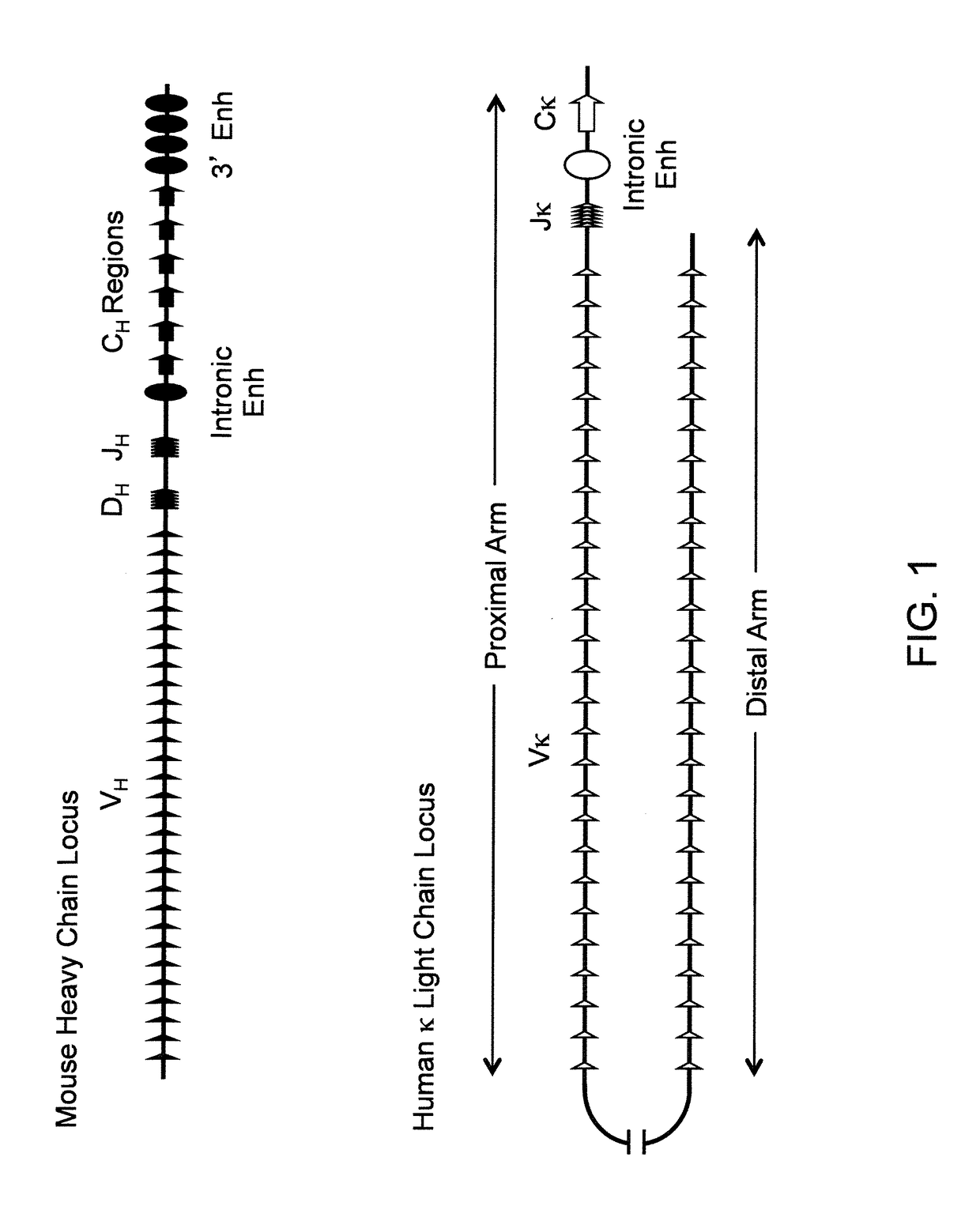
Figure 1 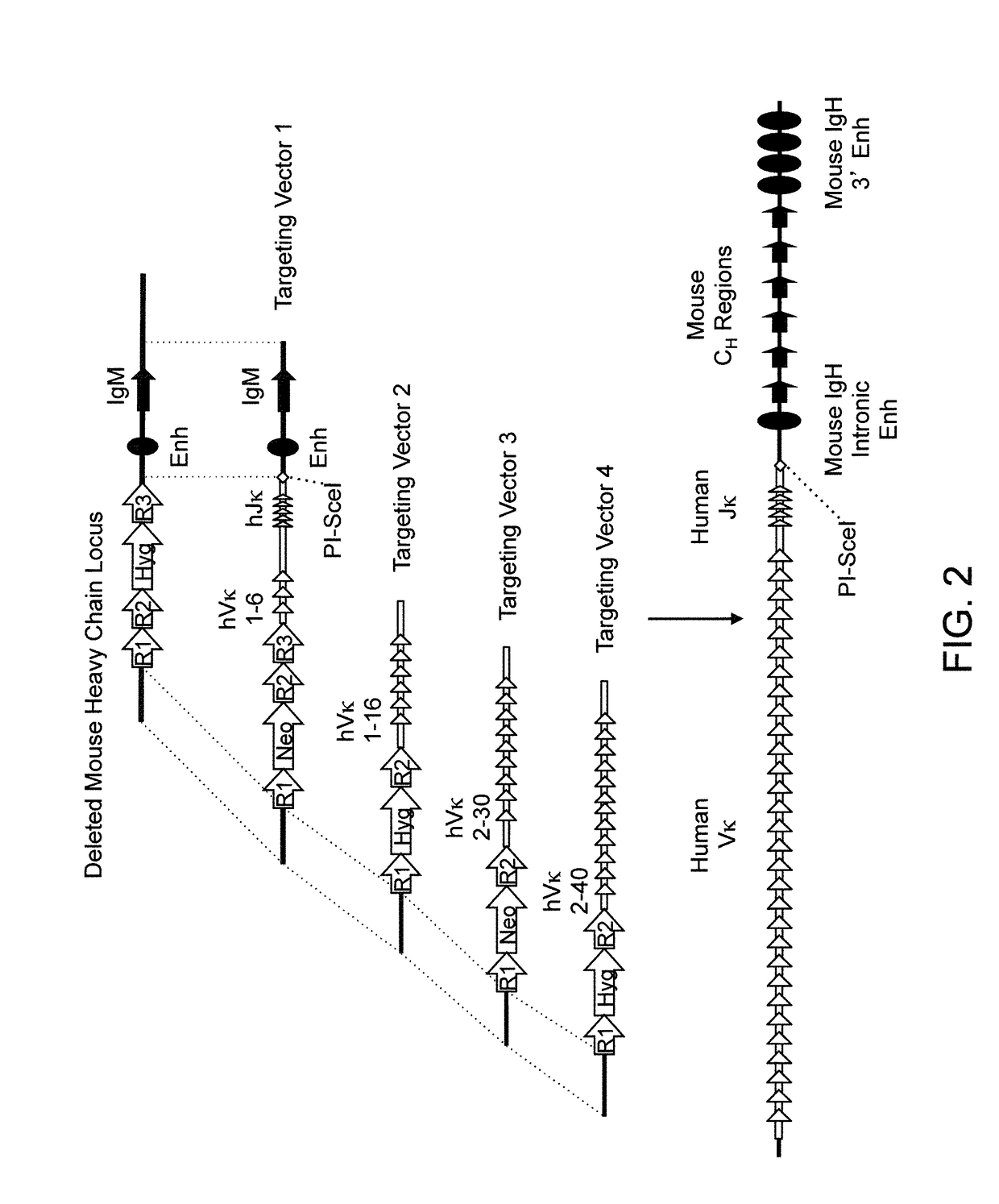
Figure 2 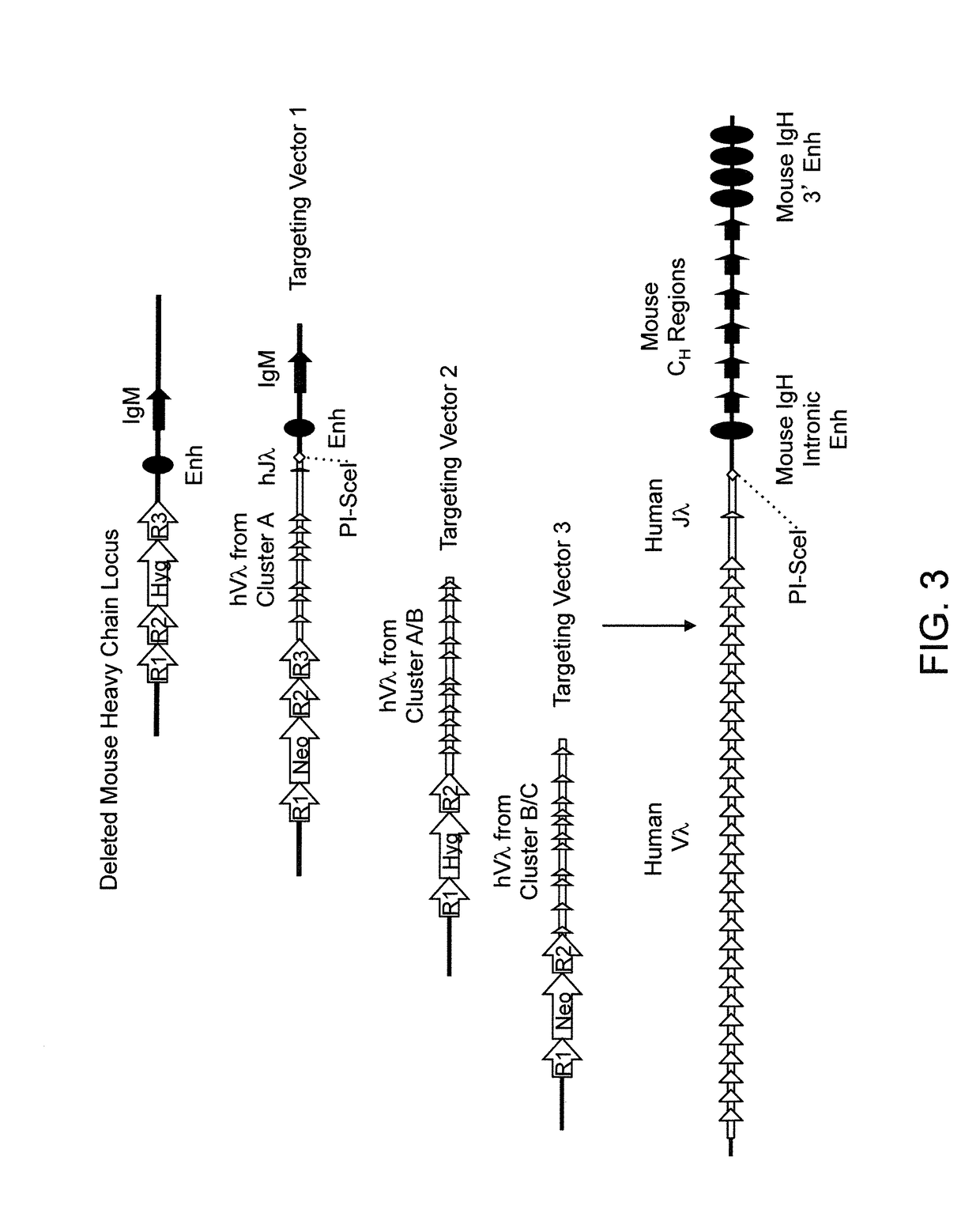
Figure 3
Abstract
Description
CROSS-REFERENCE TO RELATED APPLICATIONS
[0001] This application claims the benefit under 35 USC §119(e) of U.S. Provisional Application Ser. No. 61 / 593,463, filed Feb. 1, 2012 and U.S. Provisional Application Ser. No. 61 / 677,538, filed Jul. 31, 2012, which applications are hereby incorporated by reference in their entirety.FIELD OF INVENTION
[0002] Genetically modified non-human fertile animals that express human immunoglobulin-like binding proteins comprising an immunoglobulin heavy chain constant region fused with an immunoglobulin light chain variable domain are provided, as well as binding proteins having an immunoglobulin light chain variable domain fused to a light chain constant domain and an immunoglobulin light chain variable domain fused to a heavy chain constant domain. Genetically modified mice, cells, embryos, and tissues that comprise a nucleic acid sequence that encodes a functional ADAM6 protein are described, wherein the mice, cells, embryos, and tissues comprise human ...
Examples
example 1
ion of Human Light Chain Gene Segments into a Heavy Chain Locus
[0505]Various targeting constructs were made using VELOCIGENE® genetic engineering technology (see, e.g., U.S. Pat. No. 6,586,251 and Valenzuela et al. (2003), High-throughput engineering of the mouse genome coupled with high-resolution expression analysis, Nat Biotechnol 21:652-659) to modify mouse genomic Bacterial Artificial Chromosome (BAC) libraries. Mouse BAC DNA was modified by homologous recombination to inactivate the endogenous heavy chain locus through targeted deletion of VH, DH and JH gene segments for the ensuing insertion of unrearranged human germline κ light chain gene sequences (e.g., see top of FIG. 2).
[0506]Briefly, the mouse heavy chain locus was deleted in two successive targeting events using recombinase-mediated recombination. The first targeting event included a targeting at the 5′ end of the mouse heavy chain locus using a targeting vector comprising from 5′ to 3′ a 5′ mouse homology arm, a reco...
example 2
ation of Targeted ES Cells and Generation of Genetically Modified Mice Bearing Human Light Chain Gene Segments at an Endogenous Heavy Chain Locus
[0520]The targeted BAC DNA made in the foregoing Examples is used to electroporate mouse ES cells to created modified ES cells for generating chimeric mice that express VL binding proteins (i.e., human κ light chain gene segments operably linked to mouse heavy chain constant regions). Targeted ES cells containing an insertion of unrearranged human κ light chain gene segments are identified by a quantitative PCR assay, TAQMAN® (Lie, Y. S., and Petropoulos, C. J. (1998) Advances in quantitative PCR technology: 5′ nuclease assays. Curr Opin Biotechnol 9(1): 43-48). Specific primers sets and probes are designed to detect insertion of human κ sequences and associated selection cassettes, loss of mouse heavy chain sequences and retention of mouse sequences flanking the endogenous heavy chain locus.
[0521]ES cells bearing the human κ light chain ge...
example 4
ring of ADAM Genes into a Modified Heavy Chain Locus
[0527]Mice with modified immunoglobulin heavy chain loci in which the endogenous variable region gene segments (i.e., VDJ) have been replaced and / or deleted lack expression of endogenous ADAM6 genes. In particular, male mice comprising such modifications of the immunoglobulin heavy chain loci demonstrate a reduction in fertility. This Example demonstrates two methods to reengineer the capability to express ADAM6 into the mice with the modified heavy chain loci according to Example 1, thus allowing for the maintenance of the modified mouse strains using normal breeding methods.
[0528]Reengineering of ADAM6 Genes within Human Light Chain Gene Segments.
[0529]A modified immunoglobulin heavy chain locus containing human Vκ and Jλ gene segments was reengineered to contain a genomic fragment encoding mouse ADAM6a and ADAM6b by homologous recombination using BAC DNA. This was accomplished by VELOCIGENE® genetic engineering technology (supra...