
Treatment of circadian rhythm disorders
a technology for circadian rhythm and disorders, applied in the field of circadian rhythm disorders, can solve the problems of abnormal night sleep patterns, difficulty in staying awake during the day, and the inability of the master body clock to be reset daily and maintain entrainment to a 24-hour day
Patent Information
- Authority / Receiving Office
- US · United States
- Patent Type
- Applications(United States)
- Current Assignee / Owner
- Publication Date
- 2017-10-26
- Estimated Expiration
- Not applicable · inactive patent
Smart Images
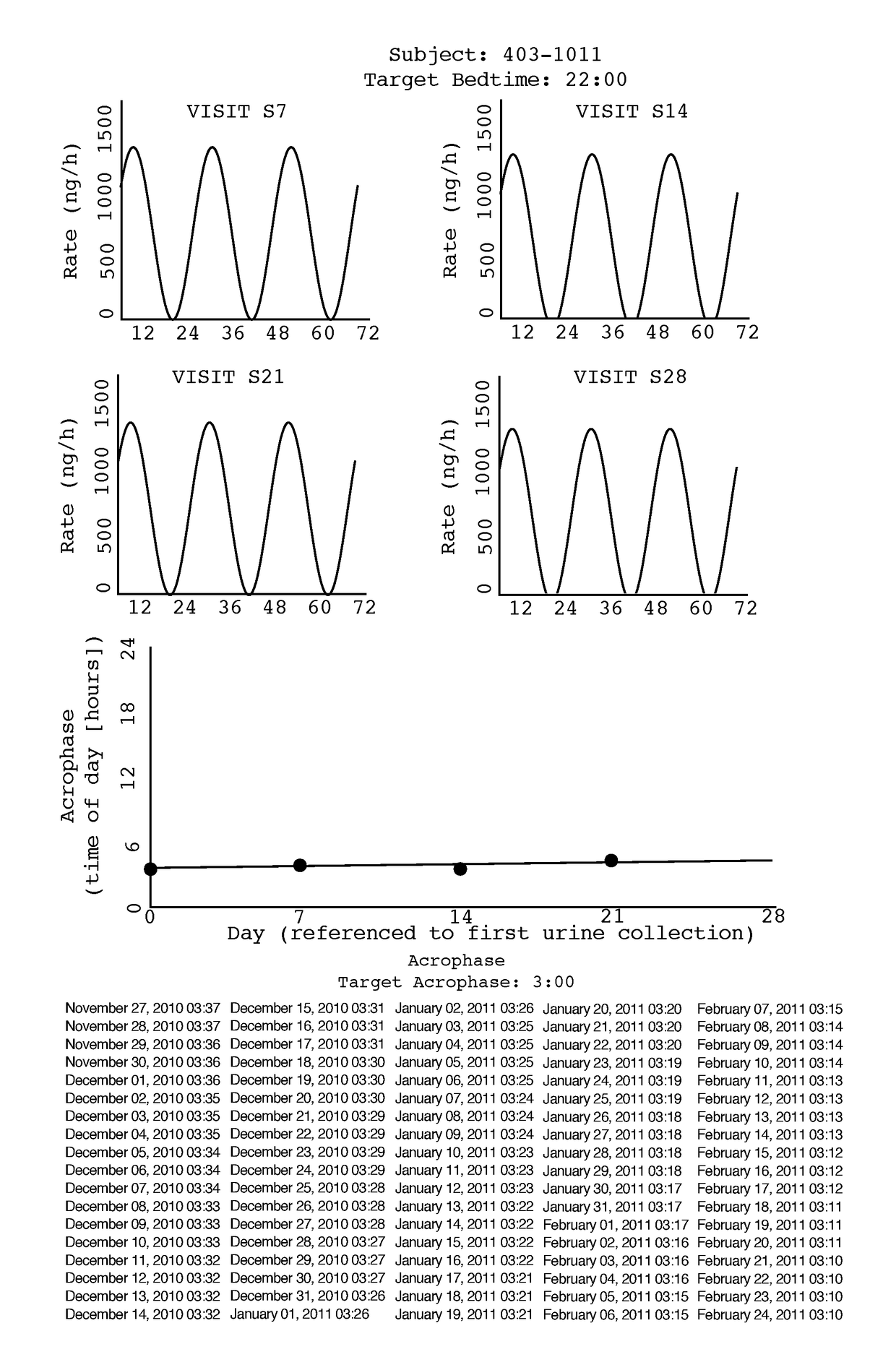
Figure 1 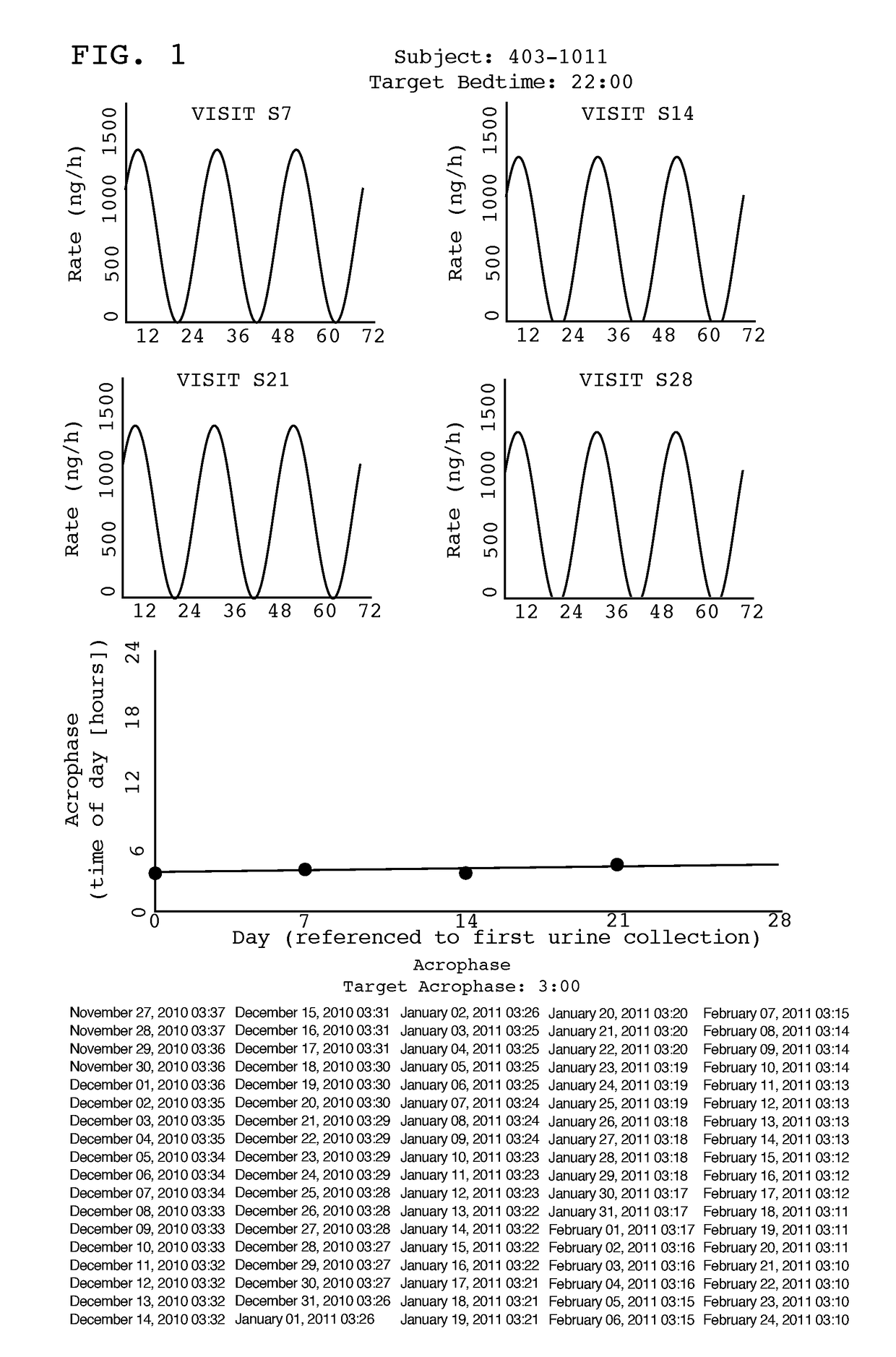
Figure 2 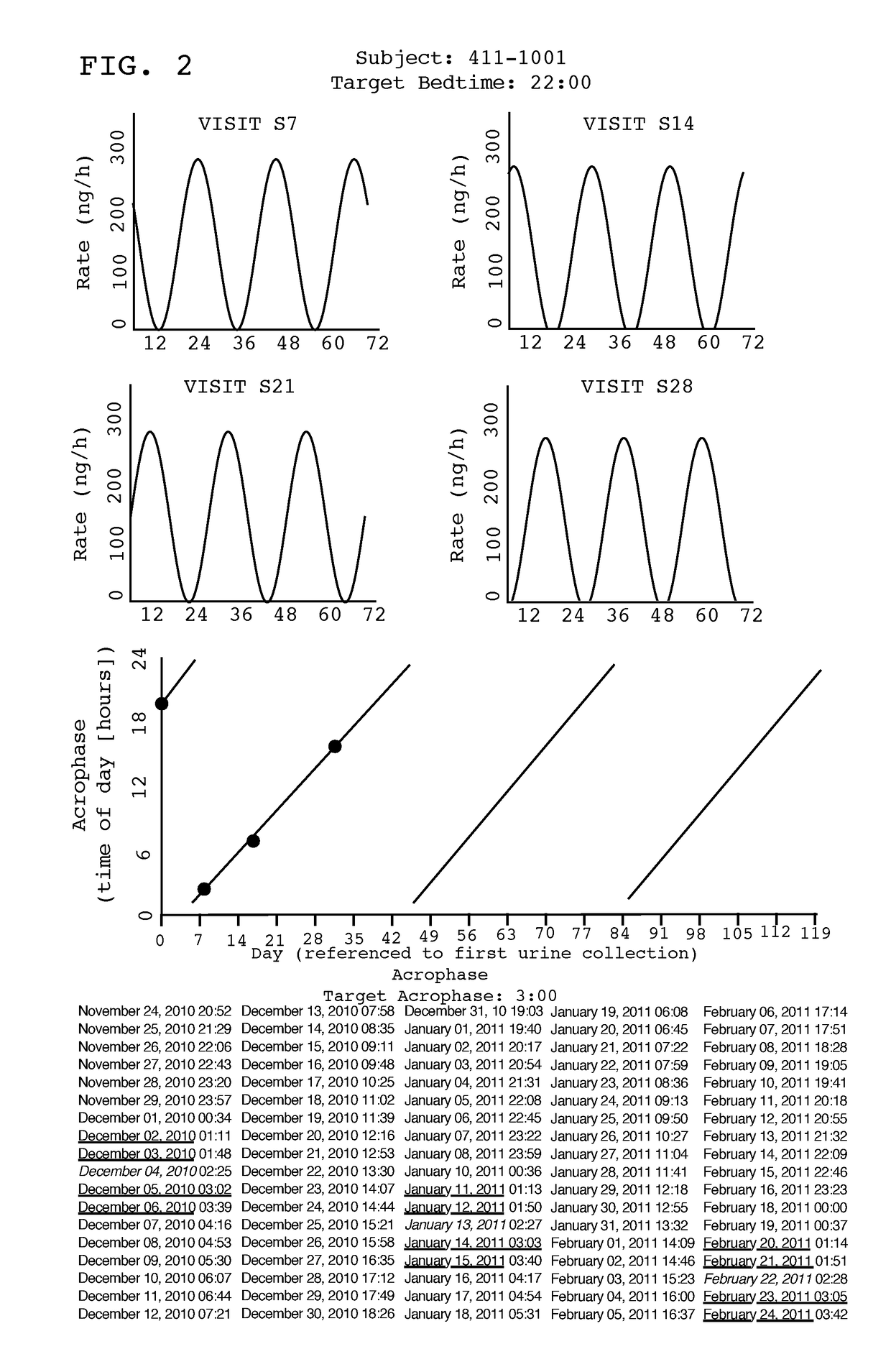
Figure 3
Abstract
Description
CROSS-REFERENCE TO RELATED APPLICATIONS
[0001] This application is a continuation U.S. patent application Ser. No. 14 / 510,321, filed 9 Oct. 2014, which is a continuation of then co-pending International Patent Application No. PCT / US13 / 76311, filed 18 Dec. 2013, which in turn claims the benefit of then co-pending U.S. Provisional Patent Application No. 61 / 903,354, filed 12 Nov. 2013, each of which is hereby incorporated herein as though fully set forth.FIELD OF THE INVENTION
[0002] Embodiments of the invention relate generally to the field of circadian rhythm disorders (CRDs) and, more particularly, to the entrainment of circadian rhythms in persons afflicted with Non-24 Hour Disorder (Non-24).BACKGROUND OF THE INVENTION
[0003] The master body clock controls the timing of many aspects of physiology, behavior and metabolism that show daily rhythms, including the sleep-wake cycles, body temperature, alertness and performance, metabolic rhythms and certain hormones which exhibit circadian var...
Examples
Embodiment Construction
[0020]Tasimelteon has the chemical name: trans-N-[[2-(2,3-dihydrobenzofuran-4-yl)cycloprop-1yl]methyl]propanamide, has the structure of Formula I:
and is disclosed in U.S. Pat. No. 5,856,529 and in US 20090105333, both of which are incorporated herein by reference as though fully set forth.
[0021]Tasimelteon is a white to off-white powder with a melting point of about 78° C. (DSC) and is very soluble or freely soluble in 95% ethanol, methanol, acetonitrile, ethyl acetate, isopropanol, polyethylene glycols (PEG-300 and PEG-400), and only slightly soluble in water. The native pH of a saturated solution of tasimelteon in water is 8.5 and its aqueous solubility is practically unaffected by pH. Tasimelteon has 2-4 times greater affinity for MT2R relative to MT1R. Ifs affinity (Ki) for MT1R is 0.3 to 0.4 and for MT2R, 0.1 to 0.2. Tasimelteon is useful in the practice of this invention because it is a melatonin agonist that has been demonstrated, among other activities, to entrain patients s...