

Scale Deposition Inhibiting Scavenger Compositions And Their Use
a technology of scavenger compositions and compositions, which is applied in the direction of quary waste water treatment, specific water treatment objectives, separation processes, etc., can solve the problems of scale deposition that affects the performance of oilfield equipment, reduces the effectiveness of h/sub>2/sub>s scavenger components, and reduces the amount of scale inhibitor compositions required to attempt to control the scale deposition. , to achieve the effect of increasing the proportion of solid
Patent Information
- Authority / Receiving Office
- US · United States
- Patent Type
- Applications(United States)
- Current Assignee / Owner
- Publication Date
- 2022-07-07
Smart Images
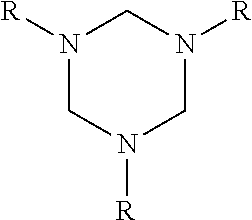
Figure 1 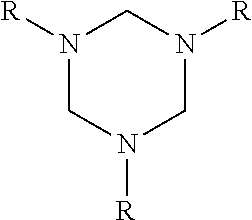
Figure 2
Abstract
Description
[0001] This invention has to do with methods and compositions for the treatment of fluids to remove or reduce levels of hydrogen sulphide and reduce or eliminate deposition of scale on surfaces in contact with the fluid.BACKGROUND
[0002] In the oil and gas industries, fluid bodies and fluid streams are often treated with scavengers to remove hydrogen sulfide (H2S). H2S is often present in processes involving the recovery, production or handling of hydrocarbons such as petroleum, petroleum gas and their derivatives. The H2S may be present not only in or above the hydrocarbon fluid but also in associated water, e.g. in sea water or underground water mixed with the hydrocarbon.
[0003] The acidity and toxicity of H2S necessitate its reduction to low levels. To remove it, various processes are known and one of these is to treat the fluid or fluids concerned with a scavenger substance which reacts selectively with the H2S. A wide range of scavenger compounds is known for this purpose. One grou...
Examples
example 1
r Test
[0053]Table 1 shows various example formulations A-C and comparative formulations D and E. All formulations showed at least 55′% triazine activity.
TABLE 1CompositionComponentABCDETriazine9590959095scavengerTerpolymer 1510Terpolymer 25Phosphonate 110Antiscale 15
[0054]The determination of the efficiency of scale inhibition, for the control of carbonate and / or sulphate scaling, was performed by a static jar technique at ambient pressure.
[0055]Visual observations and determination of the level of scale was made after 1, 2, 4 and 24 hours. Observations included visual observations of scale formed, and analysis of the scaling ions using Inductively Coupled Plasma Mass Spectrometry (ICP).
[0056]A static scale jar test gives an indication (at atmospheric pressure) of the minimum scale inhibitor concentration (MIC) required to prevent scaling, by observation of the degree of scale formed both with and without scale inhibitor. In order to achieve controlled scaling, the scaling test brin...
example 2
[0064]A static jar test was undertaken using the protocol as set out in Example 1 but using test fluid taken from an oilfield site. The test fluid already contained some scale inhibitor component so a comparative test with no addition of the composition of the present invention was also undertaken. The following tests were undertaken.
[0065]1. Oilfield fluid (Blank-1)
[0066]2. Oilfield fluid+1500 ppm triazine scavenger (Blank-2)
[0067]3. Oilfield fluid+1500 ppm composition A (table 1 above)
[0068]4. Oilfield fluid+1500 ppm composition B (table 1 above)
[0069]5. Oilfield fluid+1500 ppm composition C (table 1 above)
[0070]6. Oilfield fluid+1500 ppm composition D (table 1 above)
[0071]Analysis was by visual observation as in Example 1 and also by ICP analysis of the scale deposit. Visual results are shown in table 4 below, wherein:
[0072]0=Clear Water—No Scaling
[0073]1=Hazy water
[0074]2=Scaling
[0075]3=Thick Precipitation at the bottom.
TABLE 4Time after test start (hours)Test number024241000120...