
Hardware function generator support in a DSP
a function generator and hardware technology, applied in the field of digital signal processing, can solve the problems of limited function and data resolution, large amount of data stored in a rom lookup table that can quickly surpass practical size and cost limitations, and typical software implementations of function generation are relatively slow. , to achieve the effect of efficiently retrieving information, quick and efficient processing of cordic algorithm in pipeline, and low overhead
Patent Information
- Authority / Receiving Office
- US · United States
- Patent Type
- Patents(United States)
- Current Assignee / Owner
- Publication Date
- 2006-04-18
- Estimated Expiration
- Not applicable · inactive patent
Smart Images
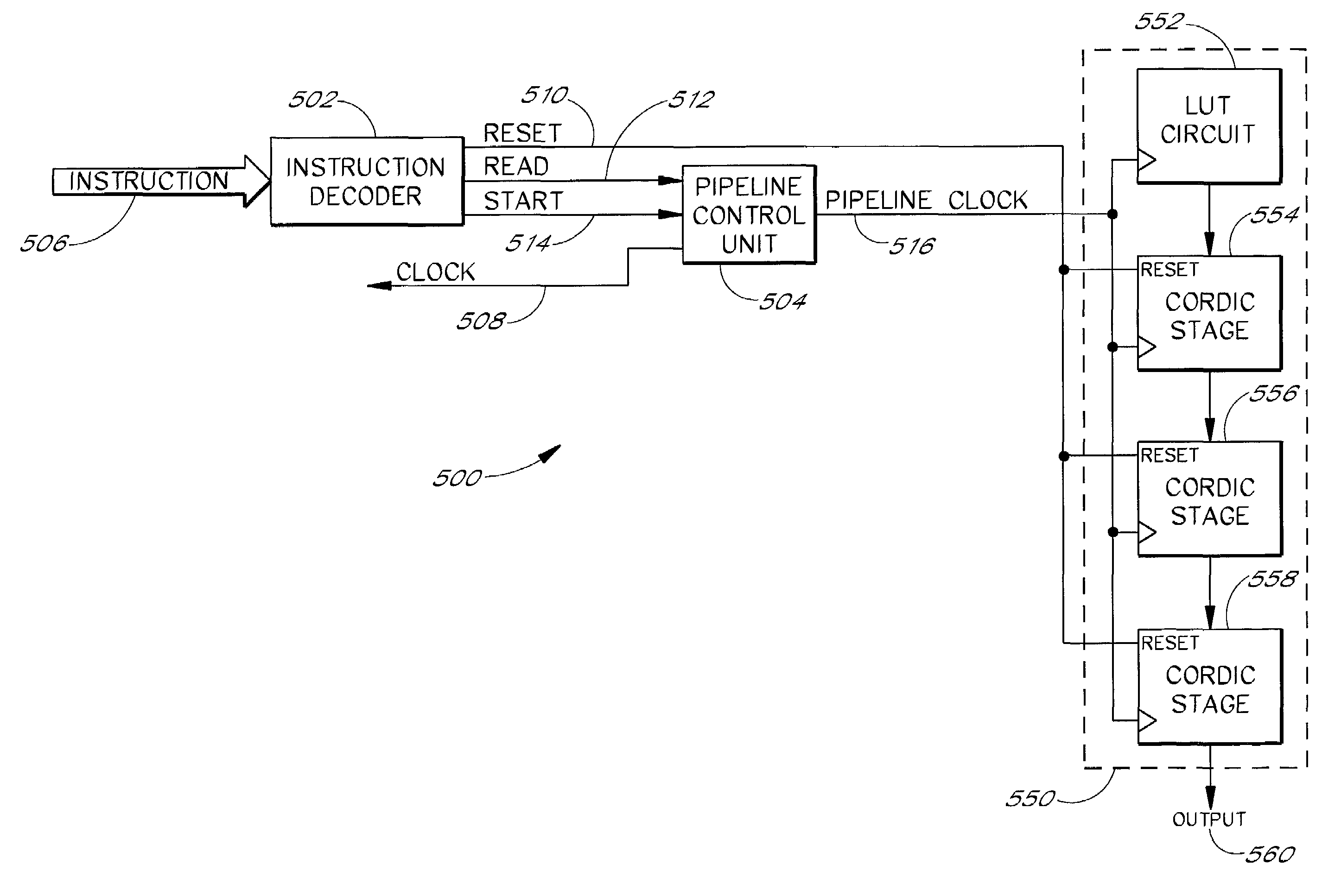
Figure 1 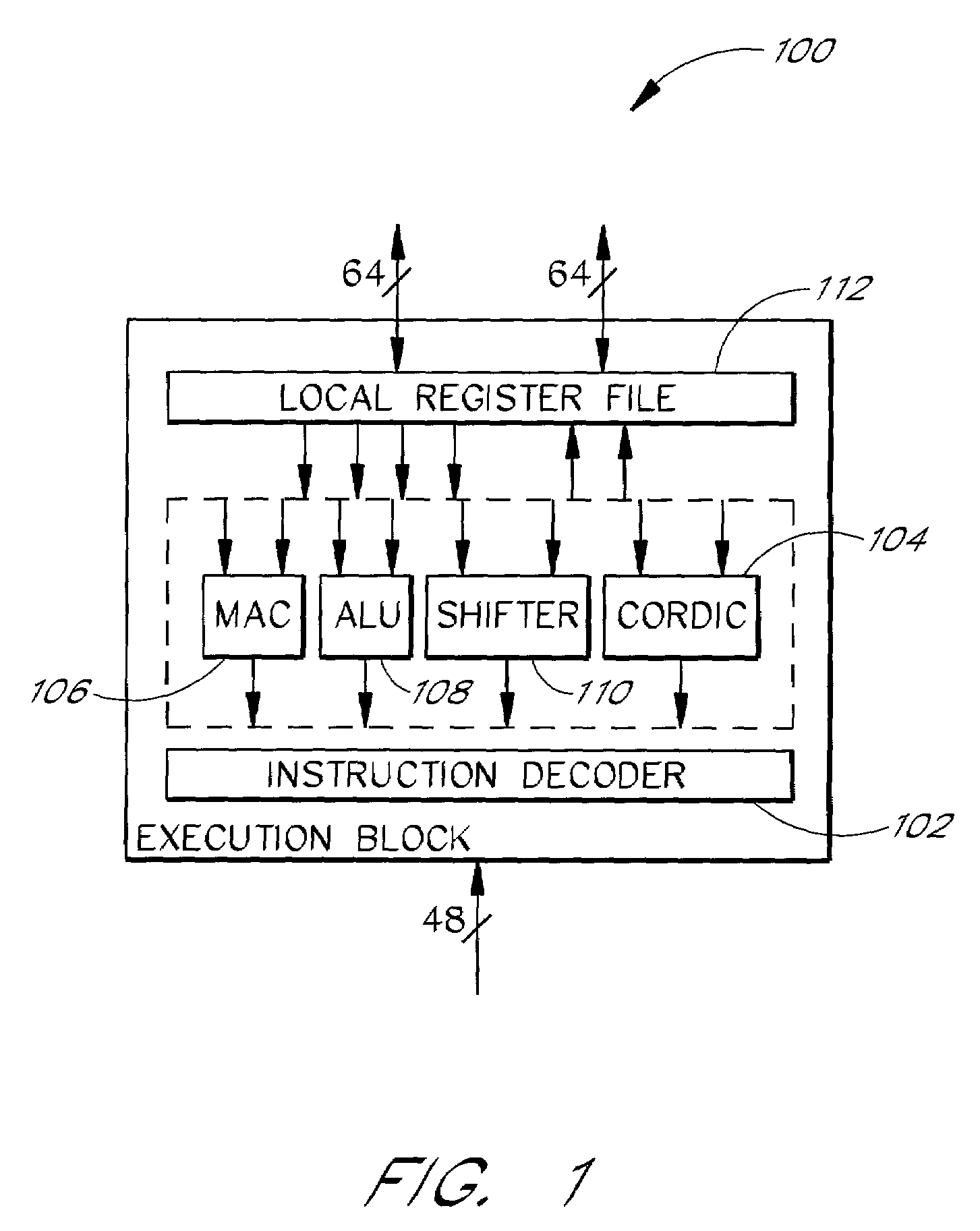
Figure 2 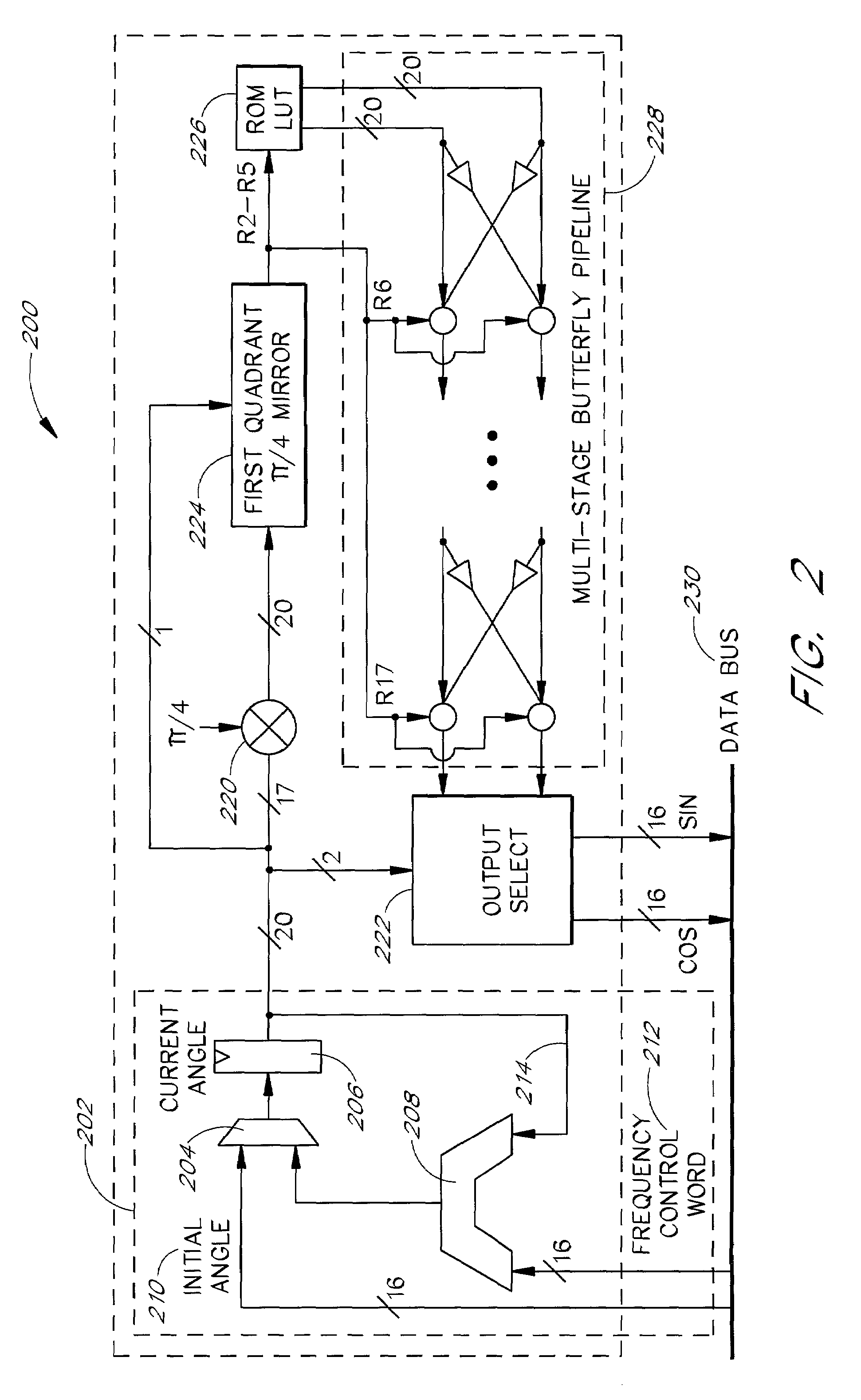
Figure 3
Abstract
Description
RELATED APPLICATION
[0001] This application claims the benefit under 35 U.S.C. § 119(e) of U.S. Provisional Application No. 60 / 231,280, filed Sep. 8, 2000, the entirety of which is hereby incorporated by reference.BACKGROUND OF THE INVENTION
[0002] 1. Field of the Invention
[0003] The present invention generally relates to digital signal processing. In particular, the present invention relates to a Coordinate Rotation Digital Computer (CORDIC) in a digital signal processor (DSP).
[0004] 2. Description of the Related Art
[0005] A Coordinate Rotation Digital Computer (CORDIC) algorithm performs vector coordinate rotations by using simple iterative shifts and add / subtract operations, which are relatively easy to implement in hardware. Advantages of the CORDIC algorithm have been well documented by U.S. Pat. No. 4,896,287 to O'Donnell, et al., U.S. Pat. No. 4,937,775 to Engeler, et al., and U.S. Pat. No. 5,684,435 to Bergen, the entireties of which are hereby incorporated by reference.
[0006] The C...
Examples
Embodiment Construction
[0029]Although this invention is described in terms of certain preferred embodiments, other embodiments that are apparent to those of ordinary skill in the art, including embodiments which do not provide all of the benefits and features set forth herein, are also within the scope of this invention. Accordingly, the scope of the present invention is defined only by reference to the appended claims.
[0030]One use of a Coordinate Rotation Digital Computer (CORDIC) algorithm is to generate functions such as trigonometric, logarithmic, hyperbolic and linear functions. Another use of the CORDIC algorithm is to convert between Polar and Cartesian coordinates. The CORDIC algorithm performs vector coordinate rotations using simple iterative shifts and add / subtract operations. The general (Givens') rotation transform expressed in Equations 1A and 1B rotates a vector by an angle φ.
x′=x cos φ−y sin φ
y′=y cos φ+x sin φ Eqs. 1A and 1B
[0031]The transform can be rearranged as shown in Equations 2A ...