
Inhibitors of c-Jun N terminal kinases (JNK) and other protein kinases
a technology of c-jun n-terminal kinase and inhibitors, which is applied in the field of inhibitors of protein kinase, can solve the problems of not being specifically selective for mapks versus other related mapks, and achieve the effects of preventing thrombin-induced platelet aggregation, preventing cell death and hyperplasia, and treating or preventing reperfusion/ischemia
Patent Information
- Authority / Receiving Office
- US · United States
- Patent Type
- Patents(United States)
- Current Assignee / Owner
- Publication Date
- 2007-01-30
- Estimated Expiration
- Not applicable · inactive patent
Smart Images
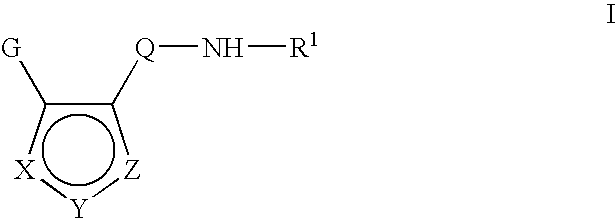
Figure 1 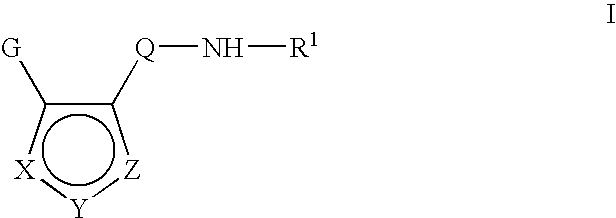
Figure 2 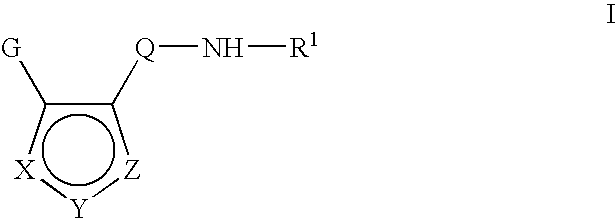
Figure 3
Abstract
Description
[0001] This application is a divisional of U.S. application Ser. No. 10 / 074,177, filed Feb. 12, 2002, now U.S. Pat. No. 6,693,108; which claims benefit of International Application PCT / US00 / 22445, filed Aug. 11, 2000; which claims priority from U.S. Provisional Application 60 / 148,795, filed Aug. 13, 1999, U.S. Provisional Application 60 / 166,922, filed Nov. 22, 1999, and U.S. Provisional Application 60 / 211,517, filed Jun. 14, 2000.TECHNICAL FIELD OF INVENTION
[0002] The present invention relates to inhibitors of protein kinase, especially c-Jun N-terminal kinases (JNK), which are members of the mitogen-activated protein (MAP) kinase family. There are a number of different genes and isoforms which encode JNKs. Members of the JNK family regulate signal transduction in response to environmental stress and proinflammatory cytokines and have been implicated to have a role in mediating a number of different disorders. The invention also relates to methods for producing these inhibitors. The i...
Examples
example 1
[0137]To benzaldhyde (10.0 g, 94 mmol) in ethanol (50 mL) was added hydroxylamine hydrochloride (6.5 g, 94 mmol in H2O (50 mL) followed by Na2CO3 in H2O (50 mL). Reaction solution was stirred for 2 hr. Poured into brine and extracted twice with diethyl ether. Combined extracts were dried over MgSO4. Evaporation afforded benzaldehyde oxime (11.0 g, 96.5% yield) as a colorless oil. 1H NMR (CDCl3) δ 7.40–7.50 (m, 3H), 7.60–7.70 (m, 2H), 8.22 (s, 1H), 9.1 (bs, 1H).
example 2
α-Chlorobenzaldehyde oxime (Benzoyl chloride oxime)
[0138]To benzaldehyde oxime (12.2 g, 0.1 mol) in chloroform was added catalytic amount of pyridine, followed by N-chlorosuccinimide (13.35 g, 0.1 mol) at room temperature. The reaction mixture was stirred for 1.5 h, then saturated aqueous NaCl was added. The organic phase was washed with saturated aqueous NaCl (twice) and dried with MgSO4. The solvent was removed under reduced pressure. 13.85 g α-chlorobenzaldehyde oxime was obtained. The yield was 87%.
example 3
1-(5-Methyl-3-phenyl-isoxazol-4-yl)-ethanone (Compound 3)
[0139]To a solution of pentane-2,4-dione (13.23 g, 0.132 mol) and triethylamine (13.35 g, 0.132 mol) in ethanol was added α-chlorobenzaldehyde oxime (13.70 g, 0.088 mol) at room temperature. The reaction mixture was stirred overnight at room temperature. To the reaction was added ethyl acetate and saturated aqueous NaCl. The organic phase was washed with saturated aqueous NaCl (twice) and dried with MgSO4, and the organic solvent was removed under reduced pressure to provide 17.7 g of the title compound. The yield was 100%.