
Device for removing by suction drill dust when drilling holes into walls
a technology of suction drill and dust removal device, which is applied in the direction of maintenance and safety accessories, boring/drilling apparatus, thread cutting machine, etc., can solve the problems of only satisfying the effect of drill dust removal, affecting the quality of the finished product, and affecting the quality of finished products, etc., and achieves the effect of convenient handling and cheap production
Patent Information
- Authority / Receiving Office
- US · United States
- Patent Type
- Patents(United States)
- Current Assignee / Owner
- Publication Date
- 2011-11-08
- Estimated Expiration
- Not applicable · inactive patent
Smart Images
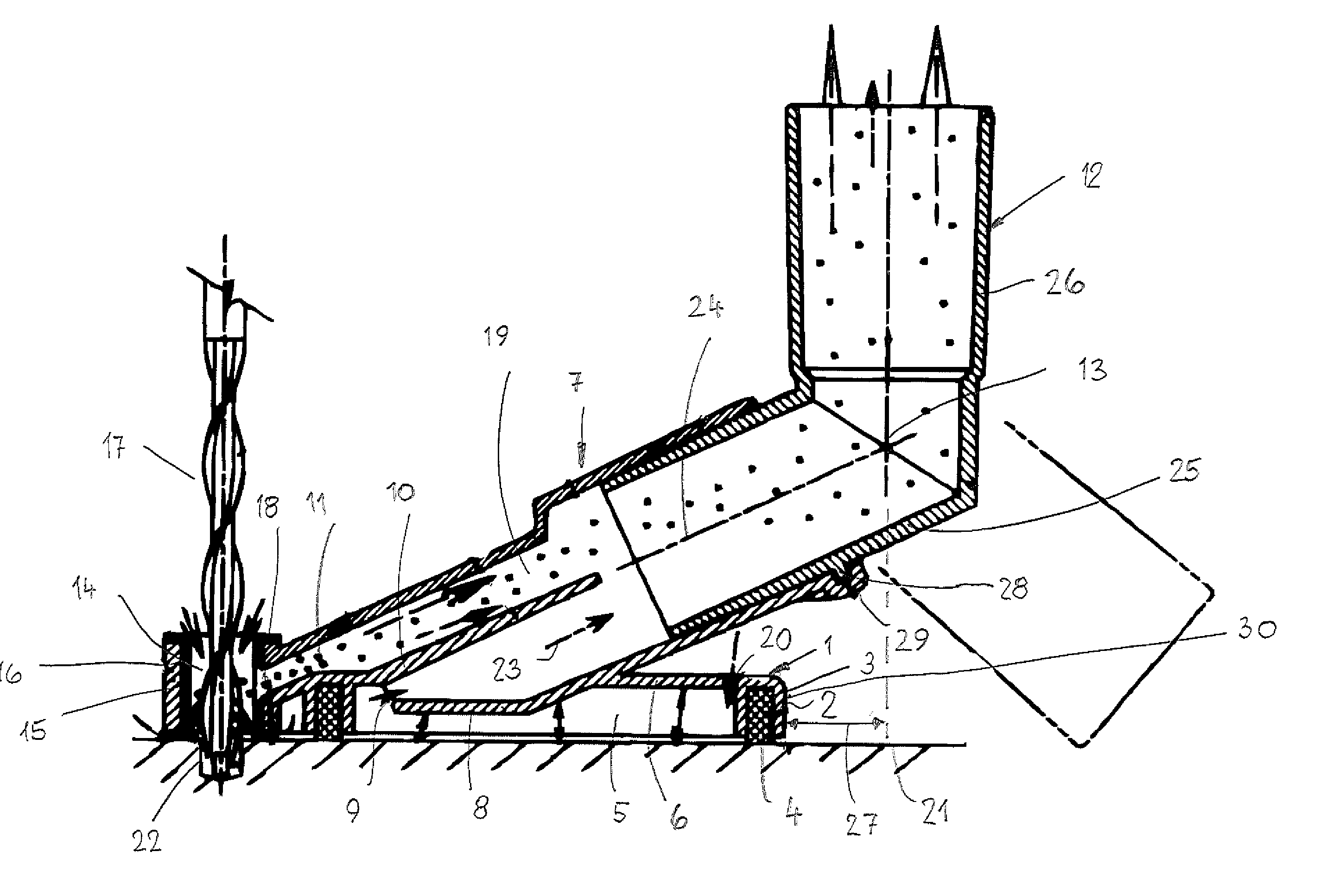
Figure 1 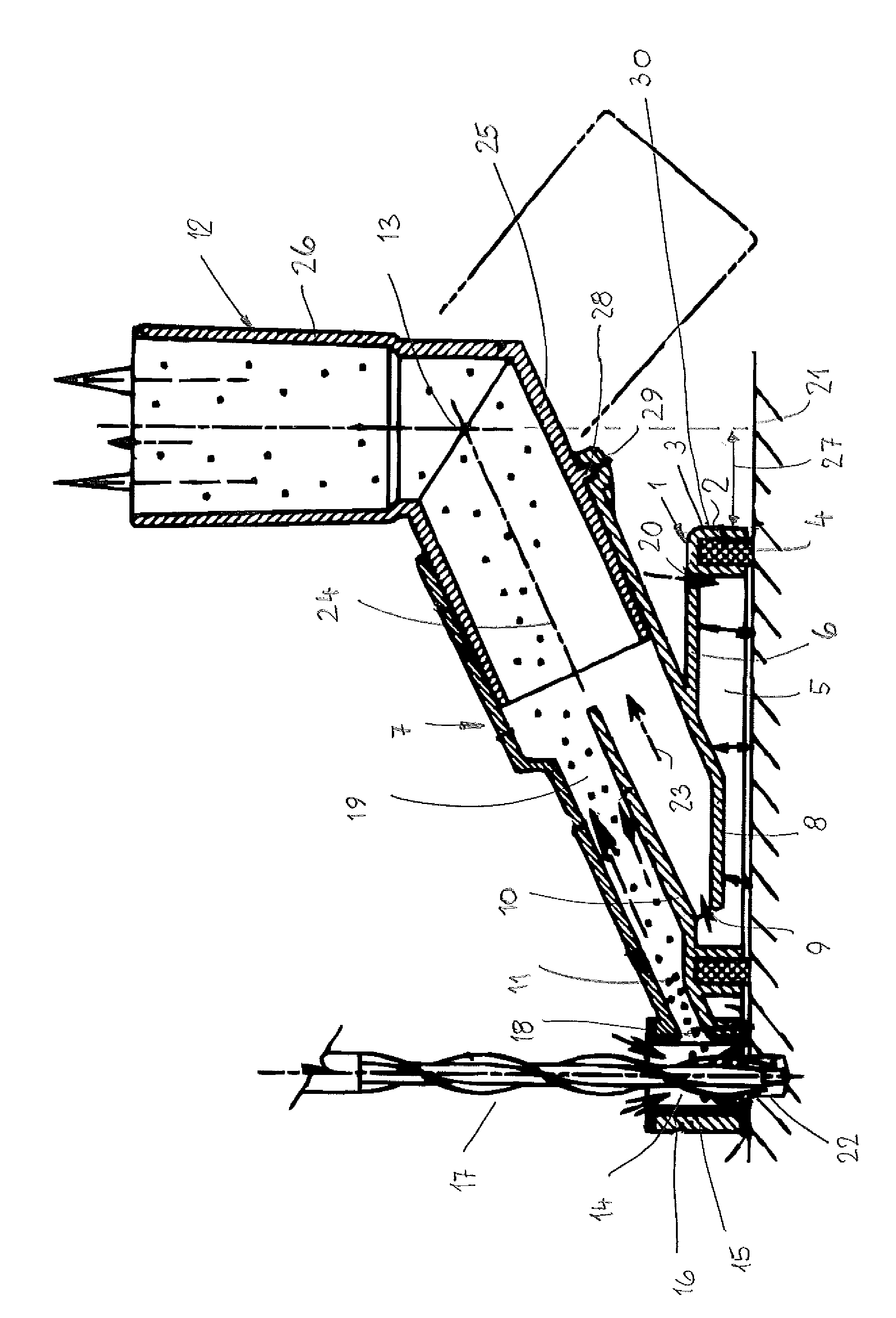
Figure 2
Abstract
Description
BACKGROUND OF THE INVENTIONThe invention relates to a device for removing by suction drill dust when drilling holes into walls and the like, wherein the device comprises at least one vacuum chamber, at least one suction site and a connector for a vacuum unit that removes by suction at the suction site the drill dust produced by drilling.Such removal devices serve the purpose of removing by suction (i.e., by vacuuming) drill dust that is produced when drilling a hole into a wall at the drilling location so that the drill dust does not fall onto the ground. For this purpose, the device is connected to a vacuum hose of a vacuum cleaner so that the drill dust is removed from the drilling location. In this connection, a vacuum or underpressure is produced in the vacuum chamber and the vacuum ensures that the device is pulled tightly against the wall. The device therefore must not be held by hand during the drilling operation. The drill is inserted through an opening in the chamber wall o...
Examples
Embodiment Construction
The removal device is used in order to remove by suction the drill dust produced when drilling a hole directly at the drilling location. The device has a base member 1 that can have any contour. About a portion of its circumference, the device has a rim 2 that is rectangularly angled and in which a recess 3 for receiving a seal 4 is provided. The seal 4 projects past the rim 2 and surrounds the vacuum chamber 5 which is delimited circumferentially by the rim 2 with seal 4 and by a cover part 6 of the base member 1. A tubular connecting socket 7 projects into the vacuum chamber 5 and is advantageously embodied monolithically together with the base member 1. The connecting socket 7 projects with most of its length past the base member 1. It projects with its end area 8 slightly into the vacuum chamber 5. The end area 8 has an opening 9 by means of which the vacuum chamber 5 is connected to the interior of the connecting socket 7.
A partition 10 is provided in the connecting socket 7 an...