

Advanced Cooling Techniques For SiC MOSFET Power Modules
SEP 8, 20259 MIN READ
Generate Your Research Report Instantly with AI Agent
PatSnap Eureka helps you evaluate technical feasibility & market potential.
SiC MOSFET Cooling Technology Background and Objectives
Silicon Carbide (SiC) MOSFET power modules have emerged as revolutionary components in power electronics, offering superior performance characteristics compared to traditional silicon-based devices. The evolution of SiC technology began in the early 1990s with fundamental research, followed by commercial availability in the 2000s, and has since experienced accelerated adoption across multiple industries including automotive, renewable energy, and industrial applications.
The inherent properties of SiC material—wide bandgap, high thermal conductivity, and high breakdown electric field—enable power devices that operate at higher temperatures, frequencies, and voltages while maintaining smaller form factors. This technological advancement has created a paradigm shift in power electronics design, allowing for more efficient and compact power conversion systems.
Despite these advantages, thermal management remains a critical challenge for SiC MOSFET power modules. As power density increases, the heat flux generated within these modules can exceed 300 W/cm², significantly higher than traditional silicon devices. Conventional cooling methods are increasingly inadequate to maintain junction temperatures within safe operating limits, which typically should not exceed 175°C for long-term reliability.
The thermal management challenge is further complicated by the faster switching speeds of SiC devices, which create more concentrated heat generation patterns and thermal transients that conventional cooling systems struggle to address. Additionally, the thermal resistance between die and heatsink becomes a more significant bottleneck as device performance improves.
Industry trends indicate a continuous push toward higher power density, efficiency, and reliability, necessitating advanced cooling solutions specifically optimized for SiC technology. The market demands smaller, lighter power electronics with improved performance metrics, particularly in electric vehicles and renewable energy systems where space and weight constraints are paramount.
The primary technical objectives for advanced cooling techniques for SiC MOSFET power modules include: reducing thermal resistance from junction to ambient below 0.1 K/W; enabling operation at junction temperatures up to 200°C while maintaining reliability; minimizing temperature gradients across the module to prevent thermal stress; and developing cooling solutions that are cost-effective and manufacturable at scale.
Future development trajectories point toward integrated cooling approaches that combine multiple techniques, such as direct liquid cooling with advanced thermal interface materials and embedded heat pipes. The ultimate goal is to fully leverage SiC's inherent capabilities by removing thermal limitations as a constraining factor in power module design, thereby enabling the next generation of high-performance power electronics systems with unprecedented power density and efficiency.
The inherent properties of SiC material—wide bandgap, high thermal conductivity, and high breakdown electric field—enable power devices that operate at higher temperatures, frequencies, and voltages while maintaining smaller form factors. This technological advancement has created a paradigm shift in power electronics design, allowing for more efficient and compact power conversion systems.
Despite these advantages, thermal management remains a critical challenge for SiC MOSFET power modules. As power density increases, the heat flux generated within these modules can exceed 300 W/cm², significantly higher than traditional silicon devices. Conventional cooling methods are increasingly inadequate to maintain junction temperatures within safe operating limits, which typically should not exceed 175°C for long-term reliability.
The thermal management challenge is further complicated by the faster switching speeds of SiC devices, which create more concentrated heat generation patterns and thermal transients that conventional cooling systems struggle to address. Additionally, the thermal resistance between die and heatsink becomes a more significant bottleneck as device performance improves.
Industry trends indicate a continuous push toward higher power density, efficiency, and reliability, necessitating advanced cooling solutions specifically optimized for SiC technology. The market demands smaller, lighter power electronics with improved performance metrics, particularly in electric vehicles and renewable energy systems where space and weight constraints are paramount.
The primary technical objectives for advanced cooling techniques for SiC MOSFET power modules include: reducing thermal resistance from junction to ambient below 0.1 K/W; enabling operation at junction temperatures up to 200°C while maintaining reliability; minimizing temperature gradients across the module to prevent thermal stress; and developing cooling solutions that are cost-effective and manufacturable at scale.
Future development trajectories point toward integrated cooling approaches that combine multiple techniques, such as direct liquid cooling with advanced thermal interface materials and embedded heat pipes. The ultimate goal is to fully leverage SiC's inherent capabilities by removing thermal limitations as a constraining factor in power module design, thereby enabling the next generation of high-performance power electronics systems with unprecedented power density and efficiency.
Market Demand Analysis for High-Performance Power Modules
The global market for high-performance power modules is experiencing unprecedented growth, driven primarily by the rapid expansion of electric vehicles (EVs), renewable energy systems, and industrial automation. SiC MOSFET power modules, with their superior performance characteristics compared to traditional silicon-based alternatives, are positioned at the forefront of this market evolution. Current market valuations place the SiC power device market at approximately $1.4 billion in 2023, with projections indicating a compound annual growth rate (CAGR) of 34% through 2028.
Electric vehicle applications represent the largest demand segment, accounting for nearly 60% of the SiC power module market. This dominance stems from the automotive industry's push toward higher efficiency powertrains, longer driving ranges, and faster charging capabilities. Major automotive manufacturers have announced aggressive electrification roadmaps, with many planning to achieve 40-50% electric vehicle production by 2030, further accelerating demand for advanced cooling solutions for SiC modules.
The renewable energy sector constitutes the second-largest market segment, representing approximately 25% of demand. Solar inverters and wind power systems increasingly require higher power density solutions that can operate reliably in challenging environmental conditions. The global push toward carbon neutrality has resulted in renewable capacity additions exceeding 290 GW annually, each installation requiring advanced power conversion systems where thermal management is critical.
Industrial applications, including motor drives, uninterruptible power supplies, and factory automation systems, comprise about 15% of the market. These applications demand power modules with extended operational lifetimes and reliability under continuous high-load conditions, making advanced cooling solutions essential.
Market research indicates that end-users are willing to pay a premium of 15-20% for power modules with superior thermal management capabilities, as the total cost of ownership benefits—including higher reliability, extended lifespan, and improved system efficiency—outweigh the initial investment. This price elasticity has created a significant opportunity for manufacturers who can deliver innovative cooling solutions.
Regional analysis shows Asia-Pacific leading the market with 45% share, followed by Europe (30%) and North America (20%). China, in particular, has emerged as both the largest consumer and producer of SiC power modules, driven by government initiatives supporting electric vehicle manufacturing and renewable energy deployment.
The market is further characterized by increasing customer demands for miniaturization, with a target power density improvement of 30% every five years. This trend directly impacts cooling requirements, as higher power densities generate more concentrated heat that must be efficiently dissipated to maintain performance and reliability.
Electric vehicle applications represent the largest demand segment, accounting for nearly 60% of the SiC power module market. This dominance stems from the automotive industry's push toward higher efficiency powertrains, longer driving ranges, and faster charging capabilities. Major automotive manufacturers have announced aggressive electrification roadmaps, with many planning to achieve 40-50% electric vehicle production by 2030, further accelerating demand for advanced cooling solutions for SiC modules.
The renewable energy sector constitutes the second-largest market segment, representing approximately 25% of demand. Solar inverters and wind power systems increasingly require higher power density solutions that can operate reliably in challenging environmental conditions. The global push toward carbon neutrality has resulted in renewable capacity additions exceeding 290 GW annually, each installation requiring advanced power conversion systems where thermal management is critical.
Industrial applications, including motor drives, uninterruptible power supplies, and factory automation systems, comprise about 15% of the market. These applications demand power modules with extended operational lifetimes and reliability under continuous high-load conditions, making advanced cooling solutions essential.
Market research indicates that end-users are willing to pay a premium of 15-20% for power modules with superior thermal management capabilities, as the total cost of ownership benefits—including higher reliability, extended lifespan, and improved system efficiency—outweigh the initial investment. This price elasticity has created a significant opportunity for manufacturers who can deliver innovative cooling solutions.
Regional analysis shows Asia-Pacific leading the market with 45% share, followed by Europe (30%) and North America (20%). China, in particular, has emerged as both the largest consumer and producer of SiC power modules, driven by government initiatives supporting electric vehicle manufacturing and renewable energy deployment.
The market is further characterized by increasing customer demands for miniaturization, with a target power density improvement of 30% every five years. This trend directly impacts cooling requirements, as higher power densities generate more concentrated heat that must be efficiently dissipated to maintain performance and reliability.
Current Cooling Solutions and Technical Challenges
Silicon Carbide (SiC) MOSFET power modules represent a significant advancement in power electronics, offering superior performance compared to traditional silicon-based devices. However, their ability to operate at higher temperatures and power densities creates substantial thermal management challenges that current cooling solutions must address.
The predominant cooling techniques currently employed for SiC MOSFET power modules can be categorized into several approaches. Air cooling remains the simplest solution, utilizing heat sinks with forced or natural convection. While cost-effective and reliable, air cooling systems struggle to dissipate the high heat flux generated by SiC devices operating at their full potential, typically limiting thermal dissipation to 0.5-1 W/cm².
Liquid cooling solutions have gained significant traction, with direct and indirect approaches. Indirect liquid cooling utilizes cold plates with internal channels for coolant circulation, achieving heat dissipation rates of 5-20 W/cm². Direct liquid cooling, where coolant directly contacts the device, can reach 50-100 W/cm² but introduces electrical isolation and reliability concerns.
Two-phase cooling technologies, including heat pipes and vapor chambers, leverage the latent heat of vaporization to achieve higher cooling efficiencies. These solutions can manage heat fluxes of 20-50 W/cm² while maintaining relatively uniform temperature distributions across the module.
Jet impingement cooling and spray cooling represent more advanced approaches, directing coolant precisely at hotspots to achieve localized cooling with heat flux capabilities exceeding 100 W/cm². However, these systems introduce complexity in terms of fluid delivery and pressure management.
Despite these advancements, significant technical challenges persist. The thermal interface materials (TIMs) between the SiC die and cooling system often create bottlenecks, with thermal resistances limiting overall cooling efficiency. Current TIMs struggle to maintain performance over time, with degradation occurring due to thermal cycling and aging.
Another critical challenge is managing thermal gradients across the module. SiC devices can experience significant temperature variations during operation, creating mechanical stress that threatens long-term reliability. Existing cooling solutions often fail to address these gradients effectively.
The integration of cooling systems with increasingly compact power module designs presents additional difficulties. As power density increases, the available space for cooling infrastructure decreases, forcing engineers to develop more efficient cooling architectures within tighter spatial constraints.
Furthermore, many advanced cooling solutions require pumps, fans, or other active components that introduce reliability concerns and energy consumption overhead, potentially offsetting some of the efficiency gains offered by SiC technology.
The predominant cooling techniques currently employed for SiC MOSFET power modules can be categorized into several approaches. Air cooling remains the simplest solution, utilizing heat sinks with forced or natural convection. While cost-effective and reliable, air cooling systems struggle to dissipate the high heat flux generated by SiC devices operating at their full potential, typically limiting thermal dissipation to 0.5-1 W/cm².
Liquid cooling solutions have gained significant traction, with direct and indirect approaches. Indirect liquid cooling utilizes cold plates with internal channels for coolant circulation, achieving heat dissipation rates of 5-20 W/cm². Direct liquid cooling, where coolant directly contacts the device, can reach 50-100 W/cm² but introduces electrical isolation and reliability concerns.
Two-phase cooling technologies, including heat pipes and vapor chambers, leverage the latent heat of vaporization to achieve higher cooling efficiencies. These solutions can manage heat fluxes of 20-50 W/cm² while maintaining relatively uniform temperature distributions across the module.
Jet impingement cooling and spray cooling represent more advanced approaches, directing coolant precisely at hotspots to achieve localized cooling with heat flux capabilities exceeding 100 W/cm². However, these systems introduce complexity in terms of fluid delivery and pressure management.
Despite these advancements, significant technical challenges persist. The thermal interface materials (TIMs) between the SiC die and cooling system often create bottlenecks, with thermal resistances limiting overall cooling efficiency. Current TIMs struggle to maintain performance over time, with degradation occurring due to thermal cycling and aging.
Another critical challenge is managing thermal gradients across the module. SiC devices can experience significant temperature variations during operation, creating mechanical stress that threatens long-term reliability. Existing cooling solutions often fail to address these gradients effectively.
The integration of cooling systems with increasingly compact power module designs presents additional difficulties. As power density increases, the available space for cooling infrastructure decreases, forcing engineers to develop more efficient cooling architectures within tighter spatial constraints.
Furthermore, many advanced cooling solutions require pumps, fans, or other active components that introduce reliability concerns and energy consumption overhead, potentially offsetting some of the efficiency gains offered by SiC technology.
State-of-the-Art Cooling Architectures for SiC MOSFETs
01 Liquid cooling systems for SiC MOSFET power modules
Liquid cooling systems are effective for managing heat in SiC MOSFET power modules. These systems typically use coolants like water or dielectric fluids that flow through channels or cold plates in direct contact with the module. The high thermal conductivity of liquids allows for efficient heat transfer from the semiconductor devices. Advanced designs incorporate microchannel structures, jet impingement, or two-phase cooling to further enhance thermal performance while maintaining electrical isolation.- Liquid cooling systems for SiC MOSFET modules: Liquid cooling systems are effective for managing heat in SiC MOSFET power modules. These systems typically use water, coolants, or dielectric fluids circulated through channels or cold plates in direct contact with the module. The liquid efficiently absorbs and transfers heat away from the semiconductor devices, maintaining optimal operating temperatures even under high power conditions. Advanced designs include microchannel structures and jet impingement techniques to enhance cooling efficiency.
- Thermal interface materials and packaging solutions: Specialized thermal interface materials and packaging designs improve heat transfer from SiC MOSFET dies to cooling systems. These include high thermal conductivity materials like sintered silver, phase change materials, and advanced thermal greases that minimize thermal resistance between components. Novel packaging approaches incorporate direct bonded copper substrates, embedded heat spreaders, and optimized die attachment techniques to create efficient thermal paths from the semiconductor junction to the cooling medium.
- Air cooling and heat sink optimization: Air cooling solutions for SiC MOSFET power modules utilize optimized heat sink designs with enhanced fin structures, forced convection, and strategic airflow management. Advanced heat sink geometries incorporate variable fin heights, densities, and orientations to maximize surface area while minimizing air resistance. Some designs combine heat pipes or vapor chambers with traditional aluminum or copper heat sinks to improve heat spreading and create more uniform temperature distributions across the module surface.
- Double-sided cooling architectures: Double-sided cooling architectures extract heat from both the top and bottom surfaces of SiC MOSFET modules, significantly improving thermal management efficiency. These designs often feature sandwich structures with cooling elements on both sides of the semiconductor devices. Implementation approaches include dual cold plates, symmetrical heat sink arrangements, and specialized module packaging that enables effective thermal interfaces on multiple surfaces. This technique can nearly double the cooling capacity compared to conventional single-sided approaches.
- Integration of cooling systems with power electronics: Integrated cooling approaches combine SiC MOSFET modules with cooling systems in compact, unified designs. These solutions feature embedded cooling channels directly within power module substrates, 3D-printed cooling structures that conform to device geometries, and multifunctional components that serve both electrical and thermal management purposes. Integration strategies focus on minimizing thermal resistance while addressing electrical isolation requirements, resulting in higher power density and improved reliability for demanding applications like electric vehicles and renewable energy systems.
02 Air cooling and heat sink designs for SiC power modules
Air cooling solutions for SiC MOSFET power modules utilize specially designed heat sinks with optimized fin structures to maximize surface area for heat dissipation. These designs often incorporate forced air cooling with fans or blowers to enhance convective heat transfer. Advanced heat sink geometries include pin-fin, folded-fin, and extruded designs that balance thermal performance with weight and space constraints. Some solutions combine heat sinks with heat pipes or vapor chambers to improve heat spreading from localized hot spots.Expand Specific Solutions03 Thermal interface materials and packaging innovations
Specialized thermal interface materials (TIMs) are crucial for efficient heat transfer between SiC MOSFETs and cooling systems. Advanced TIMs include metal-based solders, sintered silver, phase change materials, and graphene or carbon nanotube composites that minimize thermal resistance. Packaging innovations focus on reducing thermal barriers through direct bonded copper substrates, advanced die-attach methods, and integrated baseplate designs. These approaches minimize the number of thermal interfaces and improve overall thermal conductivity from the semiconductor junction to the cooling medium.Expand Specific Solutions04 Double-sided cooling architectures
Double-sided cooling architectures extract heat from both the top and bottom surfaces of SiC MOSFET modules, significantly increasing cooling efficiency. These designs often feature sandwich structures where cooling elements contact both sides of the power module. Implementation approaches include dual cold plates, embedded cooling channels, or direct liquid cooling on both sides. This technique is particularly effective for high-power density applications as it nearly doubles the available heat transfer surface area while reducing thermal gradients across the semiconductor device.Expand Specific Solutions05 Integrated thermal management systems with control strategies
Integrated thermal management systems for SiC MOSFET power modules combine hardware cooling solutions with intelligent control strategies. These systems incorporate temperature sensors, flow monitors, and control algorithms to dynamically adjust cooling parameters based on operating conditions. Advanced implementations feature predictive thermal modeling, adaptive cooling control, and integration with power electronics management systems. Some designs include redundant cooling paths or hybrid cooling approaches that combine multiple cooling technologies to optimize performance across different operating regimes while enhancing reliability.Expand Specific Solutions
Leading Manufacturers and Research Institutions
The advanced cooling techniques for SiC MOSFET power modules market is currently in a growth phase, with increasing adoption across automotive and industrial sectors. The market is projected to expand significantly as SiC technology matures, driven by demands for higher efficiency and power density. Leading players include established semiconductor manufacturers like Wolfspeed, Infineon Technologies, and ROHM, who are developing innovative cooling solutions to address thermal management challenges. Research institutions such as Xi'an Jiaotong University and Institute of Microelectronics of Chinese Academy of Sciences are contributing significant advancements, while automotive companies like Audi and Hyundai Mobis are driving application-specific requirements. The competitive landscape shows a blend of traditional power electronics companies and specialized SiC-focused enterprises working to overcome thermal limitations that currently restrict SiC MOSFET performance.
ROHM Co., Ltd.
Technical Solution: ROHM has developed an innovative cooling approach for their SiC MOSFET power modules that combines multiple cooling technologies. Their solution features a hybrid cooling architecture that integrates both direct liquid cooling and advanced air cooling elements. The company's power modules utilize a specially designed copper-graphene composite baseplate that offers thermal conductivity approximately 25% higher than pure copper while reducing weight by 15%. ROHM's cooling system incorporates a vapor chamber design where a working fluid inside a sealed chamber undergoes phase change to efficiently transport heat away from the semiconductor dies. Their modules feature optimized internal layouts with minimized thermal interfaces, reducing the number of thermal boundaries that heat must traverse. ROHM has also developed specialized insulating substrates with embedded micro heat pipes that provide directional heat spreading, effectively increasing the thermal dissipation area. Their latest designs incorporate 3D-printed cooling structures with complex geometries that would be impossible to manufacture using traditional methods, allowing for optimized coolant flow patterns that reduce pressure drop while maximizing heat transfer.
Strengths: Innovative hybrid cooling approach combining multiple technologies; lightweight yet highly conductive thermal materials; reduced thermal interfaces for improved heat transfer. Weaknesses: More complex manufacturing process; potentially higher cost due to advanced materials; requires careful system integration to fully realize cooling benefits.
Mitsubishi Electric Corp.
Technical Solution: Mitsubishi Electric has developed a comprehensive cooling solution for SiC MOSFET power modules centered around their Direct Liquid Cooling (DLC) technology. Their approach utilizes a pin-fin baseplate structure that increases the effective cooling surface area by up to 200% compared to flat baseplate designs. The company's latest modules feature a direct bonded aluminum (DBA) substrate technology that offers superior thermal cycling capability compared to traditional DBC (Direct Bonded Copper) substrates, with thermal resistance reduced by approximately 25%. Mitsubishi has implemented a unique flow channel design that ensures uniform coolant distribution across the entire module, eliminating hotspots that typically limit power density. Their modules incorporate advanced die-attach materials using silver sintering technology that provides thermal conductivity exceeding 200 W/mK, significantly outperforming conventional solder materials. The company has also developed specialized cooling structures with integrated temperature sensors for real-time thermal management and protection, enabling dynamic power control based on actual thermal conditions.
Strengths: Excellent thermal cycling reliability with DBA substrate technology; highly uniform cooling distribution; advanced real-time thermal monitoring capabilities. Weaknesses: Complex manufacturing process for pin-fin structures; higher production costs; requires precise coolant flow control systems for optimal performance.
Critical Patents and Research in SiC Thermal Management
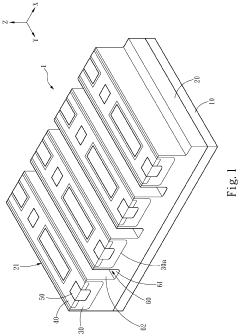
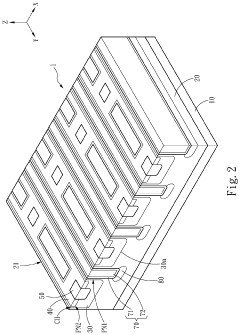
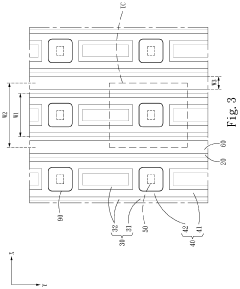
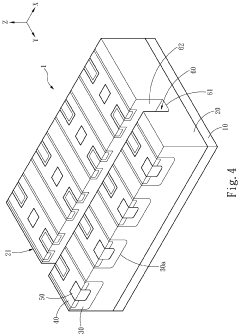
Silicon carbide semiconductor device
PatentPendingUS20240234569A9
Innovation
- A silicon carbide semiconductor device with a hybrid gate structure featuring a trench gate configuration that reduces JFET resistance and parasitic gate-to-drain capacitance, enhancing switching performance by increasing channel width density and optimizing the layout of doped regions and trenches.
Silicon carbide field-effect transistors
PatentActiveUS11894454B2
Innovation
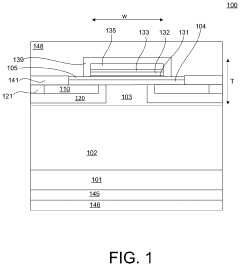
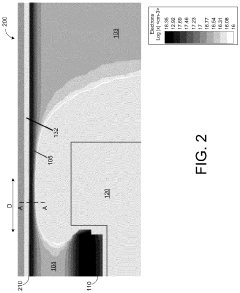
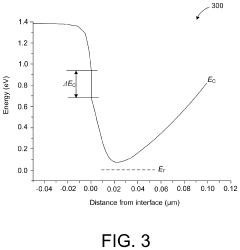
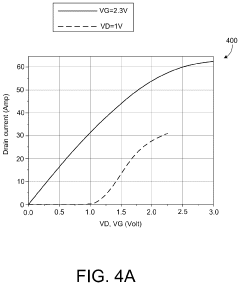
- The development of a silicon carbide (SiC) metal-oxide-semiconductor field-effect transistor (MOSFET) with a gate structure comprising a gate oxide layer, an aluminum nitride layer, and a p-type gallium nitride layer, which includes a lateral built-in channel with a p-type AlGaN gate and an AlN buffer layer, providing high threshold voltage and low interface trap density, enabling efficient operation with low on-state resistance.
Reliability and Lifetime Assessment Methods
Reliability assessment of SiC MOSFET power modules with advanced cooling techniques requires specialized methodologies that differ from traditional silicon-based systems. The higher operating temperatures and thermal cycling capabilities of SiC devices necessitate updated evaluation frameworks to accurately predict lifetime and failure mechanisms.
Accelerated life testing (ALT) represents a cornerstone methodology for reliability assessment, where power modules are subjected to extreme thermal, electrical, and mechanical stresses beyond normal operating conditions. For SiC MOSFET modules with advanced cooling, these tests must account for the unique thermal interface materials and cooling structures. Power cycling tests typically evaluate modules at junction temperatures between 150°C and 200°C, significantly higher than silicon-based counterparts, while monitoring parameters such as thermal resistance and forward voltage drop to detect degradation.
Physics of Failure (PoF) models have emerged as critical tools for lifetime prediction, incorporating material properties, geometric configurations, and cooling system characteristics. These models simulate failure mechanisms including bond wire lift-off, solder fatigue, and die-attach degradation under various cooling conditions. Advanced numerical simulations combining computational fluid dynamics with electro-thermal modeling enable accurate prediction of temperature distributions and thermal cycling effects specific to different cooling technologies.
Real-time monitoring systems represent another vital component of reliability assessment, employing embedded temperature sensors, acoustic emission detection, and electrical parameter monitoring. These systems can detect early warning signs of degradation in cooling performance or module integrity before catastrophic failure occurs. Junction temperature estimation techniques using temperature-sensitive electrical parameters (TSEPs) allow for non-invasive monitoring during operation.
Lifetime models for SiC MOSFET modules with advanced cooling must incorporate the interaction between the semiconductor and cooling system. The Coffin-Manson model, modified Norris-Landzberg equations, and Bayesian reliability frameworks have been adapted to account for the unique thermal cycling capabilities and failure modes of SiC devices with various cooling solutions. These models typically predict 2-3 times longer operational lifetimes for modules with advanced cooling compared to conventional solutions.
Standardization efforts for reliability testing of SiC power modules with advanced cooling are ongoing, with organizations like JEDEC, IEC, and automotive standards bodies developing specific test protocols. These emerging standards address the unique challenges of evaluating cooling system degradation alongside semiconductor reliability, establishing consistent methodologies for lifetime assessment across the industry.
Accelerated life testing (ALT) represents a cornerstone methodology for reliability assessment, where power modules are subjected to extreme thermal, electrical, and mechanical stresses beyond normal operating conditions. For SiC MOSFET modules with advanced cooling, these tests must account for the unique thermal interface materials and cooling structures. Power cycling tests typically evaluate modules at junction temperatures between 150°C and 200°C, significantly higher than silicon-based counterparts, while monitoring parameters such as thermal resistance and forward voltage drop to detect degradation.
Physics of Failure (PoF) models have emerged as critical tools for lifetime prediction, incorporating material properties, geometric configurations, and cooling system characteristics. These models simulate failure mechanisms including bond wire lift-off, solder fatigue, and die-attach degradation under various cooling conditions. Advanced numerical simulations combining computational fluid dynamics with electro-thermal modeling enable accurate prediction of temperature distributions and thermal cycling effects specific to different cooling technologies.
Real-time monitoring systems represent another vital component of reliability assessment, employing embedded temperature sensors, acoustic emission detection, and electrical parameter monitoring. These systems can detect early warning signs of degradation in cooling performance or module integrity before catastrophic failure occurs. Junction temperature estimation techniques using temperature-sensitive electrical parameters (TSEPs) allow for non-invasive monitoring during operation.
Lifetime models for SiC MOSFET modules with advanced cooling must incorporate the interaction between the semiconductor and cooling system. The Coffin-Manson model, modified Norris-Landzberg equations, and Bayesian reliability frameworks have been adapted to account for the unique thermal cycling capabilities and failure modes of SiC devices with various cooling solutions. These models typically predict 2-3 times longer operational lifetimes for modules with advanced cooling compared to conventional solutions.
Standardization efforts for reliability testing of SiC power modules with advanced cooling are ongoing, with organizations like JEDEC, IEC, and automotive standards bodies developing specific test protocols. These emerging standards address the unique challenges of evaluating cooling system degradation alongside semiconductor reliability, establishing consistent methodologies for lifetime assessment across the industry.
Environmental Impact and Sustainability Considerations
The environmental impact of cooling technologies for SiC MOSFET power modules represents a critical consideration in their development and deployment. Traditional cooling methods often rely on materials with significant ecological footprints, including rare metals, chemical compounds with high global warming potential, and components that present end-of-life disposal challenges. As SiC technology continues to penetrate markets like electric vehicles and renewable energy systems, the environmental implications of cooling solutions scale accordingly.
Energy efficiency emerges as a paramount environmental factor in cooling system design. While SiC MOSFETs inherently offer efficiency advantages over silicon alternatives, poorly optimized cooling systems can negate these benefits through parasitic energy consumption. Advanced cooling techniques that minimize pumping power requirements and maximize heat transfer efficiency contribute directly to reducing the operational carbon footprint of power electronic systems.
Material selection for cooling components presents both challenges and opportunities for sustainability. Liquid coolants must be evaluated not only for thermal performance but also for toxicity, biodegradability, and global warming potential. Recent innovations in bio-derived coolants and recyclable heat sink materials demonstrate promising alternatives to conventional options. The transition from copper to aluminum heat sinks, despite slightly lower thermal conductivity, offers significant sustainability advantages through reduced primary energy requirements and enhanced recyclability.
Manufacturing processes for cooling systems carry their own environmental implications. Energy-intensive production methods for microchannels, vapor chambers, and advanced heat exchangers contribute to embodied carbon in these components. Life cycle assessment (LCA) studies indicate that manufacturing impacts can constitute 15-30% of a cooling system's lifetime environmental footprint, highlighting the importance of sustainable manufacturing approaches.
The circular economy perspective is increasingly relevant for SiC MOSFET cooling systems. Design for disassembly, material recovery, and component reuse represent emerging priorities in cooling technology development. Modular cooling designs that facilitate maintenance and component replacement extend operational lifetimes while reducing waste. Additionally, some manufacturers have implemented take-back programs for cooling systems, enabling proper recycling of materials and responsible disposal of potentially harmful substances.
Water consumption presents another environmental consideration, particularly for direct and indirect liquid cooling systems. In regions facing water scarcity, cooling technologies that minimize freshwater usage offer significant sustainability advantages. Closed-loop systems with minimal makeup water requirements and technologies capable of utilizing non-potable water sources represent important advances in this domain.
Energy efficiency emerges as a paramount environmental factor in cooling system design. While SiC MOSFETs inherently offer efficiency advantages over silicon alternatives, poorly optimized cooling systems can negate these benefits through parasitic energy consumption. Advanced cooling techniques that minimize pumping power requirements and maximize heat transfer efficiency contribute directly to reducing the operational carbon footprint of power electronic systems.
Material selection for cooling components presents both challenges and opportunities for sustainability. Liquid coolants must be evaluated not only for thermal performance but also for toxicity, biodegradability, and global warming potential. Recent innovations in bio-derived coolants and recyclable heat sink materials demonstrate promising alternatives to conventional options. The transition from copper to aluminum heat sinks, despite slightly lower thermal conductivity, offers significant sustainability advantages through reduced primary energy requirements and enhanced recyclability.
Manufacturing processes for cooling systems carry their own environmental implications. Energy-intensive production methods for microchannels, vapor chambers, and advanced heat exchangers contribute to embodied carbon in these components. Life cycle assessment (LCA) studies indicate that manufacturing impacts can constitute 15-30% of a cooling system's lifetime environmental footprint, highlighting the importance of sustainable manufacturing approaches.
The circular economy perspective is increasingly relevant for SiC MOSFET cooling systems. Design for disassembly, material recovery, and component reuse represent emerging priorities in cooling technology development. Modular cooling designs that facilitate maintenance and component replacement extend operational lifetimes while reducing waste. Additionally, some manufacturers have implemented take-back programs for cooling systems, enabling proper recycling of materials and responsible disposal of potentially harmful substances.
Water consumption presents another environmental consideration, particularly for direct and indirect liquid cooling systems. In regions facing water scarcity, cooling technologies that minimize freshwater usage offer significant sustainability advantages. Closed-loop systems with minimal makeup water requirements and technologies capable of utilizing non-potable water sources represent important advances in this domain.
Unlock deeper insights with PatSnap Eureka Quick Research — get a full tech report to explore trends and direct your research. Try now!
Generate Your Research Report Instantly with AI Agent
Supercharge your innovation with PatSnap Eureka AI Agent Platform!