

How Do SiC MOSFETs Perform Under High Surge Currents?
SEP 8, 20259 MIN READ
Generate Your Research Report Instantly with AI Agent
PatSnap Eureka helps you evaluate technical feasibility & market potential.
SiC MOSFET Technology Evolution and Objectives
Silicon Carbide (SiC) power semiconductor technology has undergone remarkable evolution since its initial development in the early 1990s. The journey began with rudimentary SiC diodes, progressing through significant material science breakthroughs to today's advanced SiC MOSFETs capable of handling high voltage and current applications. This technological progression has been driven by increasing demands for higher efficiency, temperature tolerance, and switching performance in power electronics systems.
The fundamental advantage of SiC over traditional silicon stems from its wider bandgap (3.26 eV compared to silicon's 1.12 eV), enabling devices that can withstand substantially higher electric fields. This property, combined with SiC's superior thermal conductivity (approximately 3 times that of silicon), creates the foundation for power devices with exceptional performance characteristics under extreme conditions.
Early development challenges centered around crystal growth quality, interface defects, and channel mobility issues. The 2000s saw significant advancements in substrate quality and epitaxial growth techniques, leading to the first commercial SiC Schottky diodes. By the 2010s, manufacturers had overcome many of the oxide interface challenges that previously limited MOSFET performance, resulting in commercially viable SiC MOSFETs entering the market.
Recent technological objectives have focused on enhancing surge current capability while maintaining the inherent benefits of SiC technology. This represents a critical advancement as surge current handling directly impacts device reliability in applications experiencing transient overload conditions. Understanding performance under high surge currents has become increasingly important as SiC MOSFETs penetrate applications in electric vehicle powertrains, industrial motor drives, and renewable energy systems.
The current technological trajectory aims to optimize several key parameters simultaneously: reducing specific on-resistance to minimize conduction losses, improving short-circuit withstand capability, enhancing surge current handling without device degradation, and increasing overall ruggedness while maintaining competitive cost structures. These objectives align with industry demands for more efficient, reliable power conversion systems operating at higher frequencies and power densities.
Looking forward, the technology roadmap for SiC MOSFETs includes objectives for further reducing defect densities, improving channel mobility, enhancing gate oxide reliability, and developing advanced packaging solutions capable of extracting maximum performance benefits. The ultimate goal is to create devices that can maintain stable performance characteristics even when subjected to extreme transient electrical stresses, thereby expanding application possibilities in critical infrastructure and transportation systems.
The fundamental advantage of SiC over traditional silicon stems from its wider bandgap (3.26 eV compared to silicon's 1.12 eV), enabling devices that can withstand substantially higher electric fields. This property, combined with SiC's superior thermal conductivity (approximately 3 times that of silicon), creates the foundation for power devices with exceptional performance characteristics under extreme conditions.
Early development challenges centered around crystal growth quality, interface defects, and channel mobility issues. The 2000s saw significant advancements in substrate quality and epitaxial growth techniques, leading to the first commercial SiC Schottky diodes. By the 2010s, manufacturers had overcome many of the oxide interface challenges that previously limited MOSFET performance, resulting in commercially viable SiC MOSFETs entering the market.
Recent technological objectives have focused on enhancing surge current capability while maintaining the inherent benefits of SiC technology. This represents a critical advancement as surge current handling directly impacts device reliability in applications experiencing transient overload conditions. Understanding performance under high surge currents has become increasingly important as SiC MOSFETs penetrate applications in electric vehicle powertrains, industrial motor drives, and renewable energy systems.
The current technological trajectory aims to optimize several key parameters simultaneously: reducing specific on-resistance to minimize conduction losses, improving short-circuit withstand capability, enhancing surge current handling without device degradation, and increasing overall ruggedness while maintaining competitive cost structures. These objectives align with industry demands for more efficient, reliable power conversion systems operating at higher frequencies and power densities.
Looking forward, the technology roadmap for SiC MOSFETs includes objectives for further reducing defect densities, improving channel mobility, enhancing gate oxide reliability, and developing advanced packaging solutions capable of extracting maximum performance benefits. The ultimate goal is to create devices that can maintain stable performance characteristics even when subjected to extreme transient electrical stresses, thereby expanding application possibilities in critical infrastructure and transportation systems.
Market Demand Analysis for High-Surge SiC Applications
The market for Silicon Carbide (SiC) MOSFETs capable of handling high surge currents is experiencing robust growth, driven primarily by the rapid electrification across multiple industries. Power electronics applications requiring high reliability under extreme conditions represent the core demand segment, with automotive, renewable energy, and industrial sectors leading adoption.
In the automotive sector, electric vehicle (EV) manufacturers are increasingly seeking SiC MOSFETs that can withstand high surge currents during rapid charging cycles and motor drive operations. Market research indicates that the automotive power electronics segment is growing at a compound annual rate exceeding 25%, with SiC devices capturing an expanding share from traditional silicon-based solutions.
Renewable energy systems, particularly solar inverters and wind power converters, constitute another significant market for high-surge SiC applications. These systems frequently experience power surges during grid fluctuations and weather events, necessitating components with superior surge handling capabilities. The global solar inverter market alone is projected to reach $27 billion by 2026, with SiC-based solutions gaining prominence due to their reliability under surge conditions.
Industrial motor drives and uninterruptible power supplies (UPS) represent additional high-value markets for surge-resistant SiC MOSFETs. Manufacturing facilities increasingly demand power electronics that can maintain operation during grid disturbances and load variations, with minimal downtime and maintenance requirements.
Market analysis reveals a growing premium segment willing to pay 30-40% more for SiC MOSFETs with verified high surge current capabilities compared to standard SiC devices. This price premium reflects the critical nature of surge protection in high-reliability applications and the substantial cost of system failures.
Regional market distribution shows North America and Europe leading in adoption for high-reliability industrial and automotive applications, while Asia-Pacific demonstrates the fastest growth rate, particularly in manufacturing equipment and renewable energy installations.
Customer requirements are evolving toward comprehensive surge current specifications beyond simple datasheet parameters. End users increasingly demand detailed characterization across temperature ranges, multiple surge events, and various pulse durations. This trend is driving test standardization efforts within the industry.
The market is also witnessing increased demand for integrated solutions that combine SiC MOSFETs with specialized gate drivers and protection circuits specifically designed to optimize performance during surge events while maintaining the efficiency benefits inherent to SiC technology.
In the automotive sector, electric vehicle (EV) manufacturers are increasingly seeking SiC MOSFETs that can withstand high surge currents during rapid charging cycles and motor drive operations. Market research indicates that the automotive power electronics segment is growing at a compound annual rate exceeding 25%, with SiC devices capturing an expanding share from traditional silicon-based solutions.
Renewable energy systems, particularly solar inverters and wind power converters, constitute another significant market for high-surge SiC applications. These systems frequently experience power surges during grid fluctuations and weather events, necessitating components with superior surge handling capabilities. The global solar inverter market alone is projected to reach $27 billion by 2026, with SiC-based solutions gaining prominence due to their reliability under surge conditions.
Industrial motor drives and uninterruptible power supplies (UPS) represent additional high-value markets for surge-resistant SiC MOSFETs. Manufacturing facilities increasingly demand power electronics that can maintain operation during grid disturbances and load variations, with minimal downtime and maintenance requirements.
Market analysis reveals a growing premium segment willing to pay 30-40% more for SiC MOSFETs with verified high surge current capabilities compared to standard SiC devices. This price premium reflects the critical nature of surge protection in high-reliability applications and the substantial cost of system failures.
Regional market distribution shows North America and Europe leading in adoption for high-reliability industrial and automotive applications, while Asia-Pacific demonstrates the fastest growth rate, particularly in manufacturing equipment and renewable energy installations.
Customer requirements are evolving toward comprehensive surge current specifications beyond simple datasheet parameters. End users increasingly demand detailed characterization across temperature ranges, multiple surge events, and various pulse durations. This trend is driving test standardization efforts within the industry.
The market is also witnessing increased demand for integrated solutions that combine SiC MOSFETs with specialized gate drivers and protection circuits specifically designed to optimize performance during surge events while maintaining the efficiency benefits inherent to SiC technology.
Current Challenges in SiC MOSFET Surge Current Handling
Silicon Carbide (SiC) MOSFETs have emerged as promising power semiconductor devices for high-voltage, high-temperature applications. However, their performance under high surge current conditions presents significant technical challenges that require comprehensive understanding and innovative solutions.
The primary challenge lies in the thermal behavior of SiC MOSFETs during surge events. Unlike traditional silicon devices, SiC MOSFETs exhibit different thermal conductivity properties and junction temperature responses when subjected to short-duration high-current pulses. The thermal expansion coefficient mismatch between SiC die and packaging materials creates mechanical stress during rapid temperature fluctuations, potentially leading to package failure or die cracking under repeated surge conditions.
Another critical issue is the current distribution uniformity across the SiC MOSFET cell structure. During surge events, current crowding can occur at specific regions of the device, creating localized hot spots that may trigger avalanche breakdown or gate oxide degradation. This non-uniform current distribution becomes more pronounced as device dimensions shrink to achieve lower on-resistance, creating a fundamental design trade-off between normal operation efficiency and surge current capability.
The gate oxide reliability under surge conditions represents a significant vulnerability. The thinner gate oxide layers used in modern SiC MOSFETs are susceptible to dielectric breakdown when excessive voltage transients occur during surge events. This is exacerbated by the higher electric field strengths present in SiC devices compared to silicon counterparts, making them potentially more vulnerable to gate damage during uncontrolled switching transients that accompany surge events.
Short-circuit withstand capability remains substantially lower in SiC MOSFETs compared to IGBTs, typically in the range of 2-10 microseconds versus 10-20 microseconds for silicon IGBTs. This limitation stems from the smaller die size and higher current density of SiC devices, resulting in faster temperature rise during fault conditions. The narrow safe operating area during short-circuit events constrains the application of SiC MOSFETs in systems requiring robust fault tolerance.
Body diode performance during surge events presents another challenge. The intrinsic body diode in SiC MOSFETs exhibits higher forward voltage drop and slower reverse recovery characteristics than silicon counterparts. During surge events involving reverse current flow, these limitations can lead to increased power dissipation and potential device failure, particularly in applications with frequent commutation requirements.
Avalanche ruggedness, which measures a device's ability to dissipate energy during breakdown events, shows inconsistent performance across different SiC MOSFET designs and manufacturers. The limited avalanche capability restricts the use of SiC MOSFETs in applications where transient overvoltage conditions are common, necessitating additional external protection circuits that increase system complexity and cost.
The primary challenge lies in the thermal behavior of SiC MOSFETs during surge events. Unlike traditional silicon devices, SiC MOSFETs exhibit different thermal conductivity properties and junction temperature responses when subjected to short-duration high-current pulses. The thermal expansion coefficient mismatch between SiC die and packaging materials creates mechanical stress during rapid temperature fluctuations, potentially leading to package failure or die cracking under repeated surge conditions.
Another critical issue is the current distribution uniformity across the SiC MOSFET cell structure. During surge events, current crowding can occur at specific regions of the device, creating localized hot spots that may trigger avalanche breakdown or gate oxide degradation. This non-uniform current distribution becomes more pronounced as device dimensions shrink to achieve lower on-resistance, creating a fundamental design trade-off between normal operation efficiency and surge current capability.
The gate oxide reliability under surge conditions represents a significant vulnerability. The thinner gate oxide layers used in modern SiC MOSFETs are susceptible to dielectric breakdown when excessive voltage transients occur during surge events. This is exacerbated by the higher electric field strengths present in SiC devices compared to silicon counterparts, making them potentially more vulnerable to gate damage during uncontrolled switching transients that accompany surge events.
Short-circuit withstand capability remains substantially lower in SiC MOSFETs compared to IGBTs, typically in the range of 2-10 microseconds versus 10-20 microseconds for silicon IGBTs. This limitation stems from the smaller die size and higher current density of SiC devices, resulting in faster temperature rise during fault conditions. The narrow safe operating area during short-circuit events constrains the application of SiC MOSFETs in systems requiring robust fault tolerance.
Body diode performance during surge events presents another challenge. The intrinsic body diode in SiC MOSFETs exhibits higher forward voltage drop and slower reverse recovery characteristics than silicon counterparts. During surge events involving reverse current flow, these limitations can lead to increased power dissipation and potential device failure, particularly in applications with frequent commutation requirements.
Avalanche ruggedness, which measures a device's ability to dissipate energy during breakdown events, shows inconsistent performance across different SiC MOSFET designs and manufacturers. The limited avalanche capability restricts the use of SiC MOSFETs in applications where transient overvoltage conditions are common, necessitating additional external protection circuits that increase system complexity and cost.
Existing Surge Current Protection Solutions
01 Surge current protection mechanisms for SiC MOSFETs
Various protection mechanisms can be implemented to safeguard SiC MOSFETs from high surge currents. These include specialized gate drive circuits, current limiting techniques, and protection circuits that can detect overcurrent conditions and respond rapidly. Such protection mechanisms help prevent device failure during transient surge events by controlling the rate of current rise and providing fast shutdown capabilities when dangerous current levels are detected.- Surge current protection mechanisms for SiC MOSFETs: Various protection mechanisms can be implemented to safeguard SiC MOSFETs against high surge currents. These include specialized gate drive circuits, current limiting techniques, and protective components such as snubber circuits. These protection mechanisms help prevent device failure by controlling the rate of current rise and limiting peak currents during transient events, thereby enhancing the overall reliability and longevity of SiC MOSFET-based power systems.
- Thermal management solutions for SiC MOSFETs under surge conditions: Effective thermal management is crucial for SiC MOSFETs operating under high surge current conditions. Advanced cooling techniques, optimized package designs, and thermal interface materials help dissipate heat efficiently during surge events. Proper thermal management prevents device degradation and failure by maintaining junction temperatures within safe operating limits, even during extreme transient current events, thus maximizing the performance capabilities of SiC MOSFETs.
- Characterization and modeling of SiC MOSFETs under surge current conditions: Accurate characterization and modeling of SiC MOSFETs under high surge current conditions are essential for predicting device behavior in extreme operating scenarios. Advanced testing methodologies, simulation tools, and analytical models help understand the device's response to transient overcurrent events. These models account for factors such as dynamic on-resistance, parasitic inductances, and temperature-dependent parameters, enabling designers to optimize circuit designs for improved surge current handling capability.
- Circuit design considerations for SiC MOSFETs in high surge applications: Specialized circuit design techniques are required when implementing SiC MOSFETs in applications with high surge current requirements. These include optimized PCB layouts to minimize parasitic inductances, gate drive circuits with controlled switching speeds, and proper selection of passive components. Strategic placement of decoupling capacitors, careful routing of power and signal traces, and implementation of soft-switching techniques can significantly enhance the surge current handling capability of SiC MOSFET-based power converters.
- Comparative performance analysis of SiC MOSFETs versus other power devices under surge conditions: SiC MOSFETs demonstrate distinct performance characteristics compared to traditional silicon-based power devices when subjected to high surge currents. Their wider bandgap properties, higher thermal conductivity, and superior electric field strength enable better surge current handling capabilities. Comparative analyses show that SiC MOSFETs typically exhibit lower conduction losses, faster recovery times, and better temperature stability during surge events, making them increasingly preferred for high-reliability power applications with demanding transient requirements.
02 Thermal management solutions for SiC MOSFETs under surge conditions
Effective thermal management is crucial for SiC MOSFETs operating under high surge current conditions. Solutions include advanced packaging technologies, improved heat sink designs, thermal interface materials, and cooling systems that can efficiently dissipate the heat generated during surge events. These thermal management approaches help maintain device temperature within safe operating limits, preventing thermal runaway and extending the operational lifetime of SiC MOSFETs.Expand Specific Solutions03 Structural design improvements for surge current handling
Structural modifications to SiC MOSFET designs can significantly enhance their performance under high surge current conditions. These improvements include optimized cell structures, enhanced gate oxide reliability, reinforced metallization layers, and specialized edge termination designs. Such structural enhancements allow SiC MOSFETs to withstand higher surge currents without degradation or failure by distributing current more evenly across the device and reducing localized heating effects.Expand Specific Solutions04 Characterization and modeling of SiC MOSFETs under surge conditions
Advanced characterization and modeling techniques are essential for understanding SiC MOSFET behavior under high surge current conditions. These include specialized testing methodologies, simulation tools, and analytical models that can accurately predict device performance during transient events. Such characterization enables designers to better understand failure mechanisms, establish safe operating areas, and develop more robust SiC MOSFET designs with improved surge current handling capabilities.Expand Specific Solutions05 Circuit topologies for improved surge current handling
Specialized circuit topologies can be implemented to enhance SiC MOSFET performance under high surge current conditions. These include snubber circuits, soft-switching techniques, parallel device configurations with balanced current sharing, and advanced driver circuits with controlled switching speeds. Such circuit designs help mitigate stress on SiC MOSFETs during surge events by controlling voltage and current transients, thereby improving reliability and extending device lifetime.Expand Specific Solutions
Key Manufacturers and Competitive Landscape
The SiC MOSFET high surge current performance landscape is evolving rapidly, with the market currently in a growth phase as evidenced by increasing adoption across power electronics applications. The global market size for SiC power devices is expanding at a CAGR of approximately 30%, driven by automotive, industrial, and renewable energy sectors. From a technological maturity perspective, companies like Infineon Technologies, Mitsubishi Electric, and NXP Semiconductors are leading commercial deployment with advanced surge-resistant designs, while Chinese players including Yangzhou Yangjie Electronic Technology and Gree Electric are rapidly closing the gap. Academic institutions such as Xi'an Jiaotong University and Zhejiang University are contributing significant research to improve surge current handling capabilities. The technology is transitioning from early adoption to mainstream implementation, with ongoing challenges in reliability under extreme surge conditions still being addressed.
Fast Sic Semiconductor, Inc.
Technical Solution: Fast SiC Semiconductor has developed proprietary SiC MOSFET structures specifically engineered for high surge current applications. Their technology features specialized trench designs with optimized channel mobility that maintains performance during transient events. Fast SiC's devices incorporate advanced termination structures that distribute surge energy more effectively across the die, preventing localized heating and breakdown. Their MOSFETs demonstrate robust performance with surge current capabilities of up to 5x rated current for short durations while maintaining thermal stability. The company has implemented specialized metallization systems and bond wire configurations that enhance current distribution and heat dissipation during surge events, extending the safe operating area for transient conditions.
Strengths: Exceptional surge current handling capability, specialized design optimized specifically for transient performance, and rapid recovery characteristics after surge events. Weaknesses: Relatively newer market entrant with less established field reliability data compared to industry incumbents, and potentially higher cost due to specialized design features.
Mitsubishi Electric Corp.
Technical Solution: Mitsubishi Electric has developed SiC MOSFETs with enhanced surge current capabilities through their proprietary DMOS (Double-diffused MOS) structure optimized for power applications. Their devices feature specialized cell designs with reinforced source metallization and optimized channel resistance to handle high transient currents. Mitsubishi's SiC MOSFETs incorporate advanced edge termination structures that maintain blocking capability even after surge events, and their thermal management solutions include specialized die-attach materials that maintain integrity during rapid temperature fluctuations associated with surge currents. Their devices demonstrate stable performance with surge current capabilities of 3-4x rated current while maintaining junction temperature below critical thresholds. Mitsubishi has also implemented specialized gate oxide processing techniques that enhance reliability during high dv/dt and di/dt events typical of surge conditions.
Strengths: Excellent thermal cycling capability important for applications with frequent surge events, robust package designs optimized for power cycling, and well-established reliability testing protocols. Weaknesses: Potentially higher on-resistance compared to some competitors' newest designs, and more conservative ratings that may limit maximum utilization of the device capabilities.
Critical Patents and Research on SiC Surge Resilience
High temperature gate driver for silicon carbide metal-oxide-semiconductor field-effect transistor
PatentActiveUS11218145B2
Innovation
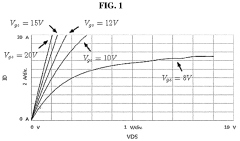
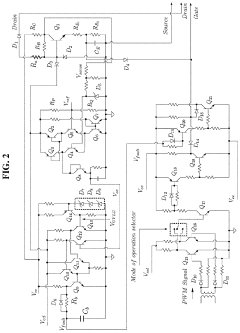
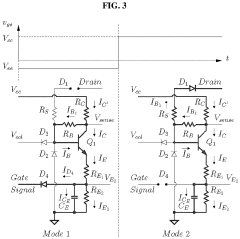
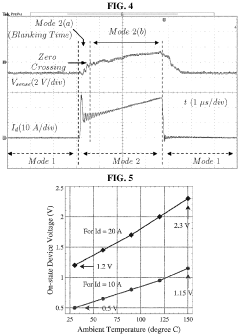
- A low-cost high temperature gate driver utilizing commercial-off-the-shelf discrete transistors and diodes, integrated with a robust overcurrent and under voltage lock out protection circuit, capable of operating up to 180°C, featuring a reduced propagation delay and flexible short-circuit protection, designed to minimize self-heating and enhance reliability.
Silicon carbide metal oxide semiconductor field effect transistor and manufacturing method of silicon carbide metal oxide semiconductor field effect transistor
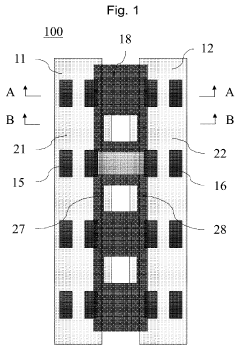
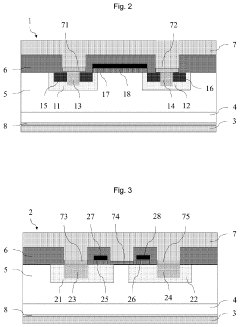
PatentPendingUS20230378341A1
Innovation
- The design incorporates alternating cells with specific well regions, source regions, and contact layers, including ohmic and Schottky contacts, to reduce channel density, enhance short-circuit tolerance, and minimize reverse leakage current and forward voltage drop, while maintaining the transistor's size and functionality.
Thermal Management Strategies for High-Surge Conditions
Effective thermal management is critical for SiC MOSFETs operating under high surge current conditions, as these devices can experience significant thermal stress that impacts both performance and reliability. The superior thermal conductivity of silicon carbide (approximately 3-4 times that of silicon) provides an inherent advantage, but dedicated thermal management strategies remain essential for maximizing device capabilities.
Direct bonded copper (DBC) substrates have emerged as a preferred solution for SiC MOSFET packaging, offering excellent thermal conductivity while maintaining electrical isolation. When combined with advanced thermal interface materials (TIMs) such as metal-based composites or phase change materials, the thermal resistance between the device and heatsink can be minimized, allowing for more efficient heat dissipation during surge events.
Active cooling solutions represent another critical aspect of thermal management for high-surge applications. Liquid cooling systems, particularly those utilizing microchannels etched directly into the substrate, have demonstrated superior performance compared to traditional air cooling methods. These systems can rapidly extract heat during surge events, preventing thermal runaway and extending the safe operating area of the device.
Thermal spreading techniques also play a vital role in managing localized hotspots that typically form during surge current events. Advanced package designs incorporating embedded heat pipes or vapor chambers help distribute heat more uniformly across the device surface, reducing peak temperatures and thermal gradients that could otherwise lead to premature failure.
Transient thermal modeling has become increasingly important for predicting device behavior under surge conditions. Finite element analysis (FEA) tools capable of simulating the complex thermal dynamics during short-duration high-current events enable designers to identify potential thermal bottlenecks and optimize cooling strategies accordingly. These models must account for the non-linear thermal properties of SiC and packaging materials at elevated temperatures.
Intelligent thermal management systems incorporating temperature sensors and adaptive cooling control algorithms represent the cutting edge of surge protection. These systems can dynamically adjust cooling parameters based on real-time temperature measurements, providing optimal thermal performance across varying operating conditions while minimizing energy consumption during normal operation.
Integration of these thermal management strategies must be considered early in the design process, as thermal considerations significantly impact overall system architecture. The trend toward higher power densities in SiC-based power electronics will continue to drive innovation in thermal management technologies, with particular focus on materials and cooling solutions capable of handling the extreme thermal transients associated with surge current events.
Direct bonded copper (DBC) substrates have emerged as a preferred solution for SiC MOSFET packaging, offering excellent thermal conductivity while maintaining electrical isolation. When combined with advanced thermal interface materials (TIMs) such as metal-based composites or phase change materials, the thermal resistance between the device and heatsink can be minimized, allowing for more efficient heat dissipation during surge events.
Active cooling solutions represent another critical aspect of thermal management for high-surge applications. Liquid cooling systems, particularly those utilizing microchannels etched directly into the substrate, have demonstrated superior performance compared to traditional air cooling methods. These systems can rapidly extract heat during surge events, preventing thermal runaway and extending the safe operating area of the device.
Thermal spreading techniques also play a vital role in managing localized hotspots that typically form during surge current events. Advanced package designs incorporating embedded heat pipes or vapor chambers help distribute heat more uniformly across the device surface, reducing peak temperatures and thermal gradients that could otherwise lead to premature failure.
Transient thermal modeling has become increasingly important for predicting device behavior under surge conditions. Finite element analysis (FEA) tools capable of simulating the complex thermal dynamics during short-duration high-current events enable designers to identify potential thermal bottlenecks and optimize cooling strategies accordingly. These models must account for the non-linear thermal properties of SiC and packaging materials at elevated temperatures.
Intelligent thermal management systems incorporating temperature sensors and adaptive cooling control algorithms represent the cutting edge of surge protection. These systems can dynamically adjust cooling parameters based on real-time temperature measurements, providing optimal thermal performance across varying operating conditions while minimizing energy consumption during normal operation.
Integration of these thermal management strategies must be considered early in the design process, as thermal considerations significantly impact overall system architecture. The trend toward higher power densities in SiC-based power electronics will continue to drive innovation in thermal management technologies, with particular focus on materials and cooling solutions capable of handling the extreme thermal transients associated with surge current events.
Reliability Testing Standards and Methodologies
The reliability assessment of SiC MOSFETs under high surge current conditions requires adherence to standardized testing methodologies to ensure consistent and comparable results across the industry. Several established standards govern these evaluations, with JEDEC JC-70.2 committee's guidelines being particularly relevant for wide bandgap semiconductors like SiC MOSFETs.
The primary surge current testing standards include IEC 60747-8 and IEC 60747-9, which define test conditions for power semiconductor devices. These standards specify parameters such as pulse duration, current amplitude, and temperature conditions that must be maintained during testing. For SiC MOSFETs specifically, the JEDEC JEP180 provides additional guidance on reliability evaluation methods tailored to their unique characteristics.
Avalanche ruggedness testing represents a critical methodology for evaluating SiC MOSFET performance under surge conditions. This test involves subjecting the device to unclamped inductive switching (UIS) events, where energy stored in an inductor is dissipated through the MOSFET during turn-off. The standard procedure requires incrementally increasing the inductor current until device failure, with the failure threshold providing a quantitative measure of ruggedness.
Short-circuit withstand capability testing constitutes another essential methodology, typically conducted using a double-pulse test setup. The standard approach involves applying a gate voltage while the device is connected to a high-voltage DC bus, measuring the time-to-failure under these extreme conditions. For SiC MOSFETs, the typical benchmark is a minimum 2-5 μs short-circuit withstand time.
Temperature-dependent testing methodologies are particularly important for SiC devices due to their wide operating temperature range. Standards require surge current tests to be performed across temperatures from -55°C to 175°C or higher, with particular attention to threshold voltage shifts and on-resistance variations that may impact surge current handling.
Accelerated lifetime testing protocols, including High Temperature Reverse Bias (HTRB) and High Temperature Gate Bias (HTGB) tests, complement surge current evaluations by assessing long-term reliability. These tests typically run for 1000+ hours under elevated temperatures and bias conditions, with interim measurements to track parametric shifts that might indicate degradation in surge current capability over time.
The implementation of these standardized methodologies enables meaningful comparison between different SiC MOSFET technologies and manufacturers, providing essential data for system designers to make informed reliability assessments for applications requiring high surge current capability.
The primary surge current testing standards include IEC 60747-8 and IEC 60747-9, which define test conditions for power semiconductor devices. These standards specify parameters such as pulse duration, current amplitude, and temperature conditions that must be maintained during testing. For SiC MOSFETs specifically, the JEDEC JEP180 provides additional guidance on reliability evaluation methods tailored to their unique characteristics.
Avalanche ruggedness testing represents a critical methodology for evaluating SiC MOSFET performance under surge conditions. This test involves subjecting the device to unclamped inductive switching (UIS) events, where energy stored in an inductor is dissipated through the MOSFET during turn-off. The standard procedure requires incrementally increasing the inductor current until device failure, with the failure threshold providing a quantitative measure of ruggedness.
Short-circuit withstand capability testing constitutes another essential methodology, typically conducted using a double-pulse test setup. The standard approach involves applying a gate voltage while the device is connected to a high-voltage DC bus, measuring the time-to-failure under these extreme conditions. For SiC MOSFETs, the typical benchmark is a minimum 2-5 μs short-circuit withstand time.
Temperature-dependent testing methodologies are particularly important for SiC devices due to their wide operating temperature range. Standards require surge current tests to be performed across temperatures from -55°C to 175°C or higher, with particular attention to threshold voltage shifts and on-resistance variations that may impact surge current handling.
Accelerated lifetime testing protocols, including High Temperature Reverse Bias (HTRB) and High Temperature Gate Bias (HTGB) tests, complement surge current evaluations by assessing long-term reliability. These tests typically run for 1000+ hours under elevated temperatures and bias conditions, with interim measurements to track parametric shifts that might indicate degradation in surge current capability over time.
The implementation of these standardized methodologies enables meaningful comparison between different SiC MOSFET technologies and manufacturers, providing essential data for system designers to make informed reliability assessments for applications requiring high surge current capability.
Unlock deeper insights with PatSnap Eureka Quick Research — get a full tech report to explore trends and direct your research. Try now!
Generate Your Research Report Instantly with AI Agent
Supercharge your innovation with PatSnap Eureka AI Agent Platform!