

NMR Data Interpretation in Complex Mixtures: Strategies
SEP 22, 20259 MIN READ
Generate Your Research Report Instantly with AI Agent
PatSnap Eureka helps you evaluate technical feasibility & market potential.
NMR Spectroscopy Background and Objectives
Nuclear Magnetic Resonance (NMR) spectroscopy has evolved significantly since its discovery in the 1940s, becoming an indispensable analytical tool in chemistry, biochemistry, and materials science. The technique leverages the magnetic properties of certain atomic nuclei to provide detailed structural information about molecules. Over decades, NMR has progressed from simple one-dimensional experiments to sophisticated multi-dimensional techniques capable of elucidating complex molecular structures and interactions.
The interpretation of NMR data from complex mixtures represents one of the most challenging frontiers in analytical chemistry. Complex mixtures, such as biological fluids, environmental samples, and food products, contain thousands of compounds with overlapping spectral features, making traditional manual interpretation approaches inadequate. The evolution of NMR technology has been driven by this challenge, with significant advancements in both hardware capabilities and data processing methodologies.
Recent technological developments have focused on increasing spectral resolution, sensitivity, and the dimensionality of NMR experiments. Higher magnetic field strengths, cryogenic probe technology, and hyperpolarization methods have dramatically improved signal-to-noise ratios, enabling the detection of lower concentration metabolites in complex mixtures. Parallel advances in pulse sequence design have enhanced spectral editing capabilities, allowing for better discrimination between similar molecular structures.
The primary objective of modern NMR data interpretation strategies for complex mixtures is to achieve comprehensive molecular characterization with minimal sample preparation and measurement time. This includes accurate identification and quantification of mixture components, even at low concentrations or in the presence of spectral overlap. Additionally, there is a growing emphasis on developing automated and semi-automated interpretation approaches that can handle the enormous data volumes generated by high-throughput NMR experiments.
Another critical goal is the integration of NMR data with other analytical techniques, such as mass spectrometry, to provide complementary structural information. This multi-modal approach has become increasingly important for applications in metabolomics, natural product discovery, and pharmaceutical analysis, where complete characterization of complex mixtures is essential for understanding biological systems and developing new therapeutic agents.
The trajectory of NMR technology suggests future developments will focus on miniaturization, portability, and real-time analysis capabilities. These advancements aim to transform NMR from a primarily laboratory-based technique to a versatile tool for field applications and point-of-care diagnostics, further expanding its utility in analyzing complex mixtures across diverse settings and conditions.
The interpretation of NMR data from complex mixtures represents one of the most challenging frontiers in analytical chemistry. Complex mixtures, such as biological fluids, environmental samples, and food products, contain thousands of compounds with overlapping spectral features, making traditional manual interpretation approaches inadequate. The evolution of NMR technology has been driven by this challenge, with significant advancements in both hardware capabilities and data processing methodologies.
Recent technological developments have focused on increasing spectral resolution, sensitivity, and the dimensionality of NMR experiments. Higher magnetic field strengths, cryogenic probe technology, and hyperpolarization methods have dramatically improved signal-to-noise ratios, enabling the detection of lower concentration metabolites in complex mixtures. Parallel advances in pulse sequence design have enhanced spectral editing capabilities, allowing for better discrimination between similar molecular structures.
The primary objective of modern NMR data interpretation strategies for complex mixtures is to achieve comprehensive molecular characterization with minimal sample preparation and measurement time. This includes accurate identification and quantification of mixture components, even at low concentrations or in the presence of spectral overlap. Additionally, there is a growing emphasis on developing automated and semi-automated interpretation approaches that can handle the enormous data volumes generated by high-throughput NMR experiments.
Another critical goal is the integration of NMR data with other analytical techniques, such as mass spectrometry, to provide complementary structural information. This multi-modal approach has become increasingly important for applications in metabolomics, natural product discovery, and pharmaceutical analysis, where complete characterization of complex mixtures is essential for understanding biological systems and developing new therapeutic agents.
The trajectory of NMR technology suggests future developments will focus on miniaturization, portability, and real-time analysis capabilities. These advancements aim to transform NMR from a primarily laboratory-based technique to a versatile tool for field applications and point-of-care diagnostics, further expanding its utility in analyzing complex mixtures across diverse settings and conditions.
Market Applications of NMR in Complex Mixture Analysis
Nuclear Magnetic Resonance (NMR) spectroscopy has established itself as an indispensable analytical tool across numerous market sectors where complex mixture analysis is required. The pharmaceutical industry represents one of the largest application domains, utilizing NMR for drug discovery, development, and quality control processes. Pharmaceutical companies leverage NMR's capabilities to analyze impurities in drug formulations, determine molecular structures of new compounds, and monitor reaction processes during synthesis.
The food and beverage industry has increasingly adopted NMR technology for authentication and quality assessment. Companies employ NMR fingerprinting to verify the geographical origin of products like wine, olive oil, and honey, detecting adulteration and ensuring compliance with labeling regulations. This application has gained significant traction as consumers demand greater transparency regarding product origins and composition.
In the petrochemical sector, NMR spectroscopy serves as a critical tool for characterizing complex hydrocarbon mixtures. Refineries utilize NMR data to optimize processing conditions and evaluate crude oil compositions, directly impacting operational efficiency and product quality. The ability to analyze complex mixtures without extensive sample preparation provides substantial time and cost advantages in industrial settings.
Environmental monitoring represents another growing application area, with NMR being employed to identify and quantify pollutants in water, soil, and air samples. Regulatory agencies and environmental consulting firms value NMR's non-destructive nature and capacity to detect multiple compounds simultaneously, enabling comprehensive contamination assessments from limited sample volumes.
The metabolomics field has witnessed explosive growth in NMR applications, particularly in clinical diagnostics and personalized medicine. Healthcare providers and research institutions use NMR to analyze biological fluids for disease biomarkers, drug metabolism studies, and nutritional assessments. This market segment is projected to expand significantly as precision medicine initiatives gain momentum globally.
Agricultural applications of NMR in complex mixture analysis include soil composition studies, pesticide residue detection, and crop quality assessment. Agribusiness companies employ NMR to optimize fertilizer formulations and monitor plant metabolites, contributing to sustainable farming practices and improved crop yields.
The cosmetics and personal care industry utilizes NMR for raw material authentication, formulation analysis, and stability testing. Manufacturers benefit from NMR's ability to characterize complex natural extracts and detect prohibited substances, ensuring regulatory compliance and product consistency.
The food and beverage industry has increasingly adopted NMR technology for authentication and quality assessment. Companies employ NMR fingerprinting to verify the geographical origin of products like wine, olive oil, and honey, detecting adulteration and ensuring compliance with labeling regulations. This application has gained significant traction as consumers demand greater transparency regarding product origins and composition.
In the petrochemical sector, NMR spectroscopy serves as a critical tool for characterizing complex hydrocarbon mixtures. Refineries utilize NMR data to optimize processing conditions and evaluate crude oil compositions, directly impacting operational efficiency and product quality. The ability to analyze complex mixtures without extensive sample preparation provides substantial time and cost advantages in industrial settings.
Environmental monitoring represents another growing application area, with NMR being employed to identify and quantify pollutants in water, soil, and air samples. Regulatory agencies and environmental consulting firms value NMR's non-destructive nature and capacity to detect multiple compounds simultaneously, enabling comprehensive contamination assessments from limited sample volumes.
The metabolomics field has witnessed explosive growth in NMR applications, particularly in clinical diagnostics and personalized medicine. Healthcare providers and research institutions use NMR to analyze biological fluids for disease biomarkers, drug metabolism studies, and nutritional assessments. This market segment is projected to expand significantly as precision medicine initiatives gain momentum globally.
Agricultural applications of NMR in complex mixture analysis include soil composition studies, pesticide residue detection, and crop quality assessment. Agribusiness companies employ NMR to optimize fertilizer formulations and monitor plant metabolites, contributing to sustainable farming practices and improved crop yields.
The cosmetics and personal care industry utilizes NMR for raw material authentication, formulation analysis, and stability testing. Manufacturers benefit from NMR's ability to characterize complex natural extracts and detect prohibited substances, ensuring regulatory compliance and product consistency.
Current Challenges in NMR Data Interpretation
Nuclear Magnetic Resonance (NMR) spectroscopy faces significant challenges when applied to complex mixtures, particularly in fields such as metabolomics, natural product analysis, and environmental monitoring. The primary difficulty lies in spectral overlap, where signals from different compounds coincide, making individual peak identification and quantification extremely challenging. This problem is exacerbated in biological samples containing hundreds of metabolites with similar structural features.
Signal-to-noise ratio limitations present another substantial hurdle, especially when analyzing low-concentration components within complex matrices. The detection threshold often prevents the identification of potentially important minor compounds, creating blind spots in analytical results. This challenge becomes particularly acute in biomarker discovery and pharmaceutical impurity analysis.
Quantification accuracy remains problematic due to variations in relaxation times and nuclear Overhauser effects across different molecules in a mixture. These variations can lead to non-linear response relationships between signal intensity and actual concentration, complicating reliable quantitative analysis without extensive calibration procedures.
Data processing complexity represents a significant bottleneck in NMR analysis workflows. Current software solutions often struggle with automated baseline correction, phase adjustment, and peak picking in highly complex spectra. Manual intervention remains necessary in many cases, introducing subjectivity and reducing throughput capacity for large-scale studies.
Reference database limitations further constrain interpretation capabilities. Despite ongoing efforts to expand spectral libraries, many compounds remain uncharacterized by NMR, particularly novel natural products, metabolites, and degradation products. This knowledge gap significantly impacts identification confidence in untargeted analyses.
Structural similarity among mixture components creates ambiguity in peak assignments. Compounds with similar structural moieties produce nearly identical spectral patterns, making definitive identification challenging without complementary analytical techniques. This issue is particularly evident in isomer differentiation and conformational analysis.
Solvent effects and sample preparation inconsistencies introduce additional variability in spectral features. Factors such as pH, ionic strength, and temperature can significantly alter chemical shifts and coupling patterns, complicating spectral matching against reference databases collected under standardized conditions.
The integration of multidimensional NMR techniques, while powerful, introduces computational challenges in data handling and interpretation. The exponential increase in data complexity with additional dimensions demands sophisticated algorithms and substantial computational resources, creating accessibility barriers for many laboratories.
Signal-to-noise ratio limitations present another substantial hurdle, especially when analyzing low-concentration components within complex matrices. The detection threshold often prevents the identification of potentially important minor compounds, creating blind spots in analytical results. This challenge becomes particularly acute in biomarker discovery and pharmaceutical impurity analysis.
Quantification accuracy remains problematic due to variations in relaxation times and nuclear Overhauser effects across different molecules in a mixture. These variations can lead to non-linear response relationships between signal intensity and actual concentration, complicating reliable quantitative analysis without extensive calibration procedures.
Data processing complexity represents a significant bottleneck in NMR analysis workflows. Current software solutions often struggle with automated baseline correction, phase adjustment, and peak picking in highly complex spectra. Manual intervention remains necessary in many cases, introducing subjectivity and reducing throughput capacity for large-scale studies.
Reference database limitations further constrain interpretation capabilities. Despite ongoing efforts to expand spectral libraries, many compounds remain uncharacterized by NMR, particularly novel natural products, metabolites, and degradation products. This knowledge gap significantly impacts identification confidence in untargeted analyses.
Structural similarity among mixture components creates ambiguity in peak assignments. Compounds with similar structural moieties produce nearly identical spectral patterns, making definitive identification challenging without complementary analytical techniques. This issue is particularly evident in isomer differentiation and conformational analysis.
Solvent effects and sample preparation inconsistencies introduce additional variability in spectral features. Factors such as pH, ionic strength, and temperature can significantly alter chemical shifts and coupling patterns, complicating spectral matching against reference databases collected under standardized conditions.
The integration of multidimensional NMR techniques, while powerful, introduces computational challenges in data handling and interpretation. The exponential increase in data complexity with additional dimensions demands sophisticated algorithms and substantial computational resources, creating accessibility barriers for many laboratories.
Modern Approaches to Complex Mixture NMR Analysis
01 Advanced NMR data processing techniques
Various computational methods and algorithms are employed to process and analyze NMR spectroscopy data. These techniques include signal processing, noise reduction, peak identification, and spectral analysis to enhance data quality and extract meaningful information from complex NMR spectra. Advanced software solutions integrate these processing techniques to automate interpretation and improve accuracy in structural elucidation.- NMR data processing and analysis techniques: Various methods and systems for processing and analyzing NMR spectroscopy data, including signal processing algorithms, peak identification, and spectral analysis. These techniques help improve the accuracy and efficiency of NMR data interpretation by enhancing signal quality, reducing noise, and extracting meaningful information from complex spectra.
- Automated NMR data interpretation systems: Automated systems and software solutions that use computational methods to interpret NMR spectroscopic data. These systems often employ machine learning, artificial intelligence, and pattern recognition algorithms to identify molecular structures, analyze chemical compositions, and predict properties based on NMR spectra without extensive manual intervention.
- Database systems for NMR spectral analysis: Specialized database systems designed for storing, retrieving, and comparing NMR spectral data. These systems facilitate the interpretation of NMR data by providing reference spectra, structural information, and correlation tools that help researchers identify unknown compounds and validate experimental results through comparison with known standards.
- Hardware improvements for NMR data acquisition: Technological advancements in NMR hardware components that enhance data acquisition quality and reliability. These innovations include improved probe designs, magnetic field stabilization techniques, and signal detection systems that contribute to clearer spectra with higher resolution, thereby facilitating more accurate data interpretation.
- Integration of NMR data with other analytical techniques: Methods and systems for combining NMR spectroscopy data with information from other analytical techniques such as mass spectrometry, infrared spectroscopy, or X-ray crystallography. This integrated approach provides complementary information that enhances the overall interpretation of molecular structures and chemical compositions, leading to more comprehensive and accurate analyses.
02 Hardware innovations for NMR data acquisition
Technological advancements in NMR hardware components such as magnets, probes, and detectors have significantly improved data acquisition capabilities. These innovations enable higher resolution spectra, increased sensitivity, and faster data collection. Specialized hardware configurations are designed for specific applications, allowing for more precise measurements and better signal-to-noise ratios in challenging samples.Expand Specific Solutions03 Machine learning and AI for NMR interpretation
Artificial intelligence and machine learning algorithms are increasingly applied to NMR data interpretation. These approaches can automatically identify patterns in complex spectra, predict molecular structures, and classify compounds based on their spectral features. Neural networks and other AI models are trained on large datasets to recognize spectral signatures and provide rapid, accurate interpretations that would be time-consuming for human analysts.Expand Specific Solutions04 Integration of NMR data with other analytical techniques
Combining NMR spectroscopy data with information from complementary analytical methods such as mass spectrometry, infrared spectroscopy, and X-ray crystallography provides comprehensive structural insights. Integrated data analysis platforms enable researchers to correlate results from multiple techniques, enhancing confidence in structural assignments and facilitating the interpretation of complex molecular systems.Expand Specific Solutions05 Specialized NMR methods for complex sample analysis
Advanced NMR pulse sequences and experimental protocols have been developed for analyzing challenging samples such as biological macromolecules, heterogeneous mixtures, and materials with limited solubility. These specialized methods include multidimensional NMR techniques, solid-state NMR approaches, and selective excitation methods that can isolate signals of interest from complex backgrounds, enabling detailed structural characterization of previously difficult-to-analyze samples.Expand Specific Solutions
Leading Research Groups and Instrument Manufacturers
The NMR data interpretation in complex mixtures market is currently in a growth phase, characterized by increasing demand for advanced analytical solutions across pharmaceutical, petrochemical, and biomedical sectors. The global market size is expanding steadily, estimated to reach significant value as research institutions and industries seek more precise molecular characterization tools. Technologically, the field shows varying maturity levels with established players like Bruker BioSpin MRI and Siemens Healthineers leading with comprehensive hardware solutions, while specialized companies such as NVision Imaging Technologies and NanoNord focus on niche applications. Academic institutions including Harvard, Rice University, and Xiamen University contribute significantly to methodological advancements. Schlumberger and TotalEnergies demonstrate the technology's importance in industrial applications, particularly in petrochemical analysis, while pharmaceutical entities like LipoScience and Revance Therapeutics leverage NMR for complex mixture characterization in drug development.
Schlumberger Technologies, Inc.
Technical Solution: Schlumberger has developed specialized NMR technologies for analyzing complex hydrocarbon mixtures in petroleum exploration and production environments. Their approach combines downhole NMR logging tools with sophisticated interpretation algorithms designed specifically for complex fluid characterization. The company's CMR-Plus and MR Scanner tools utilize T1-T2 mapping techniques to differentiate between various fluid components in reservoir conditions, enabling the separation of signals from water, gas, and different oil fractions in complex mixtures[5]. Schlumberger's interpretation methodology incorporates diffusion-editing sequences that exploit differences in molecular mobility to further resolve overlapping resonances from different hydrocarbon types. Their proprietary Fluid Characterization Analysis software applies multivariate statistical methods to extract detailed compositional information from complex NMR responses, including viscosity predictions, asphaltene content, and gas-oil ratio estimations[6]. Recent innovations include the integration of machine learning algorithms that improve the accuracy of fluid typing in complex reservoirs with mixed wettability and variable mineralogy.
Strengths: Robust technology designed for harsh downhole environments; real-time analysis capabilities; extensive calibration databases for various reservoir conditions worldwide. Weaknesses: Solutions primarily optimized for petroleum applications rather than general laboratory analysis; requires significant domain expertise in both NMR physics and petroleum engineering; limited applicability to non-hydrocarbon mixtures.
Bruker BioSpin MRI GmbH
Technical Solution: Bruker BioSpin has developed advanced NMR spectroscopy solutions specifically designed for complex mixture analysis. Their technology incorporates multi-dimensional NMR techniques (2D, 3D) that separate overlapping signals based on different coupling interactions. The company's AVANCE NEO platform integrates sophisticated pulse sequence programming capabilities with automated data acquisition protocols, enabling researchers to implement advanced correlation experiments like HSQC, HMBC, and TOCSY for detailed structural elucidation in complex mixtures[1]. Bruker's TopSpin software suite provides comprehensive data processing tools including advanced deconvolution algorithms, automated peak picking, and statistical analysis modules specifically optimized for complex mixture interpretation[2]. Their recent innovations include the implementation of non-uniform sampling (NUS) methods that significantly reduce acquisition times for multi-dimensional experiments while maintaining spectral resolution critical for mixture analysis.
Strengths: Industry-leading hardware sensitivity and stability allowing detection of low-concentration components in complex matrices; comprehensive software ecosystem that streamlines the entire workflow from acquisition to interpretation. Weaknesses: High initial investment costs; requires significant technical expertise to fully utilize advanced capabilities; some proprietary data formats can limit integration with third-party analysis tools.
Key Algorithms and Software for NMR Data Processing
Method for processing nuclear magnetic resonance (NMR) spectroscopic data
PatentInactiveUS10866295B2
Innovation
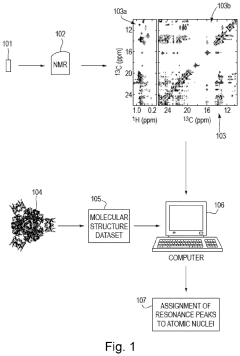
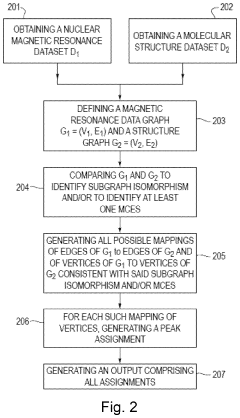
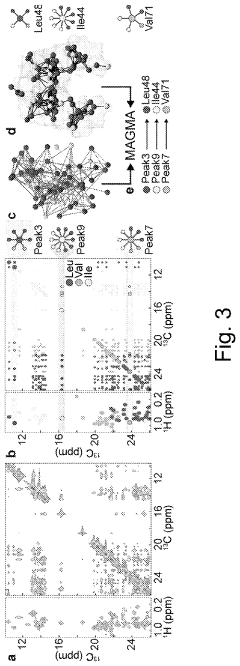
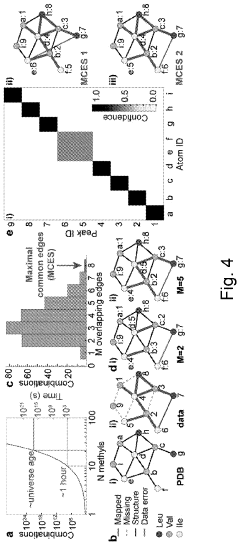
- A graph-matching algorithm that combines structural models with experimental multidimensional magnetic resonance data to accurately identify confident and ambiguous peak assignments by comparing experimental distance restraints with structural models, reducing the need for laborious experiments and providing exact sets of plausible assignments.
Patent
Innovation
- Advanced deconvolution algorithms for resolving overlapping NMR signals in complex mixtures, enabling more accurate identification and quantification of individual components.
- Multi-dimensional NMR techniques (2D, 3D) that provide additional spectral dimensions to separate overlapping signals based on different types of molecular interactions and couplings.
- Combination of NMR with complementary analytical techniques (LC-NMR, MS-NMR) to enhance the identification capabilities through orthogonal data integration.
Integration with Other Analytical Techniques
The integration of Nuclear Magnetic Resonance (NMR) spectroscopy with complementary analytical techniques represents a powerful approach for comprehensive characterization of complex mixtures. Mass Spectrometry (MS) stands as the most synergistic partner for NMR, offering exceptional sensitivity and molecular weight determination capabilities that complement NMR's structural elucidation strengths. Hyphenated techniques such as LC-NMR-MS provide simultaneous separation and multi-modal analysis, enabling researchers to correlate chromatographic, spectroscopic, and mass data for unambiguous compound identification in complex matrices.
Chromatographic methods including HPLC, GC, and TLC serve as essential pre-fractionation steps that simplify complex mixtures before NMR analysis. This separation reduces spectral overlap and enhances the quality of resulting NMR data, particularly valuable when dealing with natural products, metabolomics samples, or pharmaceutical formulations containing numerous components.
Infrared (IR) and Raman spectroscopy provide complementary vibrational information that, when combined with NMR data, offers more complete structural characterization. These techniques are particularly useful for identifying specific functional groups that may be difficult to distinguish by NMR alone, such as carbonyl configurations or hydrogen bonding networks.
Statistical and computational approaches have revolutionized multi-technique data integration. Multivariate statistical methods like Principal Component Analysis (PCA) and Partial Least Squares (PLS) enable researchers to correlate data from different analytical platforms, revealing hidden patterns and relationships between samples. Machine learning algorithms increasingly facilitate automated integration of multi-technique datasets, extracting maximum information while minimizing human interpretation bias.
Data fusion strategies have evolved from simple correlation approaches to sophisticated integration frameworks. Low-level fusion combines raw data from multiple techniques, mid-level fusion integrates extracted features, while high-level fusion combines the interpretations from each technique. These approaches allow researchers to leverage the strengths of each analytical method while mitigating their individual limitations.
Standardized workflows and data formats are emerging to facilitate seamless integration between analytical platforms. Open-source software tools like NMRProcFlow and MetaboAnalyst support multi-technique data processing, while community-driven initiatives are establishing best practices for data sharing and integration across analytical domains.
Chromatographic methods including HPLC, GC, and TLC serve as essential pre-fractionation steps that simplify complex mixtures before NMR analysis. This separation reduces spectral overlap and enhances the quality of resulting NMR data, particularly valuable when dealing with natural products, metabolomics samples, or pharmaceutical formulations containing numerous components.
Infrared (IR) and Raman spectroscopy provide complementary vibrational information that, when combined with NMR data, offers more complete structural characterization. These techniques are particularly useful for identifying specific functional groups that may be difficult to distinguish by NMR alone, such as carbonyl configurations or hydrogen bonding networks.
Statistical and computational approaches have revolutionized multi-technique data integration. Multivariate statistical methods like Principal Component Analysis (PCA) and Partial Least Squares (PLS) enable researchers to correlate data from different analytical platforms, revealing hidden patterns and relationships between samples. Machine learning algorithms increasingly facilitate automated integration of multi-technique datasets, extracting maximum information while minimizing human interpretation bias.
Data fusion strategies have evolved from simple correlation approaches to sophisticated integration frameworks. Low-level fusion combines raw data from multiple techniques, mid-level fusion integrates extracted features, while high-level fusion combines the interpretations from each technique. These approaches allow researchers to leverage the strengths of each analytical method while mitigating their individual limitations.
Standardized workflows and data formats are emerging to facilitate seamless integration between analytical platforms. Open-source software tools like NMRProcFlow and MetaboAnalyst support multi-technique data processing, while community-driven initiatives are establishing best practices for data sharing and integration across analytical domains.
Standardization and Reproducibility Considerations
Standardization of NMR data acquisition and interpretation protocols represents a critical challenge in complex mixture analysis. The inherent variability in sample preparation, instrument calibration, and data processing workflows significantly impacts reproducibility across different laboratories and research groups. Current efforts focus on establishing consensus guidelines for sample handling, with particular emphasis on pH control, temperature stability, and reference compound selection. These parameters must be rigorously controlled as even minor variations can substantially alter chemical shift values and coupling patterns in complex biological or environmental samples.
Instrument-specific considerations further complicate standardization efforts. Different NMR spectrometers, even those with identical field strengths, may produce subtly different spectral characteristics due to variations in hardware configuration, probe design, and pulse sequence implementation. The scientific community has begun addressing this through round-robin testing programs where identical samples are analyzed across multiple platforms to quantify and account for instrument-dependent variations.
Data processing represents another critical area requiring standardization. The selection of window functions, phase correction parameters, baseline correction algorithms, and integration methods can dramatically influence quantitative outcomes. Several international initiatives, including those led by IUPAC and CODATA, are working to establish standardized computational workflows and data formats to ensure consistent processing across different software platforms and research environments.
Reference databases for complex mixture components present additional reproducibility challenges. Current spectral libraries often lack comprehensive coverage of metabolite variations under different physiological or environmental conditions. Efforts to expand these repositories with spectra acquired under standardized but varied conditions (pH ranges, salt concentrations, temperature gradients) are essential for robust interpretation of complex mixture data.
Quality control metrics represent a promising approach to enhancing reproducibility. Implementation of internal standard protocols, statistical validation frameworks, and uncertainty quantification methods allows researchers to objectively assess data quality and reliability. Several analytical chemistry journals now require detailed reporting of these metrics as part of their publication requirements, driving broader adoption of standardized quality assessment procedures.
Interlaboratory comparison studies have revealed that even with identical samples and nominally similar instruments, significant variations in quantitative results can occur. These findings underscore the need for comprehensive reporting standards that document all experimental parameters potentially affecting spectral outcomes. The development of machine-readable experimental metadata formats is facilitating more rigorous comparison of results across different research environments.
Instrument-specific considerations further complicate standardization efforts. Different NMR spectrometers, even those with identical field strengths, may produce subtly different spectral characteristics due to variations in hardware configuration, probe design, and pulse sequence implementation. The scientific community has begun addressing this through round-robin testing programs where identical samples are analyzed across multiple platforms to quantify and account for instrument-dependent variations.
Data processing represents another critical area requiring standardization. The selection of window functions, phase correction parameters, baseline correction algorithms, and integration methods can dramatically influence quantitative outcomes. Several international initiatives, including those led by IUPAC and CODATA, are working to establish standardized computational workflows and data formats to ensure consistent processing across different software platforms and research environments.
Reference databases for complex mixture components present additional reproducibility challenges. Current spectral libraries often lack comprehensive coverage of metabolite variations under different physiological or environmental conditions. Efforts to expand these repositories with spectra acquired under standardized but varied conditions (pH ranges, salt concentrations, temperature gradients) are essential for robust interpretation of complex mixture data.
Quality control metrics represent a promising approach to enhancing reproducibility. Implementation of internal standard protocols, statistical validation frameworks, and uncertainty quantification methods allows researchers to objectively assess data quality and reliability. Several analytical chemistry journals now require detailed reporting of these metrics as part of their publication requirements, driving broader adoption of standardized quality assessment procedures.
Interlaboratory comparison studies have revealed that even with identical samples and nominally similar instruments, significant variations in quantitative results can occur. These findings underscore the need for comprehensive reporting standards that document all experimental parameters potentially affecting spectral outcomes. The development of machine-readable experimental metadata formats is facilitating more rigorous comparison of results across different research environments.
Unlock deeper insights with PatSnap Eureka Quick Research — get a full tech report to explore trends and direct your research. Try now!
Generate Your Research Report Instantly with AI Agent
Supercharge your innovation with PatSnap Eureka AI Agent Platform!