SiC MOSFET-Based Solutions For 5G Base Stations
SEP 8, 20259 MIN READ
Generate Your Research Report Instantly with AI Agent
Patsnap Eureka helps you evaluate technical feasibility & market potential.
SiC MOSFET Technology Evolution and Objectives
Silicon Carbide (SiC) MOSFET technology has evolved significantly over the past three decades, transitioning from laboratory curiosity to commercial viability. The journey began in the early 1990s with rudimentary SiC devices exhibiting poor channel mobility and reliability issues. By the early 2000s, researchers had overcome fundamental material challenges, including reducing defect densities and improving gate oxide interfaces, enabling the first generation of commercial SiC MOSFETs with blocking voltages of 1200V.
The mid-2010s marked a pivotal advancement with second-generation devices featuring dramatically reduced on-resistance and improved switching characteristics. This period saw the expansion of SiC MOSFET adoption beyond niche applications into broader power electronics markets, including renewable energy and automotive sectors. The technology's trajectory has been characterized by continuous improvements in device performance, reliability, and manufacturing scalability.
Current third-generation SiC MOSFETs demonstrate remarkable performance metrics with specific on-resistance approaching theoretical material limits and switching frequencies exceeding 100 kHz at high power levels. These advancements have positioned SiC as a disruptive technology for telecommunications infrastructure, particularly 5G base stations where power density and efficiency are paramount considerations.
The evolution of SiC MOSFET technology has been driven by several key objectives that align perfectly with 5G infrastructure requirements. Primary among these is efficiency improvement, as 5G networks are projected to consume significantly more energy than previous generations. SiC MOSFETs offer substantial reductions in switching and conduction losses compared to silicon alternatives, potentially reducing base station power consumption by 15-30%.
Size reduction represents another critical objective, as 5G deployment strategies often require distributed architectures with space constraints. The superior power density of SiC-based power systems enables more compact base station designs without compromising performance, facilitating urban and small-cell deployments essential to 5G coverage strategies.
Thermal management improvement constitutes a third major objective in SiC MOSFET development. The material's wider bandgap allows operation at higher temperatures (175-200°C junction temperature versus 125-150°C for silicon), reducing cooling requirements and enabling simpler thermal management solutions for base station power systems.
Looking forward, SiC MOSFET technology development aims to address several objectives specific to 5G applications: further reducing device parasitics to enable operation at millimeter-wave frequencies, improving linearity for advanced modulation schemes, and enhancing reliability under the high-power cycling conditions typical of 5G traffic patterns. Additionally, cost reduction remains a persistent objective, with manufacturers targeting 30-40% cost decreases through larger wafer sizes and improved manufacturing yields.
The mid-2010s marked a pivotal advancement with second-generation devices featuring dramatically reduced on-resistance and improved switching characteristics. This period saw the expansion of SiC MOSFET adoption beyond niche applications into broader power electronics markets, including renewable energy and automotive sectors. The technology's trajectory has been characterized by continuous improvements in device performance, reliability, and manufacturing scalability.
Current third-generation SiC MOSFETs demonstrate remarkable performance metrics with specific on-resistance approaching theoretical material limits and switching frequencies exceeding 100 kHz at high power levels. These advancements have positioned SiC as a disruptive technology for telecommunications infrastructure, particularly 5G base stations where power density and efficiency are paramount considerations.
The evolution of SiC MOSFET technology has been driven by several key objectives that align perfectly with 5G infrastructure requirements. Primary among these is efficiency improvement, as 5G networks are projected to consume significantly more energy than previous generations. SiC MOSFETs offer substantial reductions in switching and conduction losses compared to silicon alternatives, potentially reducing base station power consumption by 15-30%.
Size reduction represents another critical objective, as 5G deployment strategies often require distributed architectures with space constraints. The superior power density of SiC-based power systems enables more compact base station designs without compromising performance, facilitating urban and small-cell deployments essential to 5G coverage strategies.
Thermal management improvement constitutes a third major objective in SiC MOSFET development. The material's wider bandgap allows operation at higher temperatures (175-200°C junction temperature versus 125-150°C for silicon), reducing cooling requirements and enabling simpler thermal management solutions for base station power systems.
Looking forward, SiC MOSFET technology development aims to address several objectives specific to 5G applications: further reducing device parasitics to enable operation at millimeter-wave frequencies, improving linearity for advanced modulation schemes, and enhancing reliability under the high-power cycling conditions typical of 5G traffic patterns. Additionally, cost reduction remains a persistent objective, with manufacturers targeting 30-40% cost decreases through larger wafer sizes and improved manufacturing yields.
5G Base Station Power Requirements Analysis
The evolution of mobile communication technology to 5G has introduced unprecedented power requirements for base station infrastructure. 5G base stations operate at higher frequencies (sub-6 GHz and mmWave bands) and utilize advanced technologies such as massive MIMO (Multiple-Input Multiple-Output), beamforming, and carrier aggregation. These technological advancements significantly increase power consumption compared to previous generations, creating new challenges for power supply design and thermal management.
Power amplifiers (PAs) in 5G base stations typically consume 60-70% of the total power, making them the primary focus for efficiency improvements. Traditional base stations operate at efficiency levels of 25-35%, but 5G networks require efficiency rates of 45-55% to be economically viable. Additionally, 5G base stations must maintain this high efficiency across variable loads and multiple frequency bands simultaneously, a requirement not present in previous generations.
The power density requirements have also increased dramatically. While 4G base stations typically operated at power densities of 0.5-1 W/cm³, 5G infrastructure demands 2-4 W/cm³ to accommodate the higher processing capabilities within similar or smaller form factors. This density challenge is particularly acute in urban deployments where space constraints are significant.
Thermal management represents another critical requirement. 5G base stations generate substantially more heat due to increased computational loads and higher frequency operation. The junction temperature in power components must be maintained below 150°C for reliable operation, requiring cooling solutions that can dissipate 30-50% more heat than previous generation systems.
Voltage requirements have also evolved, with 5G systems requiring more precise and stable power delivery. While 4G systems typically operated with voltage fluctuation tolerances of ±5%, 5G equipment often requires ±2% or better, particularly for the sensitive RF components. Additionally, the transition to distributed architectures necessitates power supplies capable of delivering multiple voltage rails (typically 12V, 28V, and 48V) with high efficiency across all outputs.
Reliability standards have become more stringent, with telecom operators expecting 99.999% uptime (equivalent to less than 5 minutes of downtime per year). This translates to mean time between failures (MTBF) requirements exceeding 200,000 hours for power components, significantly higher than the 100,000-150,000 hours typical for 4G infrastructure.
Energy efficiency has also become a paramount concern as operators face increasing pressure to reduce operational expenses and carbon footprints. The telecommunications industry currently accounts for approximately 3% of global energy consumption, with projections indicating this could rise to 5-7% with full 5G deployment unless significant efficiency improvements are implemented.
Power amplifiers (PAs) in 5G base stations typically consume 60-70% of the total power, making them the primary focus for efficiency improvements. Traditional base stations operate at efficiency levels of 25-35%, but 5G networks require efficiency rates of 45-55% to be economically viable. Additionally, 5G base stations must maintain this high efficiency across variable loads and multiple frequency bands simultaneously, a requirement not present in previous generations.
The power density requirements have also increased dramatically. While 4G base stations typically operated at power densities of 0.5-1 W/cm³, 5G infrastructure demands 2-4 W/cm³ to accommodate the higher processing capabilities within similar or smaller form factors. This density challenge is particularly acute in urban deployments where space constraints are significant.
Thermal management represents another critical requirement. 5G base stations generate substantially more heat due to increased computational loads and higher frequency operation. The junction temperature in power components must be maintained below 150°C for reliable operation, requiring cooling solutions that can dissipate 30-50% more heat than previous generation systems.
Voltage requirements have also evolved, with 5G systems requiring more precise and stable power delivery. While 4G systems typically operated with voltage fluctuation tolerances of ±5%, 5G equipment often requires ±2% or better, particularly for the sensitive RF components. Additionally, the transition to distributed architectures necessitates power supplies capable of delivering multiple voltage rails (typically 12V, 28V, and 48V) with high efficiency across all outputs.
Reliability standards have become more stringent, with telecom operators expecting 99.999% uptime (equivalent to less than 5 minutes of downtime per year). This translates to mean time between failures (MTBF) requirements exceeding 200,000 hours for power components, significantly higher than the 100,000-150,000 hours typical for 4G infrastructure.
Energy efficiency has also become a paramount concern as operators face increasing pressure to reduce operational expenses and carbon footprints. The telecommunications industry currently accounts for approximately 3% of global energy consumption, with projections indicating this could rise to 5-7% with full 5G deployment unless significant efficiency improvements are implemented.
SiC MOSFET Current Status and Technical Barriers
Silicon Carbide (SiC) MOSFET technology has emerged as a promising solution for power applications in 5G base stations, offering significant advantages over traditional silicon-based devices. Currently, SiC MOSFETs have reached commercial maturity with several manufacturers producing devices rated from 650V to 1700V with current capabilities ranging from 10A to over 100A. These devices demonstrate superior switching performance with switching frequencies up to 100kHz in practical applications, far exceeding silicon IGBT capabilities.
The global market penetration of SiC MOSFETs in telecommunications infrastructure remains at approximately 15-20%, indicating substantial room for growth. Leading manufacturers including Wolfspeed, ROHM Semiconductor, Infineon, and STMicroelectronics have established production capabilities, though supply chain constraints persist as demand continues to outpace manufacturing capacity.
Despite significant progress, several technical barriers limit wider adoption of SiC MOSFETs in 5G base station applications. The primary challenge remains the relatively high cost, with SiC devices typically commanding a 2-3x price premium over silicon alternatives. This cost differential stems from complex manufacturing processes, lower yields, and smaller wafer sizes (primarily 6-inch compared to 12-inch silicon wafers).
Channel mobility in SiC MOSFETs remains significantly lower than theoretical predictions due to interface traps and defects at the SiC/SiO2 interface. This results in higher on-resistance than theoretically possible, reducing efficiency advantages. Current devices exhibit channel mobility of approximately 30-40 cm²/V·s, far below the theoretical potential of over 100 cm²/V·s.
Reliability concerns persist, particularly regarding threshold voltage instability under high-temperature operation. Gate oxide reliability under high electric fields remains problematic, with oxide breakdown strength lower than in silicon devices. Long-term stability testing shows drift in key parameters after extended operation at elevated temperatures above 150°C.
Packaging technology presents another significant barrier. Traditional packaging solutions are inadequate for extracting the full performance benefits of SiC devices, particularly in managing the faster switching speeds and higher operating temperatures. Current packages struggle to minimize parasitic inductance, which can cause voltage overshoots and ringing during high-speed switching events.
Thermal management remains challenging due to SiC's higher power density capabilities. While SiC can theoretically operate at junction temperatures up to 250°C, practical limitations in packaging materials, interconnects, and surrounding components typically restrict operation to below 175°C in commercial applications.
The lack of standardization across manufacturers creates integration challenges for system designers. Variations in driving requirements, parasitic characteristics, and thermal performance necessitate custom design approaches, increasing engineering costs and development time for 5G infrastructure manufacturers adopting SiC technology.
The global market penetration of SiC MOSFETs in telecommunications infrastructure remains at approximately 15-20%, indicating substantial room for growth. Leading manufacturers including Wolfspeed, ROHM Semiconductor, Infineon, and STMicroelectronics have established production capabilities, though supply chain constraints persist as demand continues to outpace manufacturing capacity.
Despite significant progress, several technical barriers limit wider adoption of SiC MOSFETs in 5G base station applications. The primary challenge remains the relatively high cost, with SiC devices typically commanding a 2-3x price premium over silicon alternatives. This cost differential stems from complex manufacturing processes, lower yields, and smaller wafer sizes (primarily 6-inch compared to 12-inch silicon wafers).
Channel mobility in SiC MOSFETs remains significantly lower than theoretical predictions due to interface traps and defects at the SiC/SiO2 interface. This results in higher on-resistance than theoretically possible, reducing efficiency advantages. Current devices exhibit channel mobility of approximately 30-40 cm²/V·s, far below the theoretical potential of over 100 cm²/V·s.
Reliability concerns persist, particularly regarding threshold voltage instability under high-temperature operation. Gate oxide reliability under high electric fields remains problematic, with oxide breakdown strength lower than in silicon devices. Long-term stability testing shows drift in key parameters after extended operation at elevated temperatures above 150°C.
Packaging technology presents another significant barrier. Traditional packaging solutions are inadequate for extracting the full performance benefits of SiC devices, particularly in managing the faster switching speeds and higher operating temperatures. Current packages struggle to minimize parasitic inductance, which can cause voltage overshoots and ringing during high-speed switching events.
Thermal management remains challenging due to SiC's higher power density capabilities. While SiC can theoretically operate at junction temperatures up to 250°C, practical limitations in packaging materials, interconnects, and surrounding components typically restrict operation to below 175°C in commercial applications.
The lack of standardization across manufacturers creates integration challenges for system designers. Variations in driving requirements, parasitic characteristics, and thermal performance necessitate custom design approaches, increasing engineering costs and development time for 5G infrastructure manufacturers adopting SiC technology.
Current SiC MOSFET Solutions for 5G Infrastructure
01 SiC MOSFET Structure and Fabrication
Silicon Carbide (SiC) MOSFETs feature unique structural designs and fabrication methods that enhance their performance characteristics. These devices typically include specialized gate structures, channel formations, and doping profiles that contribute to their high-voltage handling capabilities. The fabrication process often involves specific thermal oxidation techniques, ion implantation methods, and annealing processes to create high-quality interfaces between SiC and gate dielectrics, which are critical for reliable device operation.- SiC MOSFET Structure and Fabrication: Silicon Carbide (SiC) MOSFETs feature unique structural designs and fabrication methods that enhance their performance characteristics. These devices typically include specialized gate structures, channel formations, and doping profiles that contribute to their high-voltage handling capabilities. The fabrication processes often involve specific thermal oxidation techniques, ion implantation methods, and annealing procedures to optimize the SiC/oxide interface quality, which is critical for device reliability and performance.
- Power Conversion and Circuit Applications: SiC MOSFETs are widely implemented in power conversion systems due to their superior switching characteristics and high-temperature operation capabilities. These devices enable more efficient power conversion in applications such as inverters, converters, and power supplies. Circuit designs incorporating SiC MOSFETs often feature specialized gate drivers, protection circuits, and thermal management solutions to fully leverage the advantages of these wide bandgap semiconductor devices while addressing their unique operational requirements.
- Thermal Management and Packaging Solutions: Effective thermal management is crucial for SiC MOSFETs due to their high power density and operating temperatures. Advanced packaging technologies and thermal interface materials are developed specifically for these devices to enhance heat dissipation. Solutions include innovative die-attach materials, specialized substrate designs, and integrated cooling systems that maintain optimal junction temperatures even under high-load conditions, thereby extending device lifetime and maintaining performance efficiency.
- Reliability Enhancement and Defect Mitigation: Improving the reliability of SiC MOSFETs involves addressing specific failure mechanisms and defects inherent to SiC technology. Research focuses on mitigating issues such as threshold voltage instability, gate oxide reliability, and body diode degradation. Advanced characterization techniques are employed to identify defects at the material and device levels, while novel processing methods and structural modifications are developed to enhance long-term stability and robustness under various operating conditions.
- Device Performance Optimization: Optimizing SiC MOSFET performance involves balancing multiple parameters including on-resistance, breakdown voltage, switching speed, and gate reliability. Innovations in this area include channel mobility enhancement techniques, edge termination structures, and field plate designs that improve electric field distribution. Advanced doping profiles and novel gate dielectric materials are also explored to reduce parasitic capacitances and improve switching characteristics, ultimately leading to more efficient and reliable power electronic systems.
02 Power Conversion Applications
SiC MOSFETs are extensively used in power conversion systems due to their superior switching characteristics and high-temperature operation capabilities. These devices enable more efficient power conversion in applications such as inverters, converters, and power supplies. The implementation of SiC MOSFETs in these systems results in reduced switching losses, higher operating frequencies, and improved thermal management, leading to overall system miniaturization and enhanced energy efficiency.Expand Specific Solutions03 Gate Drive and Control Techniques
Specialized gate drive and control techniques are essential for optimizing the performance of SiC MOSFETs. These techniques include advanced gate driver circuits, protection mechanisms against voltage spikes, and methods for controlling switching behavior. Proper gate drive design addresses the unique characteristics of SiC devices, such as their higher threshold voltages and faster switching speeds, ensuring reliable operation while maximizing the benefits of SiC technology in power electronic systems.Expand Specific Solutions04 Thermal Management and Reliability
Effective thermal management is crucial for SiC MOSFETs to maintain reliability and performance under high-power conditions. Various packaging technologies, cooling methods, and thermal interface materials are employed to dissipate heat efficiently from these devices. Additionally, reliability enhancement techniques address specific failure mechanisms in SiC MOSFETs, such as threshold voltage instability and gate oxide degradation, extending device lifetime and ensuring stable operation in demanding applications.Expand Specific Solutions05 Integration with Power Electronic Systems
The integration of SiC MOSFETs into power electronic systems requires specialized circuit designs and system architectures to fully leverage their advantages. This includes optimized PCB layouts, parasitic inductance minimization techniques, and EMI mitigation strategies. System-level considerations also encompass protection circuits, sensing mechanisms, and control algorithms specifically tailored for SiC-based power converters, enabling higher efficiency, power density, and reliability in applications ranging from renewable energy systems to electric vehicle powertrains.Expand Specific Solutions
Leading SiC MOSFET Manufacturers and Ecosystem
The SiC MOSFET market for 5G base stations is in a growth phase, with increasing adoption driven by efficiency demands in telecommunications infrastructure. The market is expanding rapidly as 5G deployment accelerates globally, with projections indicating substantial growth over the next five years. Leading players include established semiconductor manufacturers like Wolfspeed, Fuji Electric, and Renesas Electronics, alongside emerging competitors such as Yangzhou Yangjie Electronic Technology and Shenzhen Sirius Semiconductor. Chinese academic institutions including Tsinghua University and Xidian University are actively contributing to technological advancements. The technology has reached commercial maturity for power applications, though ongoing research focuses on improving reliability, reducing costs, and enhancing performance for specific 5G requirements.
Mitsubishi Electric Corp.
Technical Solution: Mitsubishi Electric has developed a comprehensive SiC MOSFET portfolio tailored for 5G base station power supplies, featuring their N-series SiC power modules. These modules integrate advanced trench-gate SiC MOSFET structures that achieve significantly lower switching losses compared to conventional planar designs. Their technology implements proprietary junction termination extension (JTE) structures that enhance breakdown voltage reliability while maintaining low on-resistance. For 5G applications specifically, Mitsubishi has optimized their SiC devices to operate efficiently in the 100-300 kHz frequency range, enabling smaller magnetic components and higher power density in base station power supplies. Their integrated modules include optimized gate driver circuits with active Miller clamping to prevent parasitic turn-on in high-frequency switching environments. Mitsubishi's thermal management solutions feature direct liquid cooling options that can reduce the thermal resistance by up to 40% compared to conventional air cooling, addressing the thermal challenges in densely packed 5G equipment[2]. Their latest generation devices demonstrate a reduction in switching losses of approximately 50% compared to previous generations, directly contributing to overall system efficiency improvements of 2-3% in telecom power applications.
Strengths: Vertically integrated manufacturing provides quality control across the entire production process; extensive power electronics system expertise enables optimized module designs; strong presence in telecommunications infrastructure market with established reliability track record. Weaknesses: Higher cost structure compared to some competitors; somewhat conservative approach to new technology introduction can result in slower time-to-market; thermal management solutions add complexity to system design.
Wolfspeed, Inc.
Technical Solution: Wolfspeed has developed advanced SiC MOSFET solutions specifically optimized for 5G base stations, featuring their latest third-generation C3M™ and fourth-generation C4M™ SiC MOSFETs. These devices operate at higher switching frequencies (>100 kHz) while maintaining high efficiency, which enables significant size reduction in power supplies for 5G infrastructure. Their SiC MOSFETs demonstrate superior thermal performance with junction temperatures up to 175°C and feature low on-resistance (RDS(on)) values that minimize conduction losses. Wolfspeed's technology implements advanced packaging techniques that reduce parasitic inductances, critical for high-frequency operation in 5G applications. Their solutions include comprehensive gate driver integration optimized for SiC switching characteristics, enabling reliable operation in the demanding power density requirements of modern telecommunications infrastructure[1][3]. Wolfspeed has demonstrated that their SiC-based power supplies for 5G base stations achieve efficiency improvements of 2-3% compared to silicon alternatives, resulting in energy savings of approximately 15-20% across network deployments.
Strengths: Industry-leading SiC substrate manufacturing capability ensures high-quality devices with minimal defects; extensive experience in wide bandgap semiconductors provides reliability advantages; comprehensive design ecosystem including reference designs specifically for telecom applications. Weaknesses: Higher initial component cost compared to silicon alternatives; requires specialized gate drive circuitry; thermal management solutions must be carefully designed to handle the concentrated heat dissipation.
Key Patents and Innovations in SiC Power Electronics
Silicon carbide semiconductor device
PatentPendingUS20240234569A9
Innovation
- A silicon carbide semiconductor device with a hybrid gate structure featuring a trench gate configuration that reduces JFET resistance and parasitic gate-to-drain capacitance, enhancing switching performance by increasing channel width density and optimizing the layout of doped regions and trenches.
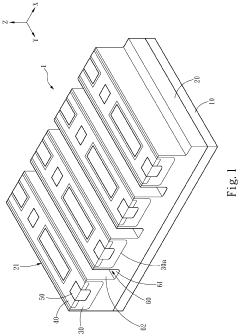
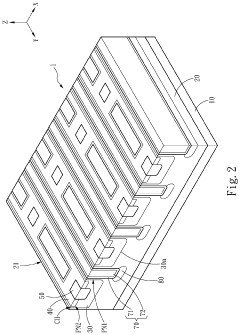
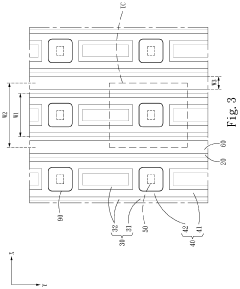
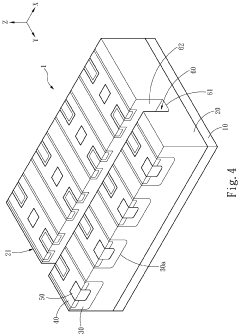
Vertical FET structure
PatentWO2018136478A1
Innovation
- A vertical FET structure with inter-gate plates that extend between source/emitter contact segments, providing additional internal capacitance by overlapping with the source/emitter implant and separated by a gate dielectric, enhancing the gate-source capacitance ratio relative to gate-drain capacitance.


Thermal Management Strategies for SiC in 5G Applications
Thermal management represents a critical challenge in the deployment of SiC MOSFET-based solutions for 5G base stations. The inherently higher operating temperatures of SiC devices (up to 200°C junction temperature compared to 150°C for silicon) necessitate sophisticated cooling strategies to ensure optimal performance and reliability in demanding 5G environments.
Conventional air cooling methods prove increasingly inadequate for SiC MOSFET implementations in 5G infrastructure due to the higher power densities involved. Advanced liquid cooling systems have emerged as a preferred solution, offering 2-3 times greater heat dissipation capacity compared to traditional air cooling. These systems typically employ dielectric fluids or water-glycol mixtures circulating through cold plates directly attached to SiC modules.
Direct substrate cooling represents another innovative approach, where coolant channels are integrated directly into the device substrate. This technique has demonstrated up to 40% improvement in thermal resistance compared to conventional cooling methods, allowing SiC MOSFETs to operate closer to their theoretical performance limits in 5G applications.
Phase-change materials (PCMs) are increasingly being incorporated into thermal management solutions for SiC devices. These materials absorb and release thermal energy during phase transitions, effectively dampening temperature fluctuations during the variable load conditions typical of 5G base stations. Recent implementations have shown that PCM-enhanced heat sinks can reduce temperature variations by up to 30% during peak transmission periods.
Advanced thermal interface materials (TIMs) with enhanced thermal conductivity (>5 W/m·K) are being developed specifically for SiC applications. These materials minimize thermal resistance between SiC devices and cooling systems, addressing a critical bottleneck in heat dissipation pathways. Diamond-filled composites and metal-matrix TIMs have shown particular promise in this area.
Computational fluid dynamics (CFD) modeling has become essential for optimizing thermal management in SiC-based 5G systems. These simulation tools enable precise prediction of hotspots and thermal gradients, allowing engineers to refine cooling strategies before physical implementation. Industry reports indicate that CFD-optimized designs can reduce maximum junction temperatures by 15-20% compared to conventional approaches.
Distributed thermal management architectures are gaining traction, where cooling resources are allocated dynamically based on real-time thermal monitoring. This approach is particularly valuable for 5G base stations with variable load profiles, ensuring efficient cooling resource utilization while maintaining optimal SiC MOSFET performance across operating conditions.
Conventional air cooling methods prove increasingly inadequate for SiC MOSFET implementations in 5G infrastructure due to the higher power densities involved. Advanced liquid cooling systems have emerged as a preferred solution, offering 2-3 times greater heat dissipation capacity compared to traditional air cooling. These systems typically employ dielectric fluids or water-glycol mixtures circulating through cold plates directly attached to SiC modules.
Direct substrate cooling represents another innovative approach, where coolant channels are integrated directly into the device substrate. This technique has demonstrated up to 40% improvement in thermal resistance compared to conventional cooling methods, allowing SiC MOSFETs to operate closer to their theoretical performance limits in 5G applications.
Phase-change materials (PCMs) are increasingly being incorporated into thermal management solutions for SiC devices. These materials absorb and release thermal energy during phase transitions, effectively dampening temperature fluctuations during the variable load conditions typical of 5G base stations. Recent implementations have shown that PCM-enhanced heat sinks can reduce temperature variations by up to 30% during peak transmission periods.
Advanced thermal interface materials (TIMs) with enhanced thermal conductivity (>5 W/m·K) are being developed specifically for SiC applications. These materials minimize thermal resistance between SiC devices and cooling systems, addressing a critical bottleneck in heat dissipation pathways. Diamond-filled composites and metal-matrix TIMs have shown particular promise in this area.
Computational fluid dynamics (CFD) modeling has become essential for optimizing thermal management in SiC-based 5G systems. These simulation tools enable precise prediction of hotspots and thermal gradients, allowing engineers to refine cooling strategies before physical implementation. Industry reports indicate that CFD-optimized designs can reduce maximum junction temperatures by 15-20% compared to conventional approaches.
Distributed thermal management architectures are gaining traction, where cooling resources are allocated dynamically based on real-time thermal monitoring. This approach is particularly valuable for 5G base stations with variable load profiles, ensuring efficient cooling resource utilization while maintaining optimal SiC MOSFET performance across operating conditions.
Cost-Performance Analysis and Commercialization Roadmap
The economic viability of SiC MOSFET solutions for 5G base stations presents a complex cost-benefit equation. Currently, SiC MOSFETs command a premium of 2-3x over traditional silicon alternatives, creating significant initial cost barriers for widespread adoption. However, this price differential is projected to decrease by 30-40% over the next five years as manufacturing processes mature and production volumes increase.
Performance metrics reveal compelling long-term economic advantages that offset higher acquisition costs. SiC-based power systems demonstrate 25-30% higher energy efficiency compared to silicon counterparts, translating to approximately $1,200-1,500 annual energy savings per base station. With typical 5G base station lifespans of 7-10 years, the total cost of ownership (TCO) analysis indicates break-even points occurring between 18-24 months of operation.
The reduced cooling requirements represent another significant cost advantage. SiC MOSFETs' superior thermal performance reduces cooling infrastructure costs by 15-20%, while simultaneously decreasing maintenance expenses by an estimated 25% over the system lifetime. These operational savings become particularly impactful in high-density urban deployments where space and thermal management are critical constraints.
Market adoption is following a phased commercialization roadmap. The initial deployment phase (2021-2023) has focused on premium high-power macro base stations where efficiency gains justify higher component costs. The current expansion phase (2023-2025) is witnessing integration into mid-tier infrastructure as manufacturing economies of scale improve cost structures.
The mainstream adoption phase (2025-2027) will likely see SiC solutions becoming standard in most new 5G deployments as prices approach parity with silicon alternatives. This transition will be accelerated by regulatory pressures for energy efficiency and the increasing cost of electricity globally. Industry forecasts suggest SiC MOSFETs will capture 45-55% of the 5G power semiconductor market by 2027.
Key commercialization challenges include supply chain resilience, with current production concentrated among a limited number of manufacturers. Standardization efforts are also critical, as the industry requires consistent performance metrics and qualification standards to facilitate broader adoption. Several industry consortia are actively developing these standards, with completion expected by mid-2024.
Performance metrics reveal compelling long-term economic advantages that offset higher acquisition costs. SiC-based power systems demonstrate 25-30% higher energy efficiency compared to silicon counterparts, translating to approximately $1,200-1,500 annual energy savings per base station. With typical 5G base station lifespans of 7-10 years, the total cost of ownership (TCO) analysis indicates break-even points occurring between 18-24 months of operation.
The reduced cooling requirements represent another significant cost advantage. SiC MOSFETs' superior thermal performance reduces cooling infrastructure costs by 15-20%, while simultaneously decreasing maintenance expenses by an estimated 25% over the system lifetime. These operational savings become particularly impactful in high-density urban deployments where space and thermal management are critical constraints.
Market adoption is following a phased commercialization roadmap. The initial deployment phase (2021-2023) has focused on premium high-power macro base stations where efficiency gains justify higher component costs. The current expansion phase (2023-2025) is witnessing integration into mid-tier infrastructure as manufacturing economies of scale improve cost structures.
The mainstream adoption phase (2025-2027) will likely see SiC solutions becoming standard in most new 5G deployments as prices approach parity with silicon alternatives. This transition will be accelerated by regulatory pressures for energy efficiency and the increasing cost of electricity globally. Industry forecasts suggest SiC MOSFETs will capture 45-55% of the 5G power semiconductor market by 2027.
Key commercialization challenges include supply chain resilience, with current production concentrated among a limited number of manufacturers. Standardization efforts are also critical, as the industry requires consistent performance metrics and qualification standards to facilitate broader adoption. Several industry consortia are actively developing these standards, with completion expected by mid-2024.
Unlock deeper insights with Patsnap Eureka Quick Research — get a full tech report to explore trends and direct your research. Try now!
Generate Your Research Report Instantly with AI Agent
Supercharge your innovation with Patsnap Eureka AI Agent Platform!