
Dynamic channel distributing method
A dynamic channel allocation and channel technology, applied in the field of communication, can solve the problems of weakened dynamic effect, connection success rate and voice quality degradation, and achieves the effect of increasing the connection rate, shortening the channel search time, and avoiding an infinite loop.
- Summary
- Abstract
- Description
- Claims
- Application Information
AI Technical Summary
Problems solved by technology
Method used
Image

Examples
Embodiment Construction
[0019] Relevant detailed description and technical contents of the present invention are as follows now in conjunction with the accompanying drawings:
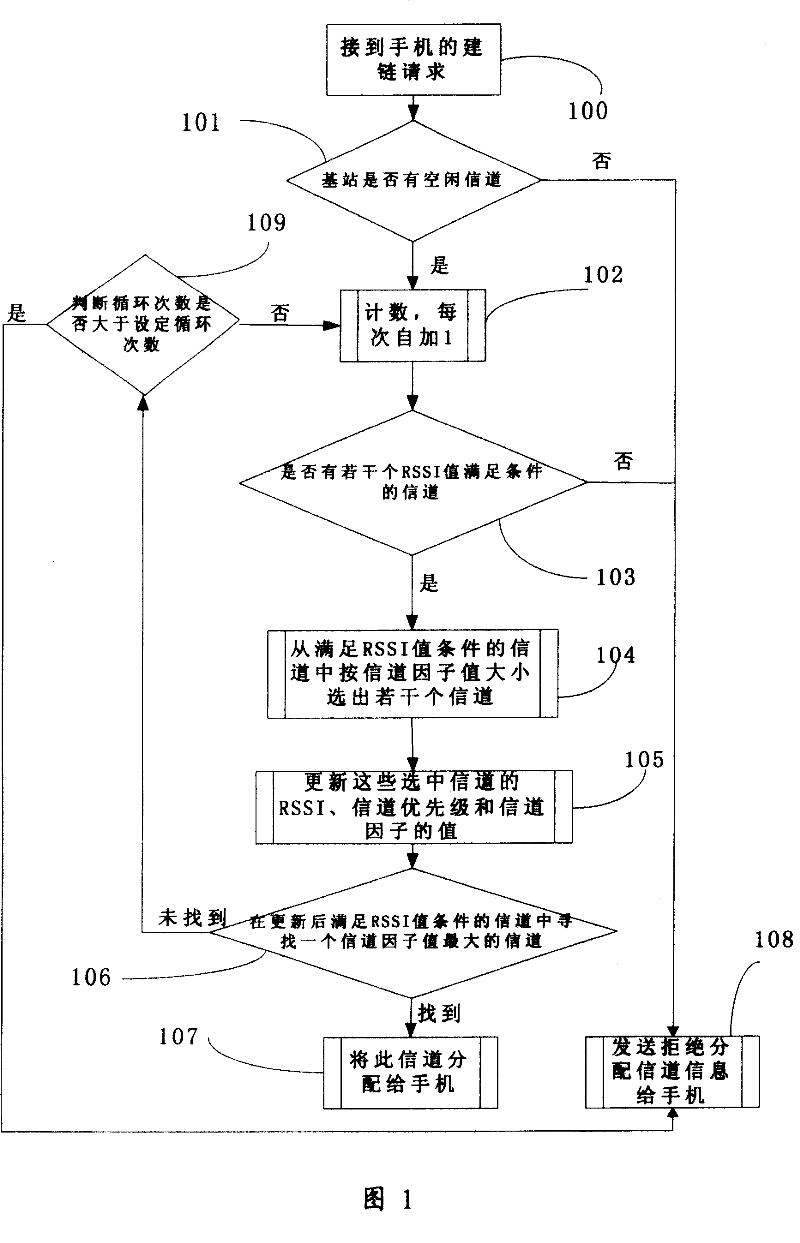
[0020] Referring first to FIG. 1, FIG. 1 is a flowchart of an embodiment of the present invention. In step 100, the base station receives a call link establishment request from the mobile phone side. After receiving the request, the base station enters step 101 to determine whether the base station has an idle channel. If the base station detects that there is an idle channel, it enters the next step. Otherwise, it detects that there is no idle channel. Then proceed to step 108 and send the channel rejection information to the mobile phone. When it is confirmed that the base station has an idle channel, it enters the cycle counting step 102, which is automatically incremented by 1 every time it goes through a cycle process. In the next step 103, the base station detects whether the RSSI values of a certain number of channel...
PUM
 Login to View More
 Abstract
Description
Claims
Application Information
 Login to View More