
Mining waste containing pyrite, in the culture of iron-oxidizing and sulfur-oxidizing microorganisms
A technology of sulfur oxidizing microorganisms and pyrite, which is applied in the field of natural microorganisms, can solve the problems of increasing impurities, not knowing that pyrite is effectively used as an energy source for biomass growth, and being impractical, and achieving the effect of high production capacity
- Summary
- Abstract
- Description
- Claims
- Application Information
AI Technical Summary
Problems solved by technology
Method used
Image

Examples
Embodiment 1
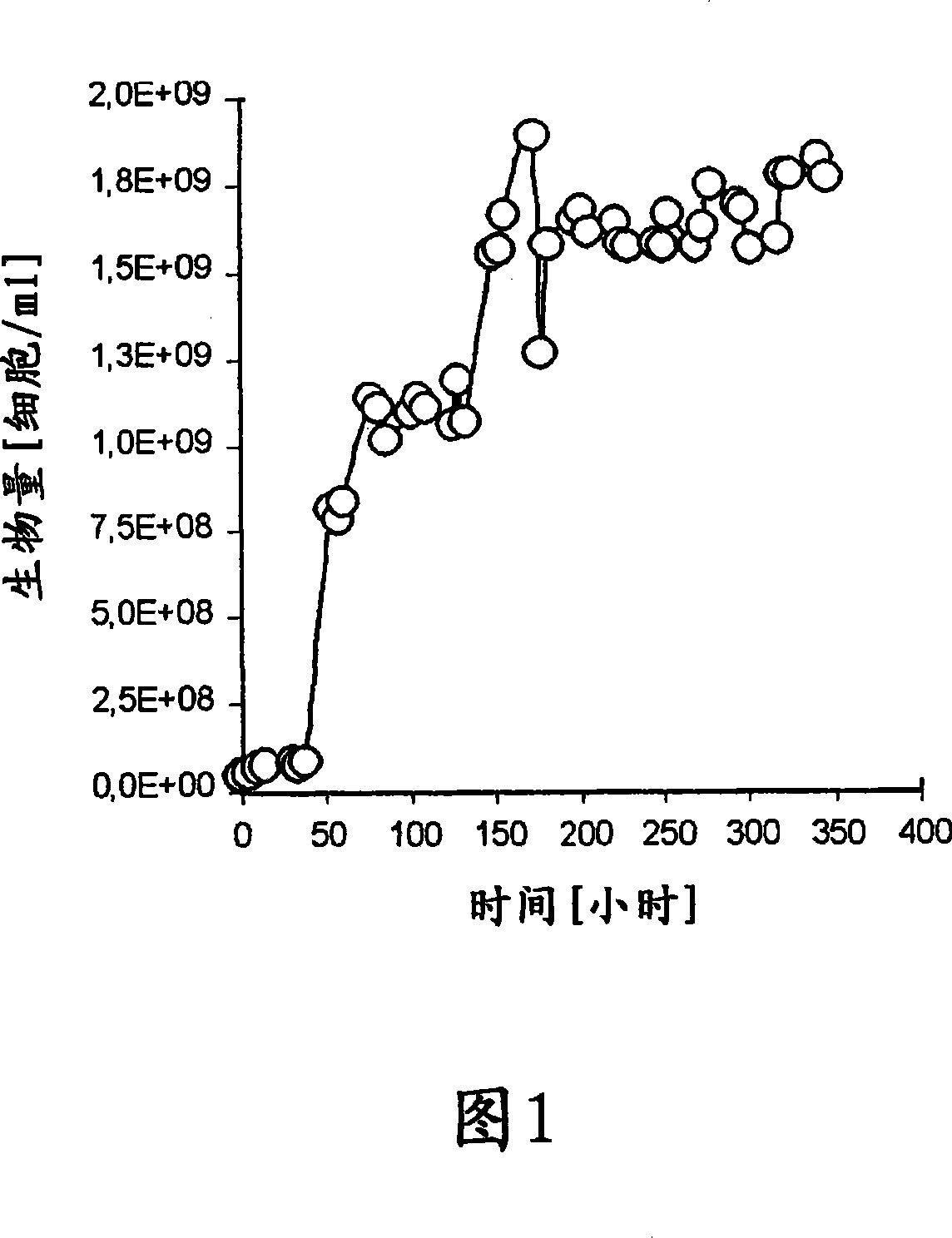
[0054] In order to determine the growth kinetics and biomass production of combinations of Wenelen DSM 16786 and Licanantay DSM 17318 microorganisms, experiments were carried out using the following protocol using a medium modified by the incorporation of sweep tailings:
[0055] Program
[0056] Bacterial growth occurs at 6m 3 effective volume of the reactor.
[0057] A medium for the propagation of microorganisms was prepared by suspending the scavenging tailings (at 1.25% pulp concentration) in a nutrient solution consisting of: 75 g FeSO 4 / L, 0.99g (NH 4 ) 2 SO 4 / L, 0.128g NaH 2 PO 4 ·H 2 O / L, 0.0525g KH 2 PO 4 / L, 0.1gMgSO 4 ·7H 2 O / L, 0.021g CaCl 2 / L. Adjust the pH of the medium to 1.8.
[0058] To start the culture, 5,400 L of medium was mixed with 600 L of bacterial inoculum with Wenelen DSM 16786 and Licanantay DSM 17318 microorganisms.
[0059] In order to allow microorganisms to grow in the reactor, provide enriched 0.5% CO 2 air. The temperature...
Embodiment 2
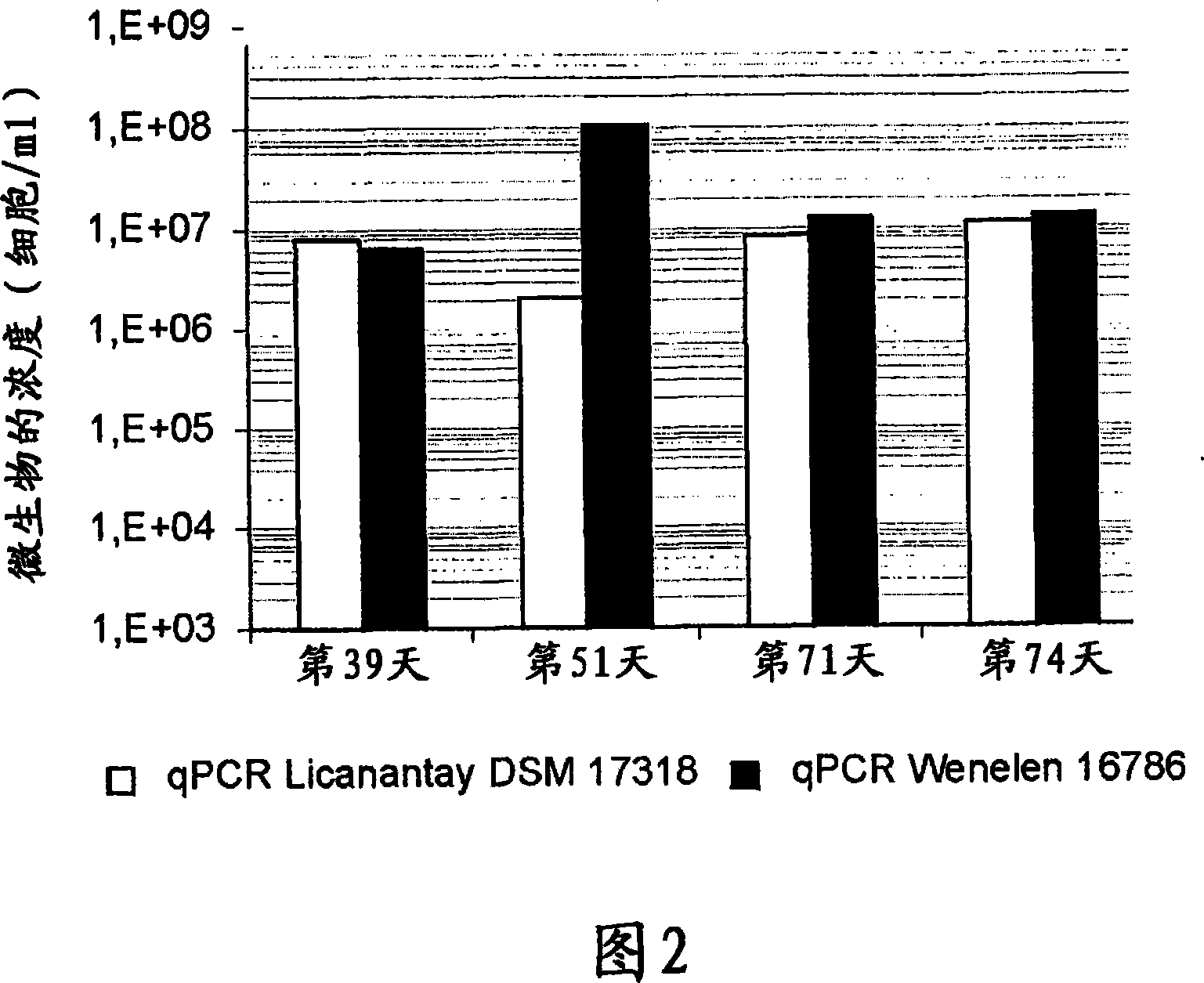
[0064] In order to demonstrate that a combination of Wenelen DSM 16786 and Licanantay DSM 17318 microorganisms can be effectively continuously propagated using a medium modified by the incorporation of sweep tailings, the following protocol was used.
[0065] Program
[0066] Bacterial growth occurs at 50m 3 in industrial reactors.
[0067] A medium for microbial propagation was prepared by suspending the scavenging tailings (at 0.125% slime concentration) in a nutrient solution consisting of: 8 g FeSO 4 / L, 0.99g (NH 4 ) 2 SO 4 / L, 0.128g NaH 2 PO 4 ·H 2 O / L, 0.0525g KH 2 PO 4 / L, 0.1gMgSO 4 ·7H 2 O / L, 0.021g CaCl 2 / L. Adjust the pH of the medium to 1.8.
[0068] To start culturing, place 44m 3 The culture medium with Wenelen DSM 16786 and Licanantay DSM 17318 microorganisms 6m 3 The bacterial inoculum was mixed.
[0069] In order to allow microorganisms to grow in the reactor, provide enriched 0.5% CO 2 air. The temperature of the reactor was controlled a...
PUM
 Login to View More
 Abstract
Description
Claims
Application Information
 Login to View More