Call admission control method

A call control and new call technology, applied in the direction of digital transmission system, electrical components, transmission system, etc., can solve the problems of severe oscillation and unstable cost of controlled link utilization

CN101438540AInactive Publication Date: 2009-05-20TELEFON AB LM ERICSSON (PUBL)
3 Cites 0 Cited by

Patent Information

Authority / Receiving Office
CN · China
Patent Type
Applications(China)
Current Assignee / Owner
Publication Date
2009-05-20
Estimated Expiration
Not applicable · inactive patent

Smart Images

  • Figure 1
    Figure 1
  • Figure 2
    Figure 2
  • Figure 3
    Figure 3
Patent Text Reader

Abstract

A system of call admission control is proposed that utilises a restriction factor to limit the number of new incoming calls admitted to a path of a packet-switched network. The restriction factor is determined on the basis of the load condition on the path as defined by measured performance indicators, such as jitter and packet loss. Preferably, the restriction factor is adjusted on the basis of both a previous load condition and a current measured load condition. The system is capable of reacting rapidly to any change in the congestion of a link while remaining stable. By determining the load on the path primarily based on the measured jitter, the system reacts to congestion in a proactive manner before experiencing packet loss. Furthermore, it ensures a good utilisation of the network is possible even in a situation of high congestion, provides acceptable voice quality even on bottleneck links and can be implemented entirely in an edge node of the network and hence does not require additional algorithms or mechanisms within in the core network, such as signalling and resource reservation.
Need to check novelty before this filing date? Find Prior Art

Description

technical field

[0001] The present invention relates to admission control of voice and multimedia calls over packet-switched Internet Protocol (IP) networks in order to maintain call quality. Background technique

[0002] When carrying real-time traffic such as voice or multimedia traffic over a packet-switched core network, such as an Internet Protocol (IP)-based network or pure L2 Ethernet (Ethernet), certain provisions must be made to provide the necessary quality of service. For transmission over packet-switched IP networks, voice or multimedia data must be broken down into discrete packets that can travel through different network paths to their final destination before being reassembled in the correct order. The transfer speed between any two endpoints can vary significantly, depending on the amount and type of traffic the network is carrying at any one time, as well as the network design and capacity. Previously, IP networks could only provide "best effort" quality o...

Examples

Embodiment Construction

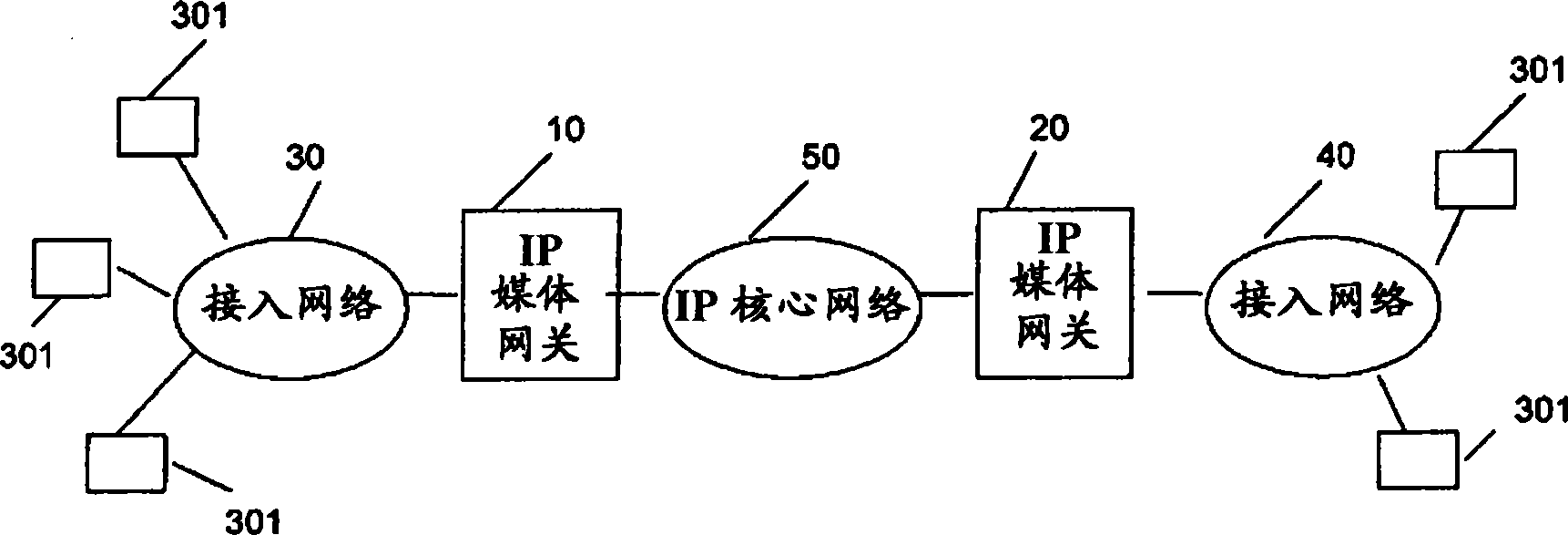
[0033] figure 1 An example apparatus is shown that provides multimedia communications over Internet Protocol (IP) or other packet-switched networks. In the shown arrangement, a plurality of users 301 are connected to a first access network 30 providing access to an IP core network 50 using an IP media gateway 10 acting as an IP network edge node. Another IP media gateway 20 connects the second access network 40 to the IP core network 50 . This second access network 40 is also connected to a plurality of users 401 . It should be understood that many other access networks could be connected to the IP core network via similar gateways or via alternative edge nodes. Users 301 and 401 may include landline telephones, cellular telephones, personal computers, or other multimedia devices. The present arrangement, in particular the media gateway 10, 20, is capable of handling delay sensitive traffic such as voice and video traffic as well as non-delay sensitive data. In order to ef...