
Wireless sensor network (WSN) trust evaluation method based on subjective belief
A wireless sensor and belief technology, applied in wireless communication, network topology, electrical components, etc., can solve the problem of incomplete measurement information, difficulty in fully expressing the subjectivity of sensor network node trust, uncertainty, ambiguity, transitivity and dynamics Sexuality, ignoring malicious attacks on trust mechanisms, etc.
- Summary
- Abstract
- Description
- Claims
- Application Information
AI Technical Summary
Problems solved by technology
Method used
Image

Examples
Embodiment Construction
[0093] The present invention will be further described in detail below in conjunction with the accompanying drawings.
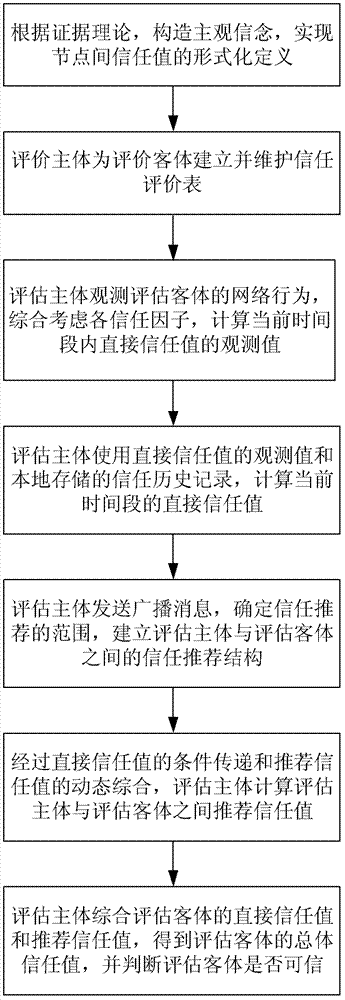
[0094] A trust evaluation method for wireless sensor networks based on subjective belief proposed by the present invention, such as figure 1 As shown, it specifically includes the following steps:
[0095] Step 1: According to evidence theory, construct subjective beliefs and realize the formal definition of trust value between nodes. The specific method is:
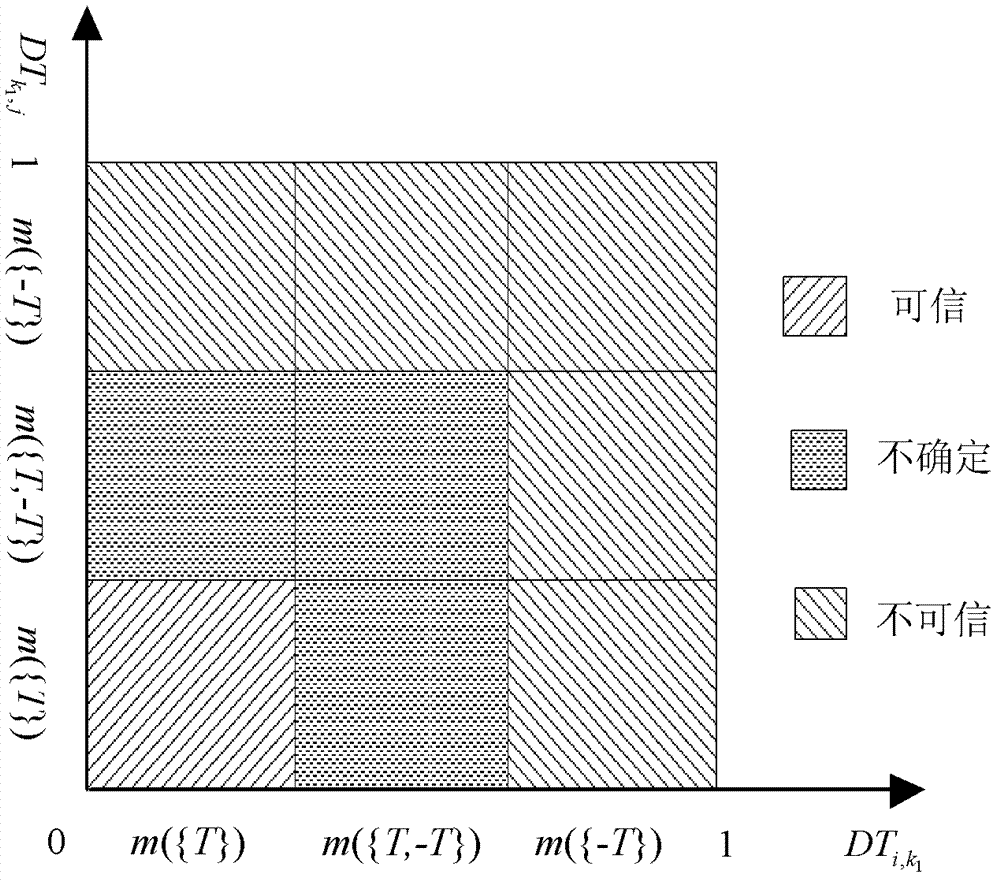
[0096] Let T and -T respectively represent two mutually exclusive and exhaustive node trust states, that is, "credible" and "untrustworthy" states. According to the D-S evidence theory, the recognition framework Ω={T, -T}, the power set 2 Ω for gather {T}, {T, -T}, {-T} represent "impossible event", "credible event", "uncertain event" and "implausible event", respectively. Basic confidence function m: 2 Ω →[0, 1], m({T}), m({T,-T}) and m({-T}) represent the degree of support of the evidence for ...
PUM
 Login to View More
 Abstract
Description
Claims
Application Information
 Login to View More