Temperature and humidity compensation type air conditioner and control method thereof
What is AI technical title?
AI technical title is built by Patsnap AI team. It summarizes the technical point description of the patent document.
A temperature and humidity compensation, air conditioner technology, applied in heating and ventilation control systems, heating methods, space heating and ventilation, etc.
Active Publication Date: 2012-08-22
MIDEA GRP CO LTD
View PDF3 Cites 42 Cited by
Summary
Abstract
Description
Claims
Application Information
AI Technical Summary
This helps you quickly interpret patents by identifying the three key elements:
Problems solved by technology
Method used
Benefits of technology
Problems solved by technology
Only controlling the temperature can no longer meet the needs of users, and controlling the humidity is becoming more and more important
In summer, when the air conditioner is running for cooling, it can not only reduce the ambient temperature, but also dehumidify to a certain extent. If the relative humidity in the room is too low at this time, it will make the user feel dry and cause the user to have a "dry throat"; If the relative humidity in the room is too high, the user will feel stuffy and it will cause inconvenience to the user
In winter, when the air conditioner is running for heating, if the humidity is not controlled, it will also affect the comfort of the air conditioner to the user.
In addition, the manufacturers of air conditioners have a sleep function on the air conditioner according to the sleeping habits of users. However, if the setting temperature of the sleep function of the air conditioner is not appropriate, it is easy to cause the user to wake up from cold, hot wake up and difficulty falling asleep due to dryness.
Generally, the air conditioner only controls the temperature during the cooling and heating operation, and does not control the humidity.
Method used
the structure of the environmentally friendly knitted fabric provided by the present invention; figure 2 Flow chart of the yarn wrapping machine for environmentally friendly knitted fabrics and storage devices; image 3 Is the parameter map of the yarn covering machine
View more
Image
Smart Image Click on the blue labels to locate them in the text.
Viewing Examples
Smart Image
Click on the blue label to locate the original text in one second.
Reading with bidirectional positioning of images and text.
Smart Image
Examples
Experimental program
Comparison scheme
Effect test
no. 2 example
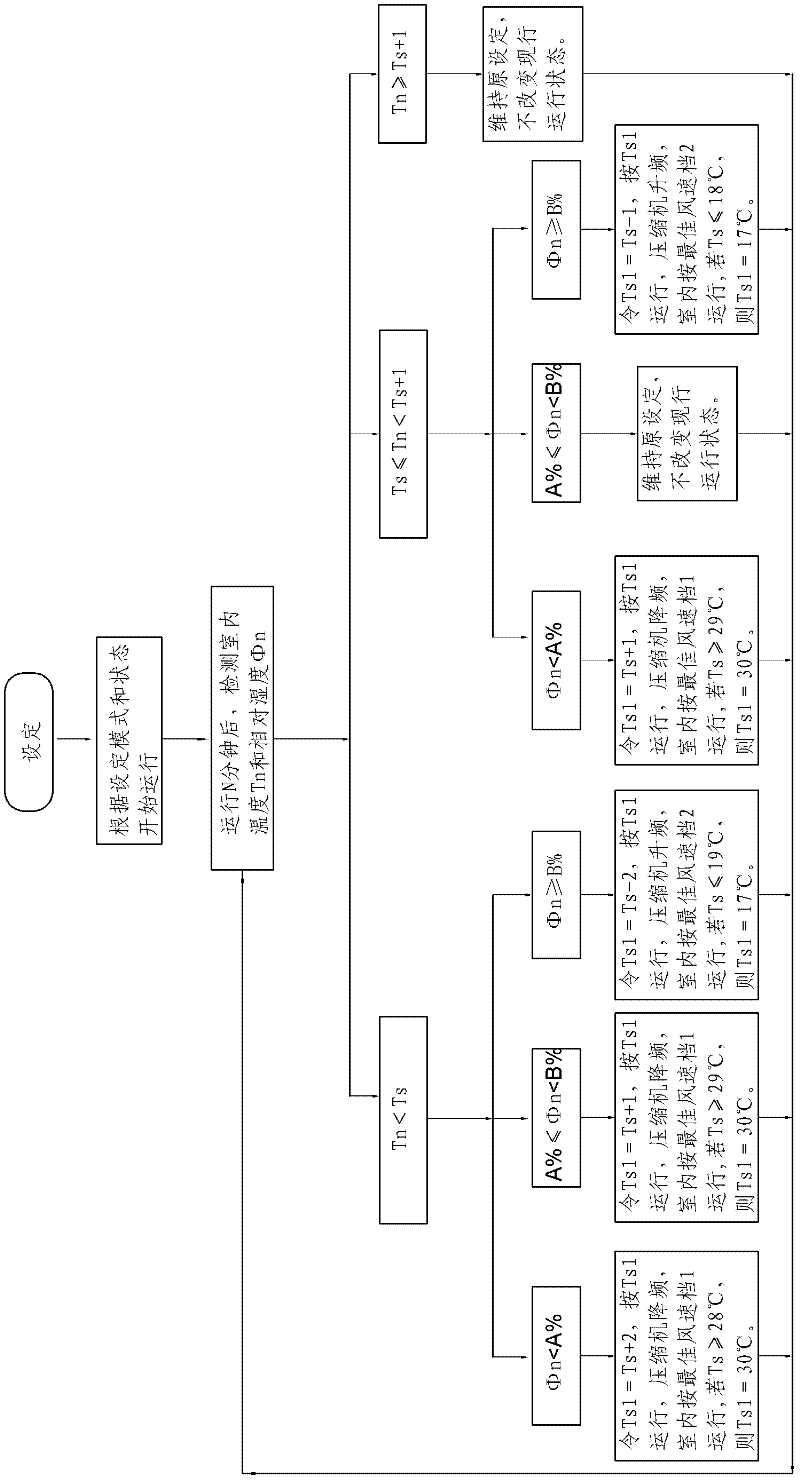
[0087] see figure 2 , this embodiment is a temperature and humidity compensation control program in the normal heating mode.
[0088] In this embodiment, when the setting mode is the normal heating mode, and the indoor temperature Tn>Ts in the room measured by the temperature sensor T1, the relative humidity Φn
[0089] When the setting mode is normal heating mode, and the indoor temperature Tn > Ts measured by the temperature sensor T1, and the relative humidity Φn≥A% measured by the humidity sensor Φ1, go to step 11 ;
[0090] When the setting mode is heating normal mode, and the indoor temperature Tn in the room measured by the temperature sensor T1 is between Ts-1<Tn≤Ts, the relative humidity in the room measured by the humidity sensor Φ1 is Φn< When A%, go to step 12;
[0091] When the setting mode is the normal heating mode, and the indoor temperature Tn in the room measured by the temperature senso...
no. 3 example
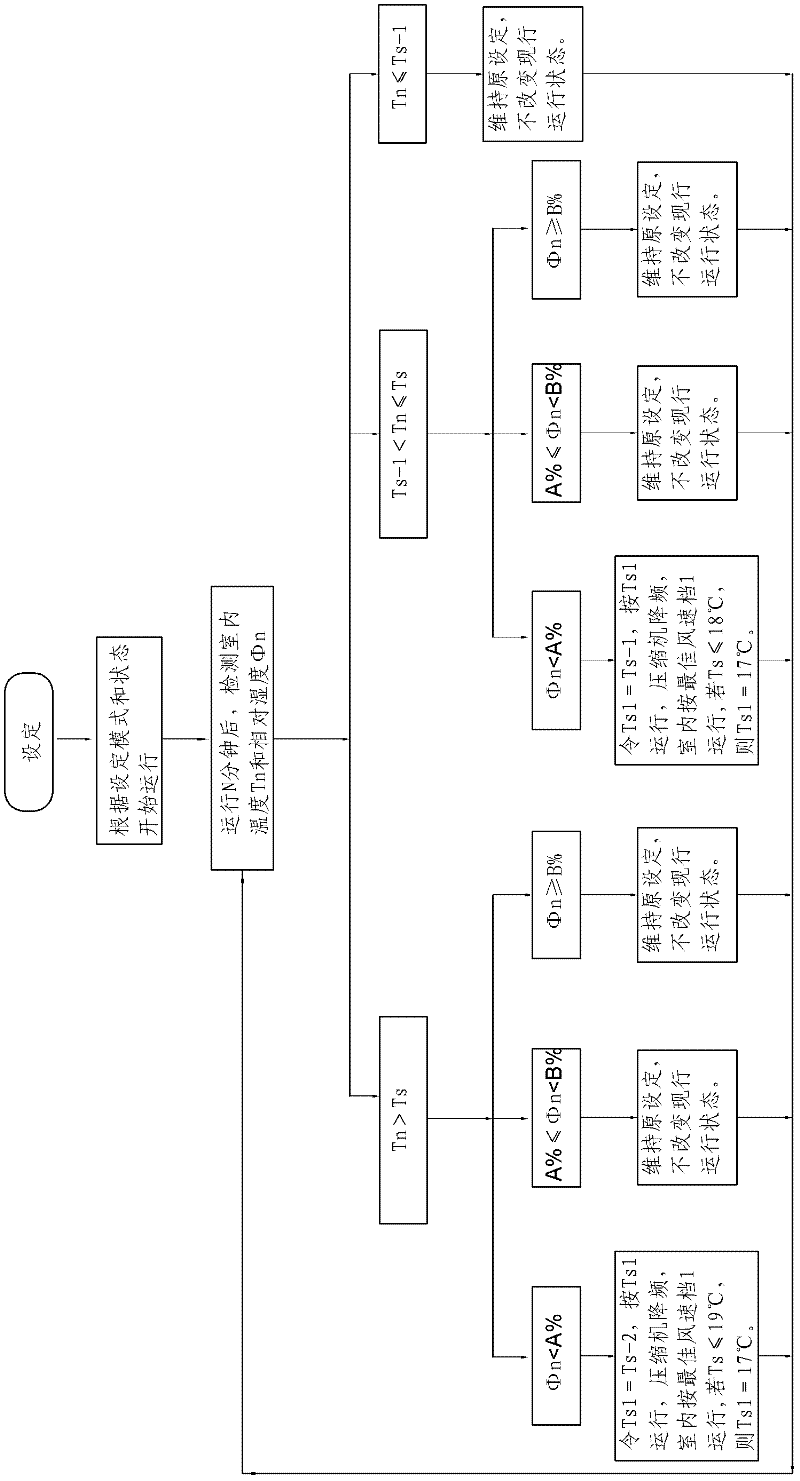
[0099] see image 3 , this embodiment is a temperature and humidity compensation control program in the cooling sleep mode.
[0100] In cooling sleep mode, control Tn≤Ts+2, and Tn≤29°C.
[0101] In this embodiment, when the setting mode is the cooling sleep mode, and the indoor temperature Tn<Ts in the room measured by the temperature sensor T1, and the relative humidity Φn<A% in the room measured by the humidity sensor Φ1, Go to step 13;
[0102] When the setting mode is cooling sleep mode, and the indoor temperature Tn
[0103] When the setting mode is the cooling sleep mode, and the indoor temperature Tn
[0104] When the setting mode is cooling sleep mode, ...
no. 4 example
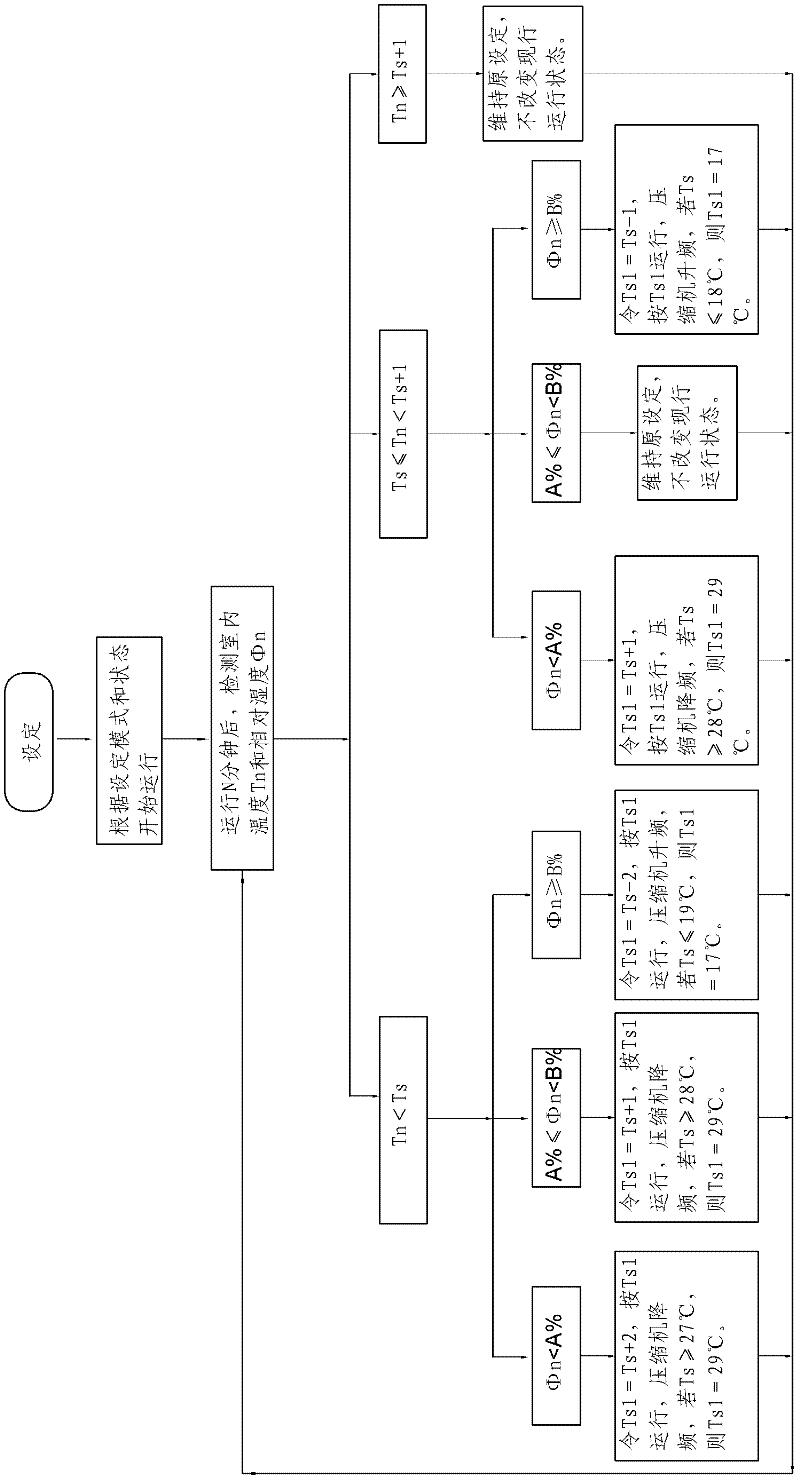
[0116] see Figure 4 , this embodiment is a temperature and humidity compensation control program in the heating sleep mode.
[0117] In the heating sleep mode, control Tn≥Ts-2 and Tn≥20°C.
[0118] In this embodiment, when the setting mode is the heating sleep mode, and the indoor temperature Tn>Ts in the room measured by the temperature sensor T1, the relative humidity Φn
[0119] When the setting mode is heating sleep mode, and the indoor temperature Tn>Ts in the room measured by the temperature sensor T1, and the relative humidity Φn≥A% in the room measured by the humidity sensor Φ1, go to step 20 ;
[0120] When the setting mode is the heating sleep mode, and the indoor temperature Tn in the room measured by the temperature sensor T1 is between Ts-1
[0121] When the setting mode is heating slee...
the structure of the environmentally friendly knitted fabric provided by the present invention; figure 2 Flow chart of the yarn wrapping machine for environmentally friendly knitted fabrics and storage devices; image 3 Is the parameter map of the yarn covering machine
Login to View More
PUM
Login to View More
Abstract
The invention relates to a temperature and humidity compensation type air conditioner and a control method thereof. The temperature and humidity compensation type air conditioner comprises an air conditioner outdoor unit and an air conditioner indoor unit. The air conditioner indoor unit is provided with a temperature sensor which is used for detecting indoor temperature in a room, and a humidity sensor which is used for detecting relative humidity in the room, wherein the temperature sensor and the humidity sensor are respectively connected with the main controller of the air conditioner. The temperature sensor and the humidity sensor detect the temperature and the relative humidity in the room in real time, the original set temperature is compensated according to the detected signals, the operating frequency of a compressor and the wind speed level of the indoor unit are controlled, humidity compensation is indirectly conducted on the air conditioner to enable the air conditioner to purposely regulate humidity when the temperature is regulated, so as to finally enable the indoor temperature and the relative humidity in the room to be gradually regulated to be within a comfortable range. The temperature and humidity compensation type air conditioner and the control method thereof have the characteristics that the operating method is simple, the control is easy to realize and the user comfort can be rapidly improved.
Description
technical field [0001] The invention relates to an air conditioner, in particular to a temperature and humidity compensation air conditioner and a control method thereof. Background technique [0002] With the popularization of air conditioners, users' requirements for air conditioners tend to be more and more humanized, personalized, strong applicability, energy saving, environmental protection, comfort and other characteristics. Only controlling the temperature can no longer meet the needs of users, and controlling the humidity is becoming more and more important. In summer, when the air conditioner is running for cooling, it can not only reduce the ambient temperature, but also dehumidify to a certain extent. If the relative humidity in the room is too low at this time, it will make the user feel dry and cause the user to have a "dry throat"; If the relative humidity in the room is too high, the user will feel stuffy, which will also cause inconvenience to the user. In ...
Claims
the structure of the environmentally friendly knitted fabric provided by the present invention; figure 2 Flow chart of the yarn wrapping machine for environmentally friendly knitted fabrics and storage devices; image 3 Is the parameter map of the yarn covering machine
Login to View More
Application Information
Patent Timeline
Application Date:The date an application was filed.
Publication Date:The date a patent or application was officially published.
First Publication Date:The earliest publication date of a patent with the same application number.
Issue Date:Publication date of the patent grant document.
PCT Entry Date:The Entry date of PCT National Phase.
Estimated Expiry Date:The statutory expiry date of a patent right according to the Patent Law, and it is the longest term of protection that the patent right can achieve without the termination of the patent right due to other reasons(Term extension factor has been taken into account ).
Invalid Date:Actual expiry date is based on effective date or publication date of legal transaction data of invalid patent.


 Login to View More
  Login to View More