
Remnant quick detecting method based on history pixel set matching degree
A detection method and a technique for remnants, applied in the field of video surveillance, can solve problems such as difficult re-detection, poor adaptability to complex scenes, and slow detection speed
- Summary
- Abstract
- Description
- Claims
- Application Information
AI Technical Summary
Problems solved by technology
Method used
Image

Examples
Embodiment Construction
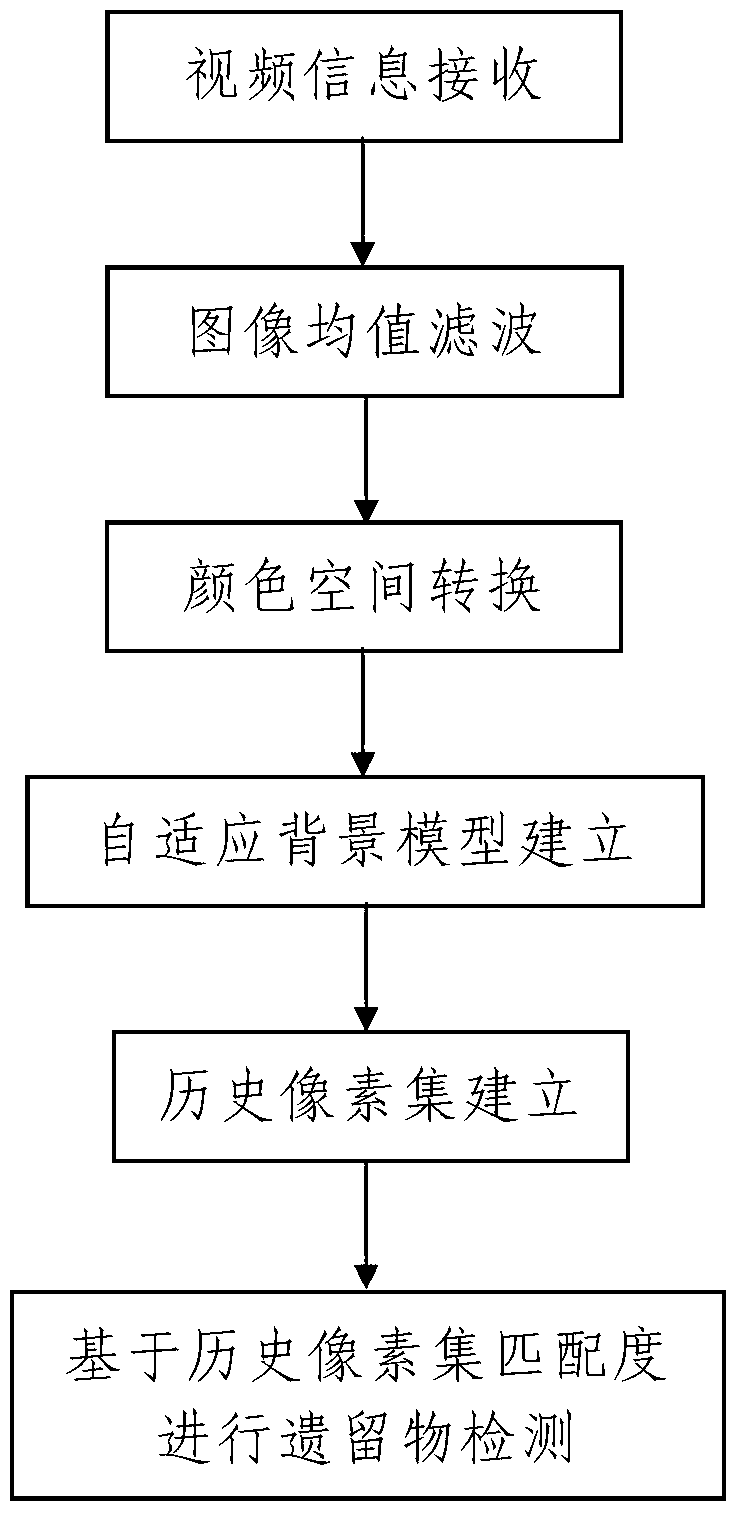
[0049] Such as figure 1 A method for quickly detecting remnants based on the matching degree of historical pixel sets is shown, which is characterized in that the method includes the following steps:
[0050] Step 1. Video information reception: using a data processor to receive the video information to be processed collected by the video acquisition device, the data processor is connected to the video acquisition device; the video information to be processed includes a plurality of image data frame, and the plurality of image data frames are arranged from front to back according to the time sequence received by the data processor.
[0051] Step 2, establishment of an adaptive background model: use the data processor to process the first N image data frames in the video information to be processed in step 1 from front to back, and establish an adaptive background model for moving object detection. A background model; the adaptive background model is a codebook model, and N is...
PUM
 Login to View More
 Abstract
Description
Claims
Application Information
 Login to View More