A test method for anti-irradiation index of star sensor lens

A technology for star sensor and index testing, applied in the field of star sensors, can solve problems such as blank test of anti-radiation index and weak anti-radiation
CN103335663BActive Publication Date: 2015-09-09SHANGHAI AEROSPACE CONTROL TECH INST

Patent Information

Authority / Receiving Office
CN Β· China
Patent Type
Patents(China)
Current Assignee / Owner
SHANGHAI AEROSPACE CONTROL TECH INST
Publication Date
2015-09-09

Smart Images

  • Figure 1
    Figure 1
  • Figure 2
    Figure 2
  • Figure 3
    Figure 3
Patent Text Reader

Abstract

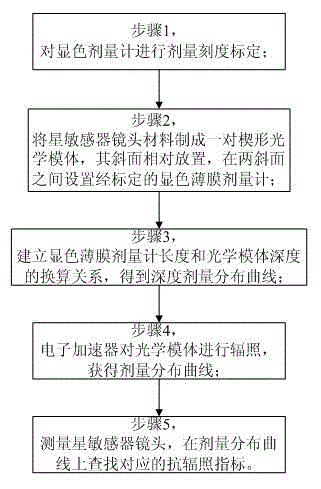
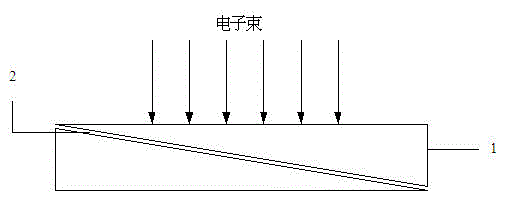
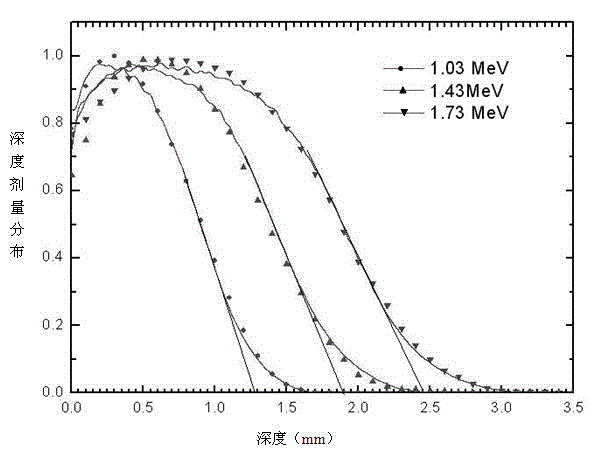
The invention discloses a method for testing a radiation-resistant index of a star sensor lens. The method comprises the following steps of: performing dose scale calibration on a developing film dose meter in a standard dose field, and converting optical density into an absorbed dose value; manufacturing the star sensor lens material into a pair of wedge-shaped optical modes, arranging the inclined surfaces of the pair of wedge-shaped optical modes opposite to each other, and setting the developing film dose meter subjected to dose scale calibration between the inclined surfaces of the two wedge-shaped optical modes; establishing a conversion relation between the length of the developing film dose meter and the depth of the optical modes, and obtaining a depth dose distribution curve of electron beams in the optical modes; irradiating the optical modes to the specific accumulated dose by adopting an electron accelerator, measuring the optical density change value of the developing film dose meter by adopting a spectrophotometer, and obtaining a dose distribution curve of the star sensor lens; and measuring the thickness of the star sensor lens, and querying to obtain the radiation-resistant index which corresponds to the thickness of the star sensor lens on the dose distribution curve. According to the method, the star sensor lens can be subjected to ground irradiation test of the radiation-resistant index.
Need to check novelty before this filing date? Find Prior Art

Description

technical field

[0001] The invention relates to a star sensor, in particular to a method for testing an anti-radiation index of a star sensor lens. Background technique

[0002] The emergence of CCD technology in the mid-1970s greatly improved the accuracy of star sensors, and at the same time greatly accelerated the development of star sensors. Because CCD has many advantages such as small size, light weight, low power consumption and high reliability, it is rapidly and widely used in the development of star sensors. The adoption of CCD technology and the autonomy of attitude measurement are the notable features that distinguish this generation of astrosensors from the previous generation. The star sensor developed by our country uses a commercial-grade CCD device. As the weak link in the anti-radiation of the star sensor, it is necessary to do a good anti-irradiation design for the optical lens in front of the CCD, so as to resist stronger space radiation. , the research...

Claims

the structure of the environmentally friendly knitted fabric provided by the present invention; figure 2 Flow chart of the yarn wrapping machine for environmentally friendly knitted fabrics and storage devices; image 3 Is the parameter map of the yarn covering machine
Login to View More