
Low-cycle creep and fatigue life evaluation method under conditions of high temperature and multiaxial spectrum load
A fatigue life and fatigue life prediction technology, applied in the field of fatigue strength
- Summary
- Abstract
- Description
- Claims
- Application Information
AI Technical Summary
Problems solved by technology
Method used
Image


Examples
Embodiment Construction
[0046] The specific embodiments of the present invention will be described with reference to the accompanying drawings and calculation examples.
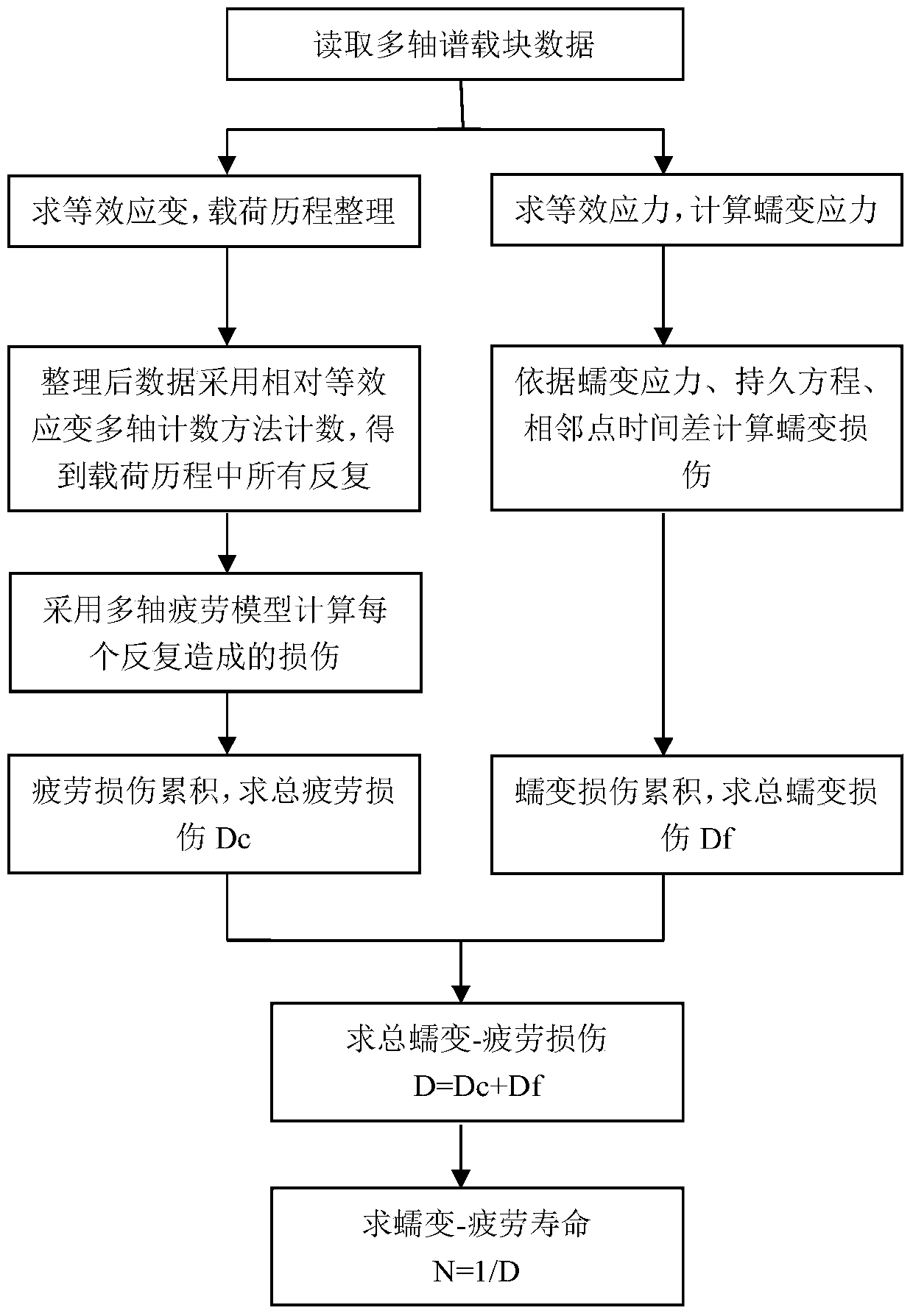
[0047] The damage estimation to be performed in the present invention includes multiaxial fatigue damage estimation and creep damage estimation. According to the damage calculation result, N is the number of load history described by the block load that the part can withstand, which is the predicted fatigue life.
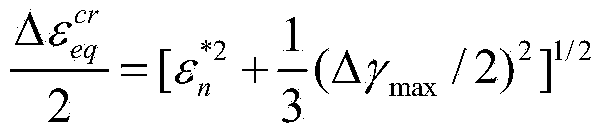
[0048] Step 1): Read the stress-strain history in the load block, and use the Mises criterion to find the equivalent strain ε of each point eq , disconnect the load spectrum from the maximum equivalent strain, and move the load history data before this point to the end of the load history to complete the load arrangement;
[0049] Suppose the fast load history is as follows:
[0050] Table 1 Load History Data
[0051]
[0052] According to the load history, the equivalent strain of each point can be obtained, and the...
PUM
 Login to View More
 Abstract
Description
Claims
Application Information
 Login to View More