
Multi-user multiple input multiple output (MU-MIMO) based stream distribution proportional fairness scheduling method
A technology of distribution ratio and scheduling method, which is applied in the fields of electrical components, wireless communication, etc.
- Summary
- Abstract
- Description
- Claims
- Application Information
AI Technical Summary
Problems solved by technology
Method used
Image

Examples
Embodiment Construction
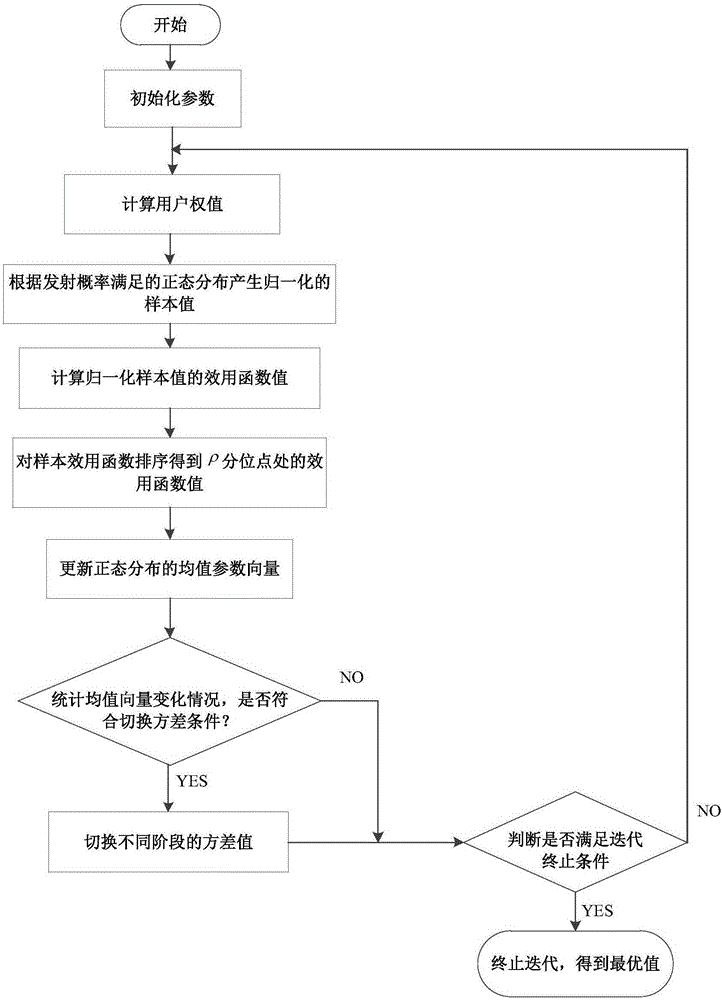
[0045] refer to figure 1 , the specific implementation steps of the present invention are as follows:
[0046] Step 1, set the initialization parameters.
[0047] Suppose the number of base station transmission modes is F, the number of users to be served is M, and the mean vector of transmission probability is g t =(g 1,t ,..., g k,t ,..., g F,t ), where g k,t Indicates the mean value of the normal distribution of the transmission probability of the kth transmission mode of the base station, the initial value The emission probabilities all obey the normal distribution;
[0048] Since the standard deviation of the normal distribution determines the sampling range of the emission probability, when the standard deviation is large, the sampling range is large and the number of iterations is small, but the final result will be inaccurate; and when the standard deviation is small, the sampling The range is small. Although a more accurate solution can be obtained, it will ca...
PUM
 Login to View More
 Abstract
Description
Claims
Application Information
 Login to View More