
Construction method of doubly ruled surface geologic body
A construction method and ruled surface technology, which is applied in the field of double ruled surface geological body construction, to achieve the effects of saving computing memory, reducing data redundancy, and reducing the amount of data
- Summary
- Abstract
- Description
- Claims
- Application Information
AI Technical Summary
Problems solved by technology
Method used
Image

Examples
specific Embodiment approach 1
[0049] Specific Embodiments 1. The construction method of a double ruled surface geological body in this embodiment is specifically prepared according to the following steps:
[0050] Step 1. Establish the size of the spatial grid unit; (ie, the size of the double ruled surface), such as 10*10 meters, 5*5 meters, etc. The establishment of this size is related to the accuracy of the spatial expression defined by the user. The higher the accuracy, the grid is required The smaller the size, the error test is established by calculating the accuracy of the double ruled surface.
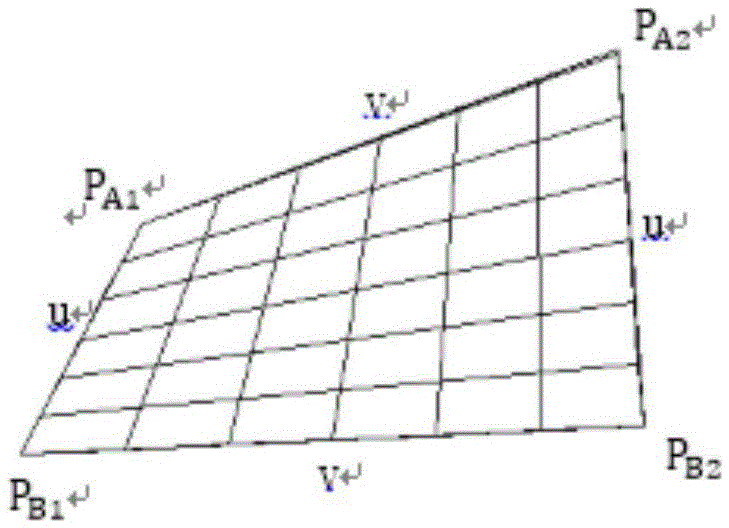
[0051] Step 2: Construct a double-ruled surface, calculate the four vertex coordinates of each double-ruled surface according to the size of the spatial grid unit, and then calculate the ruled lines of each double-ruled surface according to the four vertex coordinates of each double-ruled surface Wire;
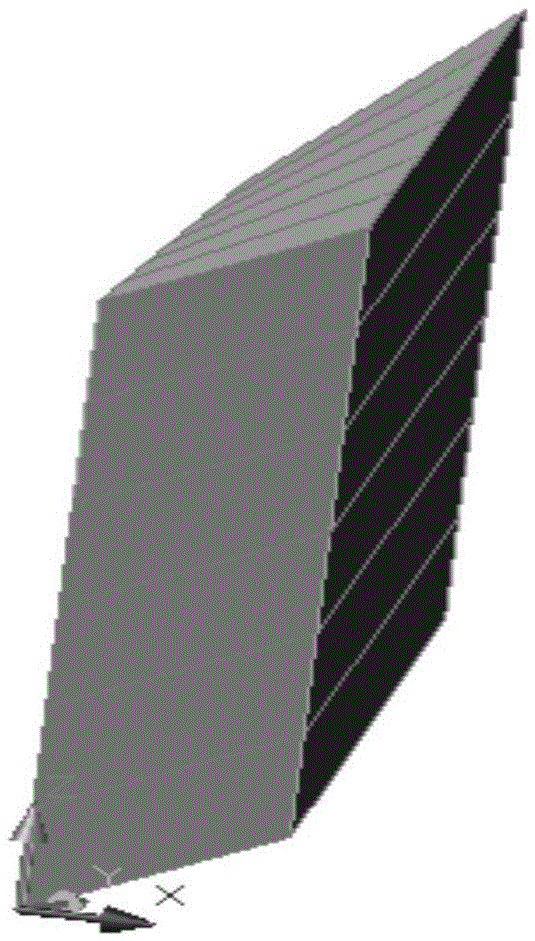
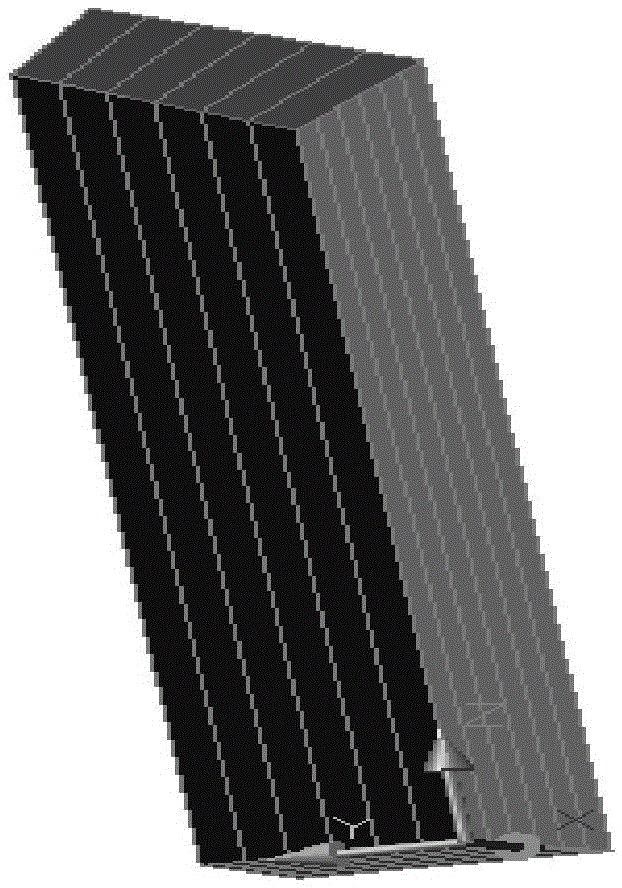
[0052] Step 3: Construct a hexahedron according to the double ruled surface.
specific Embodiment approach 2
[0053] Embodiment 2: The difference between this embodiment and Embodiment 1 is that the spatial grid unit size is established in the step 1; (that is, the size of the double ruled surface), such as 10*10 meters, 5*5 meters, etc., The establishment of this size is related to the accuracy of spatial expression defined by the user. The higher the accuracy, the smaller the grid size is required. The specific process is:
[0054] It is established by calculating the error in the precision of the double ruled surface, and the process of calculating the error in the precision of the double ruled surface is as follows:
[0055] Step 11, determine n inspection points in the double ruled surface, the inspection points are required to be evenly distributed, and can reflect the terrain characteristics, n is the number of actual measurement points, which is a positive integer;
[0056] Step one and two, calculate the inspection point value in the double ruled surface;
[0057] Step 13: C...
specific Embodiment approach 3
[0061] Embodiment 3: The difference between this embodiment and Embodiment 1 or 2 is that in the step 2, a double-ruled surface is constructed, and the four vertex coordinates of each double-ruled surface are calculated according to the size of the spatial grid unit, and then Calculate the ruled line of each double-ruled surface according to the four vertex coordinates of each double-ruled surface; the specific process is:
[0062] Specifically according to the following formula:
[0063] P → ( u , v ) = a → + u · b → + v · c → + u · v · d →
[0064]
[0065]
[0066]
[0067]
[0068] In the form...
PUM
 Login to View More
 Abstract
Description
Claims
Application Information
 Login to View More