
Liver ultrasonic image identification method based on sparse expression
An ultrasound image and sparse representation technology, which is applied in the field of liver ultrasound image recognition based on sparse representation, and can solve the problems of complex and changeable space-occupying lesions.
- Summary
- Abstract
- Description
- Claims
- Application Information
AI Technical Summary
Problems solved by technology
Method used
Image

Examples
Embodiment
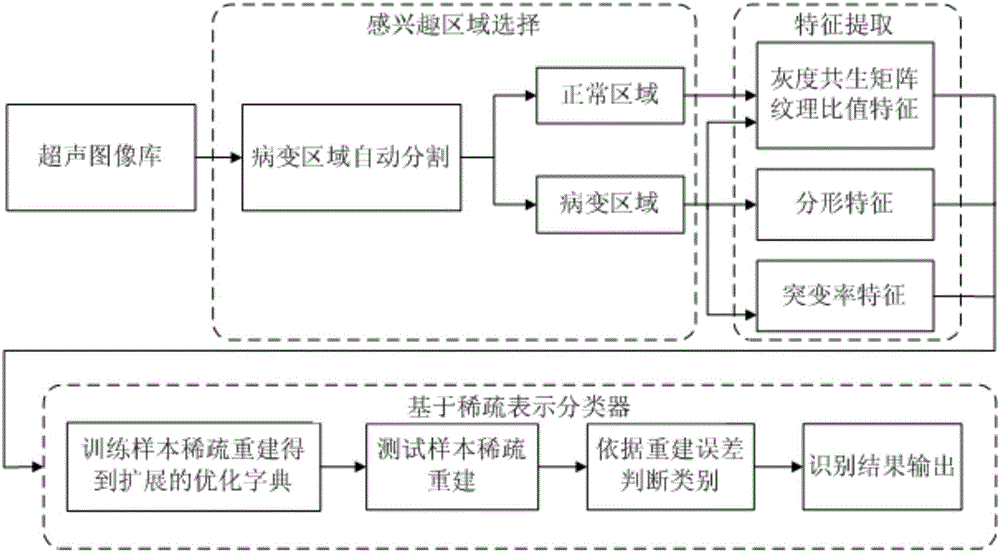
[0068] As shown in Figure 1, a liver ultrasound image recognition method based on sparse representation includes the following steps:
[0069] (1) Select the region of interest from the liver ultrasound image training sample with the space-occupying lesion region, the region of interest includes the space-occupying lesion region R 1 and normal liver area R 2 The liver ultrasound image training samples include liver cyst image samples, hepatic hemangioma image samples, and liver cancer image samples, specifically including the following steps:
[0070] (1-1) Select the space-occupying lesion area R 1 : First, use the region-growing ultrasonic image automatic segmentation algorithm based on energy constraints to outline the edge of the lesion area, then take its circumscribed rectangle, and use the circumscribed rectangle area as the occupying lesion area R 1 ;
[0071] ROI (region of interest) refers to a region selected from the image, which is the focus of image analysis. ...
PUM
 Login to View More
 Abstract
Description
Claims
Application Information
 Login to View More