Supercharge Your Innovation With Domain-Expert AI Agents!

Process for producing porous articles from alternating poly(ethylene tetrafluoroethylene) and articles produced by the process

A technology of ethylene tetrafluoroethylene and products, which is applied in the field of high-molecular-weight polymers to form porous products, and can solve problems such as difficult processing and difficult manufacture of ETFE polymers

Active Publication Date: 2020-03-13
WL GORE & ASSOC INC
View PDF7 Cites 0 Cited by
  • Summary
  • Abstract
  • Description
  • Claims
  • Application Information

AI Technical Summary

Problems solved by technology

However, ETFE polymers are difficult to manufacture and even more difficult to process

Method used

the structure of the environmentally friendly knitted fabric provided by the present invention; figure 2 Flow chart of the yarn wrapping machine for environmentally friendly knitted fabrics and storage devices; image 3 Is the parameter map of the yarn covering machine
View more

Image

Smart Image Click on the blue labels to locate them in the text.
Viewing Examples
Smart Image
  • Process for producing porous articles from alternating poly(ethylene tetrafluoroethylene) and articles produced by the process
  • Process for producing porous articles from alternating poly(ethylene tetrafluoroethylene) and articles produced by the process
  • Process for producing porous articles from alternating poly(ethylene tetrafluoroethylene) and articles produced by the process

Examples

Experimental program
Comparison scheme
Effect test

Embodiment 1

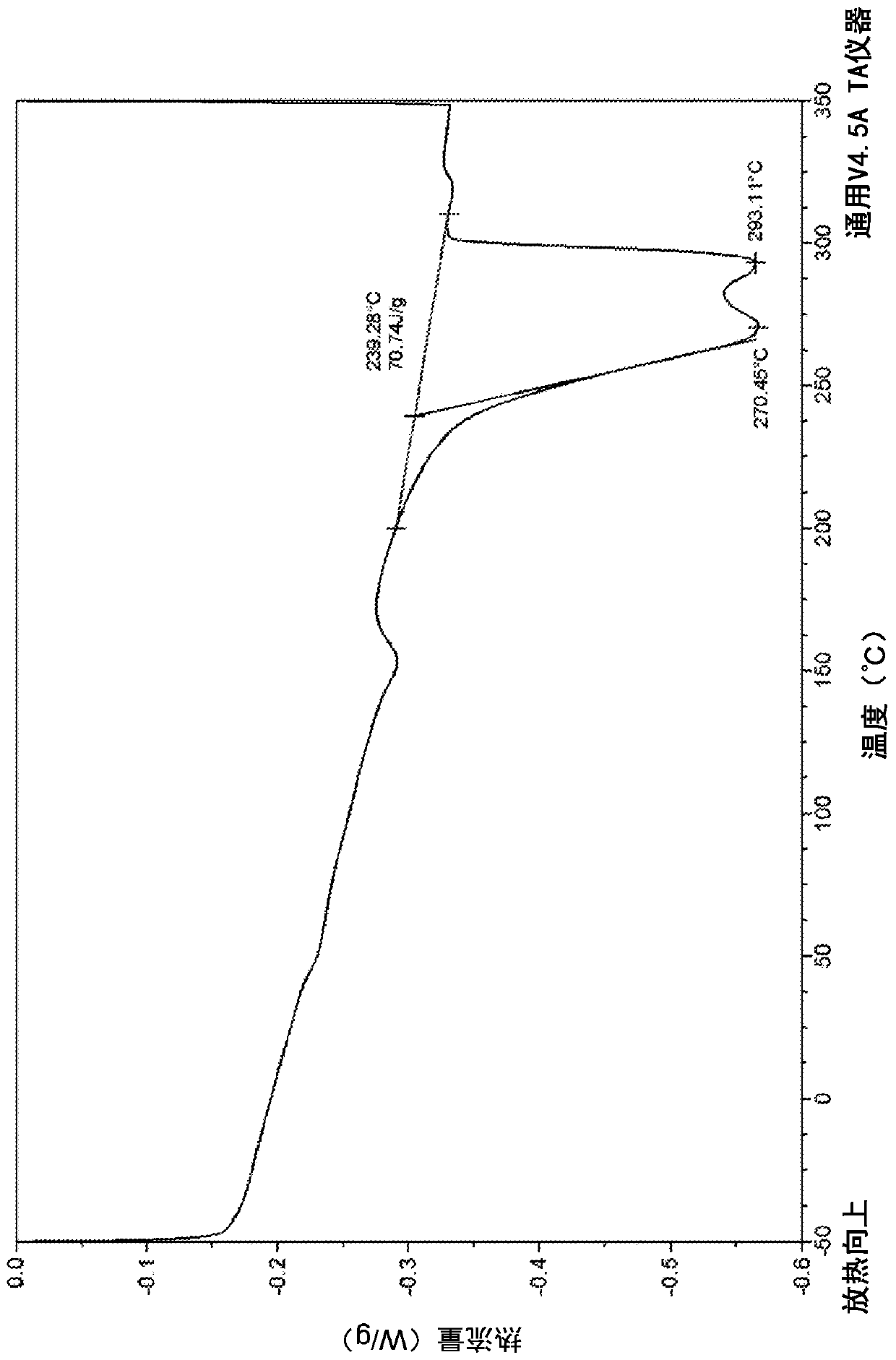
[0065] The molecular weight (Mw) measurement of the poly(ethylene tetrafluoroethylene) (ETFE) of embodiment 1

[0066] The molecular weight (Mw) of the poly(ethylene tetrafluoroethylene) (ETFE) of Example 1 was calculated using the following formula (1):

[0067]

[0068] n 0 = Melt zero-shear viscosity (Pa.s)

[0069] Ke (Wasserman,S.H.;Graessley,W.1996),

[0070] K λ = constant prefactor with Mw relationship to longest relaxation time = 1.08e -21(Tuminello,W.H.1993)

[0071] In formula (1), melt zero-shear viscosity η 0 and the prefactor can be determined from the following experimental rheological data. Complex viscosity (η * ), storage modulus (G') and loss modulus (G") versus angular frequency (ω) plots of experimental data. Figure 6 A plot of this data is shown for poly(ethylene tetrafluoroethylene) (ETFE) of Example 1.

[0072] Using the Cox-Merz rule (Cox, W.P.; Merz, E.H. 1958), the Figure 6 The plot of the experimental data is mathematically convert...

Embodiment

[0084] Example 1

[0085] Add 0.225 kg of non-telomerized perfluorinated dispersant, 1.5 kg of 3M TM Novec TM HFE-7100 fluid and 5 kg of deionized (DI) water. The mixture was emulsified until the raw dispersion particle size of the mixture was 545 nm.

[0086] Into a 50 liter horizontal polymerization reactor equipped with a 3-blade stirrer was added the above microemulsion solution, 23 kg of DI water, 5 g of oxalic acid and 15 g of ammonium oxalate. The reactor was repeatedly evacuated and pressurized with TFE (to about 1 Atm or less) until the oxygen level was reduced to 20 ppm or less. Briefly agitate the contents at about 60 rpm between vacuum and purge cycles to ensure that the water is deoxygenated.

[0087] The reactor was cooled to 10°C and stirred at 60 rpm. Subsequently, 1.4 MPa of TFE was added, followed by 0.9 MPa of ethylene. At this point, inject KMnO at a rate of 40g / min 4 Solution (0.3 g / L) in deionized (DI) water until a pressure drop of 5 kPa occurs....

Embodiment 2

[0093] 100 g of poly(ethylene tetrafluoroethylene) (ETFE) polymer of Example 1 was mixed with 58 g of perfluorocarbon liquid (FlutecPP11, F2 Chemicals Ltd., U.K., UK). The above mixture was then placed in a cylinder with a diameter of 2.54 cm. The cylinder was sealed and heated in an oven to 125°C for 2.5 hours, then pelletized at a pressure of 750 psi. The pellets were then returned to the oven at 125°C for an additional 2 hours. The lubricated pellets were then extruded through a die with an entrance angle of 30 degrees and a diameter of 8 mm at a punch rate of 0.254 cm / sec.

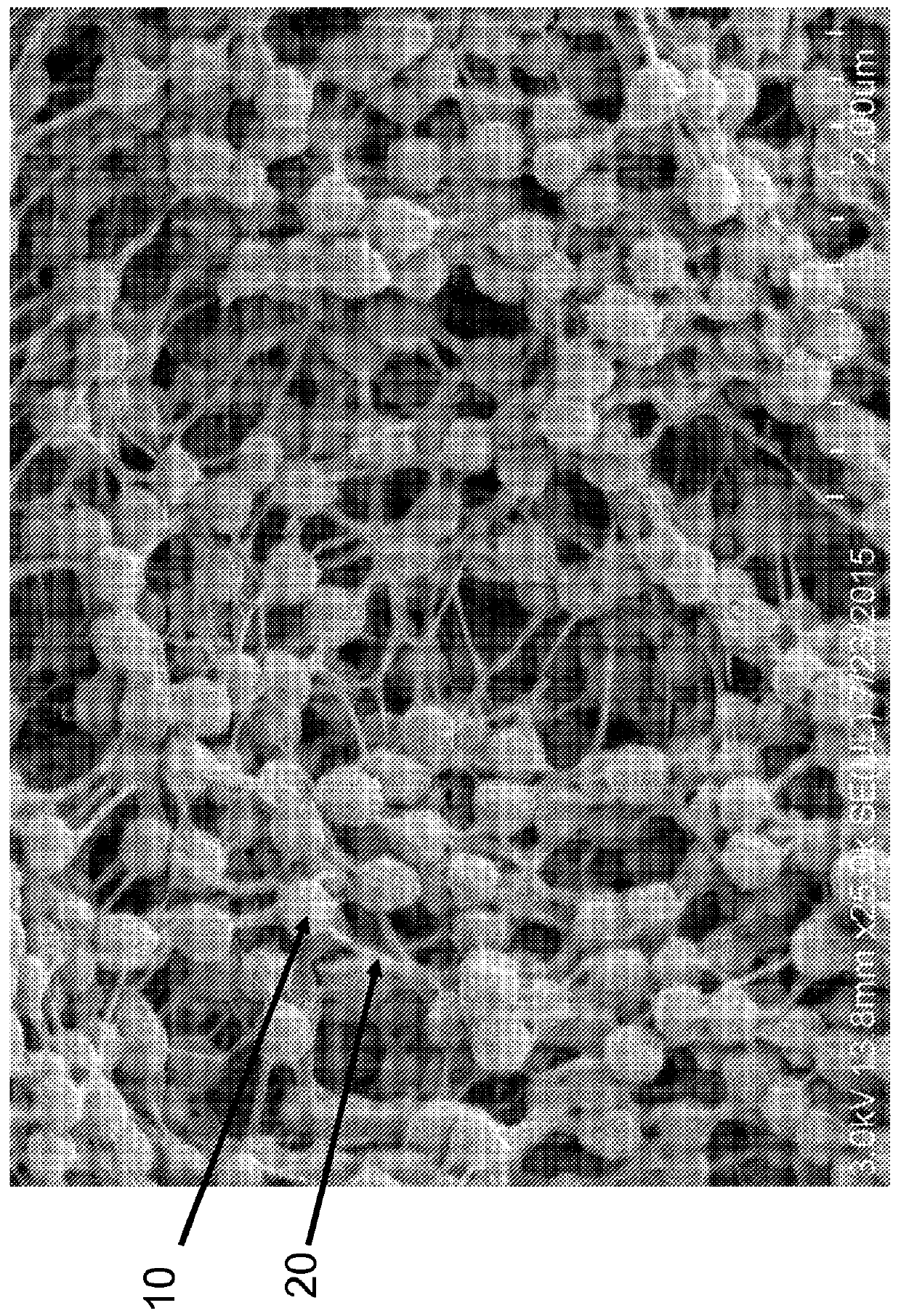
[0094] The extrudates were dried at 150°C for 1 hour in a convection oven. The resulting bead product had a density of 1.26 g / cc. The porosity of the bead preparation was determined to be 30%. figure 2 A scanning electron micrograph (SEM) of the surface of the interior of the porous bead article is shown at 20000X magnification. SEM shows that the bead preparation has nodes 10 and fibrils 20 .

the structure of the environmentally friendly knitted fabric provided by the present invention; figure 2 Flow chart of the yarn wrapping machine for environmentally friendly knitted fabrics and storage devices; image 3 Is the parameter map of the yarn covering machine
Login to View More

PUM

PropertyMeasurementUnit
melting pointaaaaaaaaaa
enthalpy of fusionaaaaaaaaaa
thicknessaaaaaaaaaa
Login to View More

Abstract

The present invention provides poly(ethylene tetrafluoroethylene) (ETFE) polymers having an average molecular weight of at least 300,000 grams / mole and an enthalpy of fusion of at least 57 joules / gram. The ETFE polymer may contain at least one other comonomer. ETFE polymers are used to form porous tapes or membranes with a node and fibril structure. The porous ETFE tape can be formed by lubricating the ETFE polymer and applying pressure to the lubricated polymer at a temperature below the melting point of the ETFE polymer. Optionally, the tape can be expanded at a temperature below the melting temperature of the ETFE polymer to form an expanded ETFE membrane. Alternatively, the ETFE polymer can be subjected to heat and pressure without adding a lubricant to form a dense preform. The dense preform can then be cut lengthwise and stretched to form dense ETFE fibers.

Description

technical field [0001] The present invention relates generally to poly(ethylene tetrafluoroethylene) and, more particularly, to methods for forming porous articles from highly crystalline, high molecular weight poly(ethylene tetrafluoroethylene) polymers. Background technique [0002] Polymers based on ethylene-tetrafluoroethylene (ETFE) are known in the art and are used as linings or coatings. However, ETFE polymers are difficult to manufacture and even more difficult to process. Therefore, there is a need in the art for a method of making ETFE articles that process below melting point, have high strength, and are highly porous that can be processed into a dense form. [0003] Summary of the invention [0004] One embodiment relates to a process for preparing porous poly(ethylene tetrafluoroethylene) (ETFE) tapes comprising: (1) subjecting a poly(ethylene tetrafluoroethylene) polymer having an average molecular weight of at least 300,000 grams / mole to lubricating to form...

Claims

the structure of the environmentally friendly knitted fabric provided by the present invention; figure 2 Flow chart of the yarn wrapping machine for environmentally friendly knitted fabrics and storage devices; image 3 Is the parameter map of the yarn covering machine
Login to View More

Application Information

Patent Timeline
no application Login to View More
Patent Type & Authority Patents(China)
IPC IPC(8): B29C48/04B29C48/92B29C51/26B29C43/00B29C43/24B29C55/00B29C55/02B29K27/12B29K105/04B29L7/00
CPCB29C48/92B29C48/04B29C43/003B29C51/266B29C55/005B29C48/022B29C2948/926B29C2948/92514B29C2948/92685B29C43/24B29C55/02B29K2027/12B29K2995/0041B29K2995/0088B29L2007/007B29K2105/04B32B2327/12B01D71/32B29C2948/92704Y02E60/10B29D99/0078C08F214/26C08F214/265B29K2023/06
Inventor G·A·斯布里格里亚
Owner WL GORE & ASSOC INC
Features
  • R&D
  • Intellectual Property
  • Life Sciences
  • Materials
  • Tech Scout
Why Patsnap Eureka
  • Unparalleled Data Quality
  • Higher Quality Content
  • 60% Fewer Hallucinations
Social media
Patsnap Eureka Blog
Learn More